


2026 Elderly Mobility Guide: Vitality & Independence
- healthyseventy3
- 37 minutes ago
- 12 min read
Mobility isn't just about moving from point A to point B; it's about building a curated ecosystem that protects your posture, your joints, and your social freedom. Many of us reach a point where a short walk to the mailbox or a stroll through the park feels more like a chore than a pleasure because of nagging joint pain or a sudden fear of falling. It's frustrating when the world starts to feel smaller just because your legs aren't as steady as they once were. You likely believe that staying active is the secret to a long life, yet you might feel hesitant to explore mobility devices for elderly adults because you don't want to feel "assisted."
We're here to change that perspective. This guide will show you how the right tools can actually restore your confidence and keep you deeply connected to the people and places you love. We'll explore the latest 2026 innovations, from the posture-correcting VOCIC Upright Walker to advanced foldable scooters. You'll learn how to choose equipment that empowers your independence rather than limiting it, ensuring you can walk further without pain and maintain the vibrant social life you deserve.
Table of Contents
Understanding the Shift: Why Mobility Aids are Your Key to Independence
Accepting a bit of extra support isn't a loss of your identity; it's a proactive investment in your future. We often view the transition to using assistance as a retreat, but in reality, it's a bold step toward maintaining the lifestyle you love. In your 70s, the connection between physical movement and mental clarity is undeniable. When you stay mobile, your brain stays engaged, your mood remains elevated, and your sense of purpose thrives. Modern 2026 designs have finally caught up to this reality, replacing the cold, clinical look of the past with sleek, empowering tools. These high-quality mobility devices for elderly adults are now designed to look like high-end lifestyle accessories rather than hospital equipment.
Thinking of your support as a "Mobility Ecosystem" helps you realize that one tool rarely fits every scenario. You might use a lightweight cane for navigating your kitchen but require more robust support for outdoor excursions. When exploring the vast landscape of options, a comprehensive guide to mobility aids can help you understand the fundamental categories, but the ultimate goal is always personal empowerment. By matching the right device to the right environment, you ensure that your world stays as large and vibrant as you want it to be.
The Silent Impact of Reduced Mobility
When movement becomes painful or uncertain, your world tends to shrink. You might start declining invitations or avoiding the stairs, leading to an unintended social withdrawal. This isolation isn't just a mental burden; it has physical consequences. Compensatory movements, like leaning heavily to one side or limping, put unnecessary strain on your "good" joints and create new patterns of chronic pain. Mobility aids act as a bridge to social vitality by removing the physical barriers that keep you isolated at home.
Reclaiming Your Social Calendar
The true power of modern mobility devices for elderly users lies in the word "yes." Can you join the family for a graduation at a large stadium? Yes. Can you navigate the uneven grass at a neighborhood picnic? With the right all-terrain wheels, yes. Knowing you can handle any environment safely replaces anxiety with a sense of adventure. This empowerment allows you to focus on the conversation and the company rather than the ground beneath your feet. For more in-depth advice on maintaining your autonomy, see our Mobility Aids for Seniors: A 2026 Comprehensive Resource for Independence.
A Comprehensive Guide to Modern Mobility Device Categories
Selecting the right support is about matching your current physical strength with your lifestyle goals. While some people thrive with the simple stability of a quad cane, others find that more robust mobility devices for elderly adults are necessary to maintain a full social calendar. In 2026, the industry standard has shifted toward the upright walker, such as the VOCIC Upright Walker. These devices are designed to help you stand tall and look forward, rather than hunching over a frame. This ergonomic focus doesn't just improve your gait; it protects your spine and boosts your confidence by keeping your eyes on the horizon.
Beyond handheld frames, we have to consider the foundation of every step. High-quality Orthofeet Orthopedic Walking Sneakers act as a "wearable" mobility aid, providing the arch support and cushioning needed to make handheld devices even more effective. By combining proper footwear with the right support frame, you create a stable base that makes movement feel natural rather than "assisted."
Rollators and Traditional Walkers
The choice between a standard walker and a rollator often comes down to your specific balance and endurance needs. A standard walker has no wheels and requires you to lift the device between steps, providing maximum weight-bearing support for those with significant instability. Conversely, a rollator features four wheels and hand brakes, allowing for a fluid, continuous walking motion. A rollator is an excellent choice if you have the balance to walk but lack the stamina for long distances, as the built-in seat provides a convenient spot for rest breaks during a trip to the grocery store or a museum. While standard walkers excel at providing rigid support, rollators are built for movement and endurance.
Powered Mobility Scooters for Active Travel
When your adventures take you across large campuses or through busy airports, a Foldable Mobility Scooter for Seniors can be a liberating addition to your life. Research on the benefits of mobility devices suggests that powered aids significantly enhance quality of life by removing the physical barriers to community participation. These powered mobility devices for elderly users allow you to conserve your energy for the destination rather than the journey.
Choosing a model typically involves a trade-off between maneuverability and stability. A 3-wheel scooter offers a tighter turning radius, making it ideal for navigating tight indoor hallways or store aisles. A 4-wheel model provides superior stability for outdoor paths and uneven sidewalks. Modern foldable designs can be packed into a car trunk or stowed on an airplane with ease, ensuring that travel remains a seamless part of your lifestyle. Always check the battery range to ensure it matches your planned daily activity, so you can focus on making memories rather than finding a power outlet.
Assessing Your Environment: Choosing Aids for Home, Community, and Travel
Choosing the right support isn't just about the device itself; it's about where that device will take you. Your home, your neighborhood, and your favorite travel destinations all have unique demands. When evaluating mobility devices for elderly users, start with a walk-through of your daily environment. Does your hallway have a narrow turn? Is there a thick rug in the living room? These details determine whether you need a compact frame or something with larger, more stable wheels. The goal is to find a tool that fits into your life seamlessly, enhancing your movement without requiring you to remodel your entire world.
Navigating the Home Safely
Before making a purchase, take a measuring tape to your doorways. Many older homes have narrow bathroom doors that might not easily accommodate a full-sized rollator. You'll also want to consider the "turning radius," which is the amount of space a device needs to pivot 360 degrees. In small apartments, a tight turning radius is the difference between fluid movement and feeling stuck. While you're optimizing your home for physical movement, don't forget the digital safety net of Medical Alert Systems for Seniors: The Complete 2026 Guide to Safety and Independence. This provides a vital layer of security when navigating thresholds or carpets alone.
Community and Outdoor Terrain
Stepping outside requires a shift in priorities. On city streets or park paths, wheel size becomes your best friend. Larger wheels, typically 8 inches or more, provide much-needed shock absorption on uneven gravel or cracked sidewalks. This protects your wrists and shoulders from the jarring impact of every bump. Security is also paramount when dealing with inclines or ramps. Ensure your device has a reliable braking system that's easy to engage, even if you have limited hand strength. A sturdy "parking brake" is essential for social stops, allowing you to lock the wheels and use the seat safely while chatting with a neighbor or waiting for a bus.
Finally, consider the "Travel Test." If you enjoy road trips or flying to see family, your aid must be light enough for a car trunk and simple to fold for an airplane cabin. In social settings like restaurants, a low-profile design ensures you can pull up to the table without blocking the aisle. High-quality mobility devices for elderly adults should support your presence in the world rather than becoming a barrier to it. By matching your device to your specific environment, you ensure that every outing is defined by your curiosity rather than your limitations.
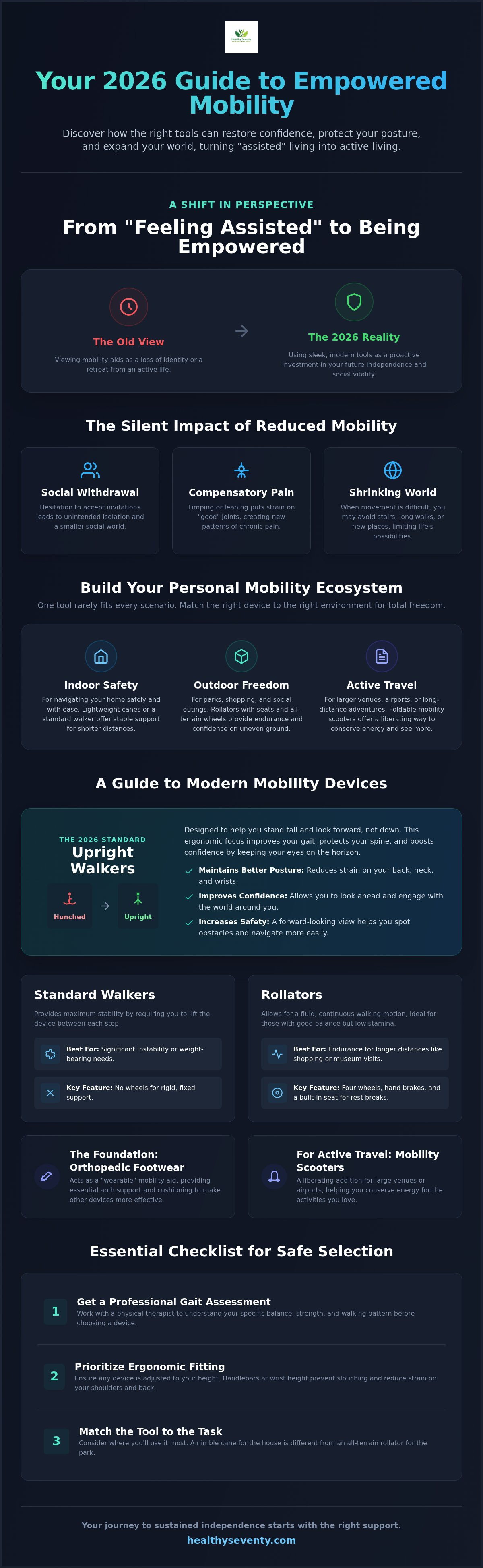
The Essential Checklist: How to Safely Select Your First Device
Selecting the right support is a process that requires both professional insight and personal testing. It's not just about picking a model off a shelf; it's about ensuring the tool matches your unique physiology. Start by consulting with a physical therapist for a professional gait assessment. They can identify specific imbalances in your stride that might make one type of support better than another. Once you have a recommendation, you can confidently evaluate mobility devices for elderly users based on your specific needs.
Check Weight Capacity: Ensure the device is rated for your weight to maintain structural integrity and safety.
Test the Lift Weight: If you plan on traveling, you must be able to personally lift the device into a car trunk or onto a bus without strain.
Evaluate Grip Material: For those with arthritis, soft foam or contoured rubber grips can prevent hand fatigue and joint pain.
Review Folding Mechanisms: Look for a design that allows for easy, one-handed folding to ensure it doesn't become a source of frustration during daily outings.
Ergonomics and the Perfect Fit
A poorly fitted device can cause more harm than good by creating new aches in your back and shoulders. To measure the correct handle height, stand as straight as possible with your arms hanging naturally at your sides. The handles should be level with your wrist crease, allowing for a slight bend in the elbow during use. We've found that upright designs are often superior for long-term health because they encourage you to stand tall rather than hunching. By using forearm supports to distribute your weight, these devices reduce the strain on your shoulders and neck that often comes with traditional walkers. If you're ready to prioritize your posture and comfort, consider the VOCIC Upright Walker for Seniors as a foundation for your movement.
Safety Features You Can’t Ignore
Safety is the cornerstone of independence. Every quality rollator must feature a reliable locking mechanism that secures the wheels when you're using the seat for a rest break. Without this, the device could roll away as you attempt to sit or stand. Visibility is another often-overlooked factor. Look for models with reflective elements to ensure you stay visible to drivers and neighbors during evening strolls. The center of gravity in a rollator determines how effectively the device stays grounded when you apply weight or navigate uneven surfaces. A well-balanced frame ensures the device stays firmly on the ground even when you're navigating slight inclines or applying pressure to the handles, giving you the peace of mind to explore your community without hesitation.
Building Your Mobility Ecosystem: Curated Recommendations for Active Living
At Healthy Seventy, we believe that true independence comes from a "lifestyle bundle" rather than a single piece of equipment. We've acted as your dedicated researchers, scouring the 2026 market to identify tools that don't just assist you, but empower you. A cohesive ecosystem means your footwear, your walking aid, and your recovery routine all work in harmony to protect your joints and your spirit. We prioritize specific models like the VOCIC Upright Walker and Orthofeet sneakers because they represent a shift away from the "medical" look toward high-performance, age-positive design. By integrating these solutions, you aren't just managing a condition; you're investing in a vibrant, active legacy.
Why the VOCIC Upright Walker is a Game-Changer
Most traditional mobility devices for elderly users share a common flaw: they force you to hunch over, looking at the ground rather than the world around you. The VOCIC Upright Walker solves this by moving the support to your forearms, allowing you to stand at your full height. This stand-up design offers surprising benefits for your internal health, as an upright posture opens the chest for improved respiratory function and creates the space needed for healthy digestion. You can learn more about these ergonomic benefits in our The Comprehensive Guide to Upright Walkers: Regain Your Posture and Independence in 2026. Beyond the physical health perks, this design significantly reduces the "fear of the curb" by keeping your eyes forward and your center of gravity stable as you navigate the community.
Footwear as a Mobility Aid
Your walking aid is only as effective as the foundation it rests on. We view Orthofeet Orthopedic Walking Sneakers as an essential part of your mobility kit because they provide the arch support and heel stability required for true balance. When you pair these sneakers with a high-quality walker, you create a synergy that makes every step feel more secure and less taxing on your knees. Our guide on the Best Walking Sneakers for Balance: A 2026 Guide to Stability and Fall Prevention details how specialized footwear reduces the risk of trips and falls by correcting overpronation and providing superior grip.
To truly maximize your joint longevity, consider combining this movement with restorative heat therapy. Using tools like a Home Infrared Sauna for Relaxation or a Shockwave Therapy Device for Pain Relief helps keep your connective tissues fluid and responsive. This holistic approach ensures that your mobility devices for elderly needs are met with a proactive plan that values your comfort as much as your movement. By choosing curated, high-quality tools, you're telling the world that you're ready to stay connected to the people and places you love for years to come.
Stepping Into a More Vibrant Future
Embracing the right support is about more than just hardware; it's about reclaiming the moments that matter most. We've explored how a curated mobility ecosystem, from posture-correcting upright walkers to stable orthopedic footwear, can transform your daily experience and restore your confidence. By focusing on ergonomic fit and your specific living environment, you ensure that your world remains as large and connected as ever. Our team of dedicated health researchers has done the vetting for you, focusing specifically on 2026 posture-correcting technology that prioritizes your long-term vitality over mere assistance.
Finding the right mobility devices for elderly adults is a significant step toward a proactive and empowered lifestyle. We provide national US support and guidance to help you navigate these choices with ease and clarity. You deserve to move through the world with grace and strength, knowing you have the tools to stay connected to the people and places you cherish. Explore our curated selection of mobility aids for a more active 2026 and take the first step toward a more independent tomorrow. Your journey toward better movement starts with a single, supported step.
Frequently Asked Questions
Will using a mobility device make my muscles weaker over time?
Using a mobility aid often has the opposite effect by allowing you to walk further and more frequently than you could unassisted. By reducing joint pain and the fear of falling, these tools encourage the consistent activity needed to maintain muscle tone and cardiovascular health. Without support, many seniors become sedentary, which leads to rapid atrophy. Think of these devices as endurance enhancers that help you reach your daily step goals.
What is the difference between an upright walker and a traditional rollator?
An upright walker features padded forearm rests that allow you to stand completely straight, whereas a traditional rollator requires you to lean forward on your wrists. The upright design shifts your weight from your hands to your arms, which significantly improves posture and reduces neck strain. This 2026 design standard is ideal for those who want to look forward at their surroundings rather than down at the ground.
How do I know if my insurance or Medicare will cover a mobility aid?
Medicare Part B covers mobility devices for elderly users when they're deemed medically necessary for use inside the home. You'll need a written prescription from a doctor after a face-to-face examination. For 2026, the Medicare Part B deductible is $283. After you meet this, Medicare typically pays 80% of the approved amount, leaving you responsible for the remaining 20% coinsurance for your durable medical equipment.
Can I use a mobility scooter inside my own home?
You can use a mobility scooter indoors if your home's layout accommodates the device's turning radius. For indoor use, 3-wheel models are generally preferred because they offer superior maneuverability in tight hallways and kitchens. However, you must measure your door widths first to ensure a clear path. Medicare specifically requires that a scooter be necessary for performing daily activities inside your home to qualify for coverage.
What are the best mobility aids for seniors who love to travel?
Lightweight, foldable designs are the gold standard for active travelers who enjoy exploring new destinations. A Foldable Mobility Scooter for Seniors or a carbon-fiber rollator can easily fit into car trunks or airplane overhead compartments. These devices allow you to navigate large airports or uneven city streets without exhaustion. Always look for "one-touch" folding mechanisms that make transitions between taxis and terminals seamless and stress-free.
How often should I have my mobility device inspected for safety?
You should perform a basic personal check every month and seek a professional inspection once a year. Check for loose screws, worn-out tire treads, and responsive brakes. If you use your device daily on outdoor terrain like gravel or cracked sidewalks, the brakes and wheels may wear down faster. Regular maintenance ensures your center of gravity remains stable and prevents unexpected mechanical failures during your social outings.
Are there lightweight walkers that can fit into a small car trunk?
Modern engineering has produced several ultra-lightweight walkers made from aluminum or carbon fiber that fold into a very compact size. Some models fold side-to-side, allowing them to stand upright even when closed, which is perfect for narrow storage spaces. These mobility devices for elderly travelers often weigh less than 15 pounds, making them easy for most seniors or caregivers to lift into a small vehicle trunk.
Can I use an upright walker if I have severe arthritis in my hands?
Upright walkers are an excellent choice for those with hand arthritis because they don't require a tight, painful grip. Instead of putting all your weight on your palms and wrists, you rest your forearms on padded platforms. This redistributes the pressure to larger muscle groups and more stable joints. Many models also feature loop-lock brakes that require minimal finger strength to engage, making them very accessible for daily use.

Comments