


Best Upright Walkers for Seniors: Regaining Posture and Independence in 2026

Have you ever noticed how a standard walker, intended to provide freedom, often leaves you feeling more restricted, hunched over, and weary? It's a common frustration for many who find that leaning forward to move causes nagging back pain and puts unnecessary strain on the wrists. You want to stay active and social, but the physical toll of a traditional rollator can make a simple walk feel like a chore. In this guide, we'll explore the best upright walkers for seniors in 2026, designed to help you stand tall, breathe easier, and rediscover the joy of moving without discomfort.
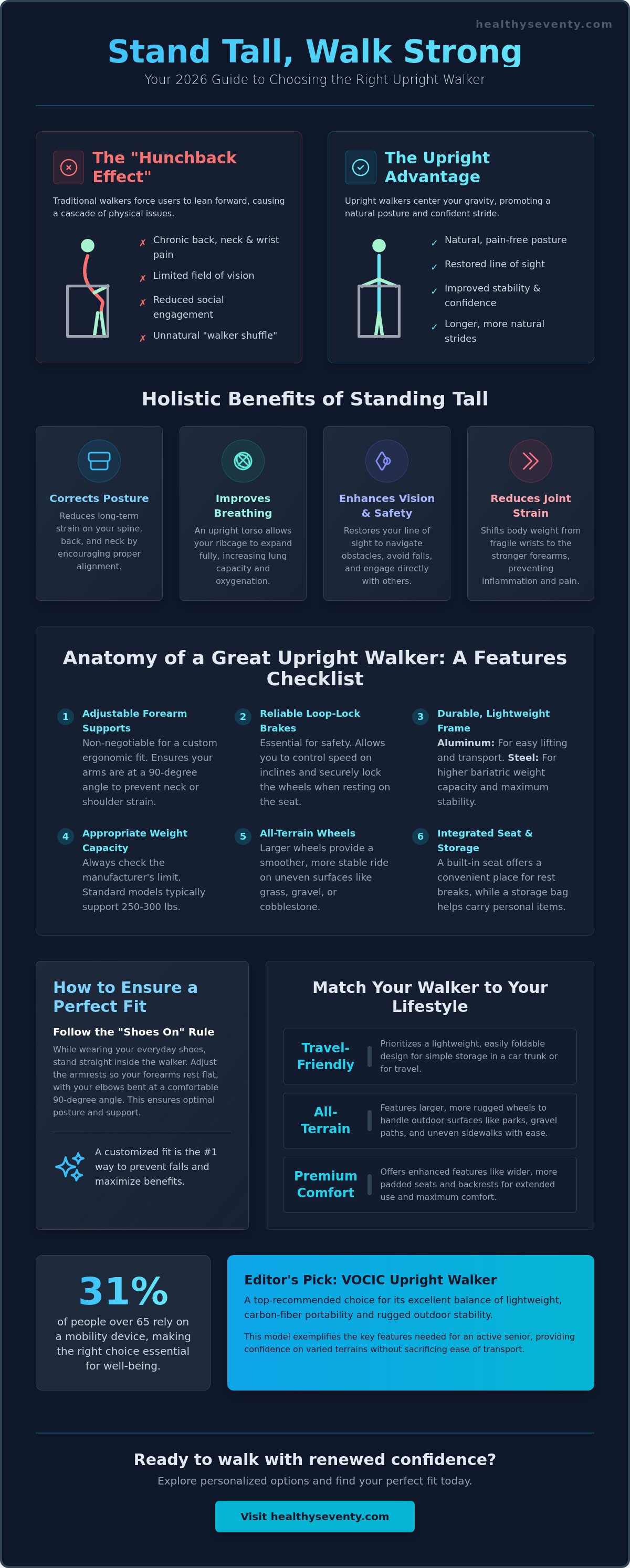
We understand that maintaining your independence is about more than just getting from one place to another; it's about your dignity and vitality. With 31 percent of people over 65 now relying on mobility devices, choosing the right tool is essential for your long-term well-being. You'll learn how to select a model that corrects your posture and supports your respiratory health by opening up your chest. We'll also cover essential 2026 updates, including how the Medicare Part B deductible, now at $257, impacts your access to these devices. From lightweight carbon fiber frames to smart safety features, we've researched the most reliable options to ensure you can walk with renewed confidence.
Key Takeaways
Understand how forearm supports can replace the "hunchback effect" with a natural, upright posture that reduces long-term strain on your spine.
Identify the critical safety features, such as loop-lock brakes, that define the best upright walkers for seniors in today's market.
Navigate the differences between all-terrain, travel-friendly, and premium comfort models to find a walker that fits your specific daily environment.
Follow our step-by-step sizing guide, including the "Shoes On" rule, to achieve a customized ergonomic fit that helps prevent falls.
See why the VOCIC Upright Walker is a recommended choice for those seeking a balance of lightweight portability and rugged outdoor stability.
Table of Contents
The Shift from Hunched to Upright: Why Posture Matters in 2026
An upright walker, often called a stand-up rollator, represents a significant leap in mobility technology. Unlike the frames of the past, these devices feature elevated, padded forearm supports that allow you to stand tall while moving. This design change is the primary reason people seek the best upright walkers for seniors. It moves the user into the center of the device rather than forcing them to push it from behind. By providing a stable platform for your arms, it transforms a simple Walker (mobility) into a tool for active posture correction.
For decades, traditional walkers have inadvertently contributed to the "Hunchback Effect." This occurs when a user must lean forward to reach low-set handles, causing the spine to curve and the head to tilt downward. This position doesn't just cause chronic back and neck pain; it also limits your field of vision. When you're forced to look at the ground, you lose the ability to engage with the world around you. Standing straight restores your line of sight, making it easier to navigate obstacles and, perhaps more importantly, maintain direct eye contact during a stroll with a friend. This boost in social confidence is a vital part of maintaining a vibrant, active lifestyle.
The physiological benefits of standing tall go even deeper. When your torso is upright and your shoulders are back, your ribcage has the space it needs to expand fully. This improvement in posture can lead to increased lung capacity and better oxygenation. It's a holistic approach to wellness where better movement leads to better breathing and increased energy levels throughout the day.
Biomechanics of the Stand-Up Walker
The magic of this design lies in how it manages your weight. By shifting the load from your delicate wrists and hands to your stronger forearms, the walker significantly reduces spinal compression. Your center of gravity stays stabilized within the safety of the walker's footprint rather than leaning out over it. This alignment eliminates the hesitant "walker shuffle" many seniors experience. When your body is properly aligned, you can take longer, natural strides because your legs have the clearance they need to swing through each step freely.
Upright Walker vs. Traditional Rollator
In a traditional rollator, all your weight-bearing pressure is concentrated on the wrists and shoulders. Over time, this can lead to joint inflammation and fatigue. The platform model of an upright walker distributes that pressure across the entire forearm, which is much more sustainable for long-distance walking. This shift is a cornerstone of posture correction for seniors. It encourages the back muscles to engage correctly and prevents the shoulders from rolling forward. When choosing the best upright walkers for seniors, you're investing in a design that works with your body's natural mechanics rather than against them.
Evaluating Essential Features of Top-Rated Upright Walkers
Finding the right mobility aid is a deeply personal journey. While we've discussed the physiological benefits of standing tall, the actual performance of the device depends on its technical specifications. The best upright walkers for seniors in 2026 prioritize deep customization because no two bodies are identical. Adjustable armrest heights are non-negotiable; this feature ensures that whether you're five feet tall or over six feet, you can maintain vital upright alignment without straining your neck or shoulders.
Frame material also plays a significant role in your daily usability. Aluminum frames are the preferred choice for active seniors because they're lightweight enough to lift into a vehicle trunk without assistance. However, if you require a higher weight capacity, steel frames offer the bariatric support needed for maximum stability. Standard models typically support between 250 and 300 pounds, so it's vital to check these limits before making a choice. Safety is further enhanced by reliable loop-lock braking systems. These brakes allow you to control your speed on downward inclines and lock the wheels completely when you need to use the integrated seat for a rest break.
True independence involves more than just walking; it's about carrying your life with you. Look for models that include detachable storage bags for personal items and dedicated cane holders. These small additions mean you don't have to leave your favorite walking stick behind when heading out for a day of errands. If you're looking for a model that balances these practical storage options with rugged durability, exploring the VOCIC Upright Walker can provide a wonderful starting point for your research.
Ergonomics and Forearm Comfort
The quality of the padding on your armrests determines how long you can walk comfortably. High-density foam or gel-infused pads are superior because they distribute pressure evenly across the forearm. To find your ideal setup, follow the 90-degree bend rule. Your elbows should sit at a right angle when resting on the pads. This position, combined with contoured handgrips, helps prevent the nerve irritation often associated with carpal tunnel syndrome, allowing for a much more pleasant walking experience.
Stability and Terrain Versatility
Wheel size is the biggest factor in where you can go. While 8-inch wheels are excellent for navigating tight indoor corners, 10-inch wheels are far better for outdoor adventures on gravel or uneven sidewalks. Modern designs also feature hidden brake cables. These cables are tucked inside the frame to prevent them from snagging on furniture or door handles. Finally, consider the front-wheel swivel radius. A tight turning radius allows you to move through narrow bathroom doors or crowded cafes without the frustration of getting stuck.
Comparison Guide: Finding the Best Upright Walker for Your Lifestyle
Selecting the right mobility aid starts with a simple question: where will your journey take you today? The best upright walkers for seniors aren't just about movement; they're about matching a tool to your specific environment. Whether you're navigating the cobblestone streets of a historic downtown or the soft grass of a backyard garden, your choice should reflect your daily reality. We generally categorize these devices into three main groups: all-terrain powerhouses, lightweight travel companions, and premium comfort models designed for long-duration use.
Your living environment is the biggest factor in this decision. Seniors in rural areas often face uneven gravel driveways or cracked sidewalks, requiring a wider wheelbase for lateral stability. Conversely, urban dwellers might prioritize a narrow frame that can glide through tight cafe doorways or fit into a crowded elevator. If you're someone who still enjoys driving to visit family or run errands, look for a "compact-fold" design. These models collapse horizontally, making them much easier to slide into a backseat or trunk than traditional designs that only fold halfway.
Don't overlook the importance of the seat and backrest quality. If you find yourself needing frequent breaks to manage your energy or breathing, a thin plastic bench won't suffice. Look for a seat with thick, breathable padding and a wide, flexible backrest. This setup provides the lumbar support you need to sit comfortably and safely, turning a simple rest break into a moment of genuine recovery.
Best for Outdoor Adventure: All-Terrain Models
If your heart is in the great outdoors, an all-terrain model is essential. These walkers feature large pneumatic or solid rubber tires that absorb the shock of bumpy paths, protecting your wrists from jarring vibrations. A wider wheelbase provides the extra stability needed to prevent tipping on soft grass or mulch. For those who want to balance this ruggedness with portability, exploring lightweight mobility aids for seniors can help you find a model that's tough enough for the trail but light enough for the car.
Best for Home and Travel: Lightweight Folding Designs
For many, the priority is ease of use within the home and during occasional trips. The most effective travel-friendly models feature a "one-hand fold" mechanism, allowing you to collapse the frame with a single pull of a strap. Aim for a walker that weighs under 20 lbs; this makes it significantly easier to lift over a doorstep or into a vehicle. A narrow frame is also vital here, ensuring you can navigate bathroom doorways and kitchen corners without scuffing your furniture or feeling trapped.
Practical Sizing and Safety: How to Ensure a Perfect Fit
A walker that doesn't fit your unique frame is more than just uncomfortable; it can be a safety hazard. When searching for the best upright walkers for seniors, you must move beyond generic height charts. The most critical step is the "Shoes On" rule. Always perform your measurements while wearing the footwear you use most often for walking. Whether it's a pair of supportive sneakers or sturdy house shoes, even a half inch difference in sole thickness can throw off your ergonomic alignment and lead to unnecessary back strain.
To find your perfect measurement, stand as straight as possible with your arms hanging naturally at your sides. Have a partner measure the distance from the floor to the middle of your forearm. This specific data point ensures the forearm supports sit exactly where your body needs them for maximum stability. Once you've adjusted the walker, take a few minutes to test the "turning circle" in your own living room. Can you navigate around your favorite armchair or through the hallway without lifting the frame? If the walker feels cumbersome in your primary living space, it may not be the right match for your home's layout.
Safety should always be your companion on every stroll. Before you ever lower yourself onto the integrated seat, perform a firm safety check. Ensure both loop-lock brakes are fully engaged and the walker is on a level surface. Sitting down while the wheels are unlocked is a common cause of preventable falls. If you're ready to find a device that prioritizes these safety details, you can view our top-rated mobility solutions to see how modern engineering keeps you secure.
Measuring for Armrest Height
The ideal armrest height is the distance from the floor to your flexed elbow when you're standing tall. You'll know the handles are adjusted correctly when your shoulders remain relaxed; if you find yourself shrugging upward, the armrests are likely too high. Don't forget to verify the width between the supports as well. There should be enough space for your torso to fit comfortably without your ribs brushing against the frame, allowing for the deep, unrestricted breathing we discussed earlier.
Navigating Thresholds and Obstacles
Many 2026 models now include a "curb climber" pedal located near the rear wheels. By gently stepping on this lever, you can tilt the front wheels upward to clear door thresholds or uneven sidewalk lips without straining your back. Proper maintenance is also key to safety. Regularly check for "wheel wobble" or loose bolts, as these can compromise your balance over time. For a deeper look at keeping your device in peak condition, explore our upright walker pillar for expert maintenance tips.
Why the VOCIC Upright Walker is a Top Choice for Active Seniors
After exploring the essential mechanics and sizing requirements, one model consistently emerges as the gold standard for those seeking the best upright walkers for seniors. The VOCIC Upright Walker isn't just a mobility aid; it's a carefully engineered partner for your active life. It strikes a rare balance by utilizing high-grade aluminum to create a lightweight frame that doesn't sacrifice all-terrain stability. Whether you're crossing a paved parking lot or a grassy park, the structure remains rigid and supportive, giving you the confidence to explore further than you might have thought possible.
Hand comfort is often an afterthought in traditional designs, but this model addresses it head-on. It features bionic ergonomic grips specifically contoured to fit the natural shape of your palm. This design significantly reduces the localized pressure that causes hand fatigue and wrist soreness during longer excursions. By keeping your upper body comfortable and properly aligned, the walker integrates perfectly with a comprehensive non invasive joint pain relief routine. It allows you to stay mobile without relying on temporary fixes, addressing the root cause of discomfort through better biomechanical support.
Premium Features of the VOCIC Model
What sets this model apart are the thoughtful details that empower independent living. It includes a height-adjustable backrest that provides genuine lumbar support when you need to take a seat; a feature often missing from more basic models. For those who enjoy running their own errands, the oversized storage tote is a game-changer. It's spacious enough for a full bag of groceries or personal essentials, ensuring you don't have to choose between your mobility and your to-do list. Best of all, the tool-free assembly process means you can set up your new walker independently and start your journey toward better posture immediately.
A Trusted Partner in Your Mobility Journey
At Healthy Seventy, we're committed to offering only curated, expert-tested aids that we would trust for our own families. We understand that purchasing a mobility device is an investment in your future vitality. That's why the VOCIC model is a mainstay in our recommendations; its robust warranty provides the peace of mind you deserve when choosing a long-term wellness tool. You're not just buying a walker; you're reclaiming your ability to walk with your head held high. If you're ready to experience this blend of comfort and freedom for yourself, explore the VOCIC Upright Walker on Healthy Seventy today and take the first step toward a more active, upright lifestyle.
Step Into a Future of Confidence and Comfort
Choosing a mobility aid is a significant decision that impacts your daily comfort and long-term vitality. We've explored how the right design can eliminate the "hunchback effect," restore your natural line of sight, and improve your respiratory health. By prioritizing features like adjustable armrests and all-terrain stability, you're not just buying a tool; you're investing in your ability to engage with the world on your own terms. Finding the best upright walkers for seniors requires a blend of ergonomic precision and practical safety, ensuring every stroll is a step toward better spinal health.
Our detailed 2026 comparative research highlights that the right fit makes all the difference in maintaining an active lifestyle. At Healthy Seventy, we specialize in expert-curated solutions specifically designed for seniors over 70 who refuse to let mobility challenges define their later years. We invite you to View the Top-Rated VOCIC Upright Walker and Regain Your Independence today. You deserve to walk with your head held high, supported by a partner that values your dignity as much as your safety. It's time to rediscover the joy of moving with ease and grace.
Frequently Asked Questions
Is an upright walker better than a standard rollator for back pain?
Yes, an upright walker is generally superior for managing back pain because it shifts your weight from your lower back to your forearms. By allowing you to stand in a natural, erect position, it eliminates the "hunchback effect" common with traditional rollators. This alignment reduces spinal compression and neck strain, making it much easier to walk longer distances without the nagging discomfort caused by leaning over handles.
Can I use an upright walker if I am over 6 feet tall?
Yes, many of the best upright walkers for seniors feature height-adjustable armrests designed to accommodate users well over 6 feet tall. It's essential to check the specific height range of the model you're considering to ensure the armrests can reach your mid-forearm level. Proper adjustment ensures you don't have to stoop, allowing your frame to remain fully supported and your posture perfectly aligned.
Are upright walkers covered by Medicare or insurance in 2026?
Yes, in 2026, Medicare Part B covers upright walkers as Durable Medical Equipment (DME) when a doctor prescribes them as medically necessary. Once you meet the 2026 Medicare Part B deductible of $257, Medicare typically pays 80 percent of the approved cost. You'll be responsible for the remaining 20 percent coinsurance, though supplemental insurance plans may help cover these out-of-pocket expenses.
How do I fold an upright walker for transport in a car?
Folding an upright walker for a car journey is a simple process that usually involves pulling a release strap located in the center of the seat. Most modern designs collapse side-to-side, creating a narrow profile that slides easily into a backseat or trunk. Some models also allow you to quickly lower the armrests, making the device even more compact for transport in smaller vehicles or during air travel.
What is the weight limit for most upright walkers for seniors?
Most standard upright walkers for seniors are designed to support a weight capacity between 250 and 300 pounds. This range provides a stable and secure experience for the majority of users while maintaining a lightweight frame for easy maneuverability. If you require additional support, bariatric models are available that can safely accommodate higher weight limits, ensuring every senior has access to a reliable mobility solution.
Is it difficult to learn how to use an upright walker's brakes?
No, learning to use the brakes on an upright walker is very intuitive and similar to using hand brakes on a bicycle. You simply squeeze the levers to slow down while walking or push them downward until they click into a locked position for safety when sitting. This loop-lock system is designed for ease of use, even for those with limited hand strength or arthritis in their fingers.
Can I use an upright walker on uneven surfaces like grass or gravel?
Yes, you can successfully navigate uneven surfaces if you choose a model equipped with large, 10-inch all-terrain wheels. These oversized wheels provide the necessary clearance and shock absorption to handle gravel paths, park grass, or cracked sidewalks comfortably. While standard 8-inch wheels are excellent for indoor use, the larger wheel size is a hallmark of the best upright walkers for seniors who enjoy outdoor adventures.
How do I know if my doorways are wide enough for an upright walker?
To ensure your walker fits through your home's doorways, you should measure the narrowest part of the door frame and compare it to the walker's total width. Most upright walkers are between 24 and 28 inches wide, which fits through standard interior doors. If you have particularly narrow bathroom doors, look for a "compact" or "narrow-frame" model specifically designed for tighter indoor living spaces.


Comments