


Lightweight Mobility Aids for Seniors: Reclaiming Your Active Independence in 2026

Imagine standing at the airport gate, heart full of excitement to see your grandchildren, without the familiar dread of wrestling a heavy, clunky walker through security. You've likely felt that sting of frustration when a bulky piece of equipment makes a simple community outing feel like a major logistical hurdle. It's perfectly natural to worry about losing your independence or feeling embarrassed by gear that looks more like a hospital fixture than a lifestyle tool. You deserve to move through the world with grace and confidence, not physical strain.
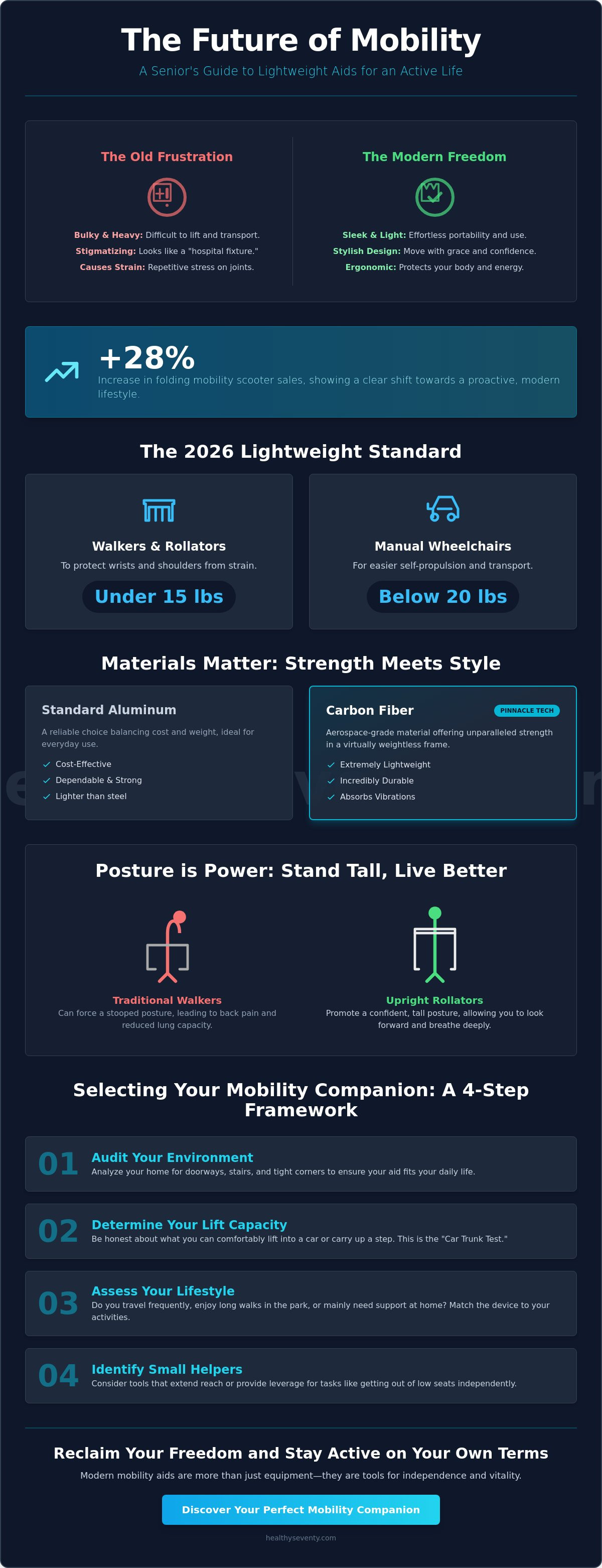
In this guide, you'll discover how the latest lightweight mobility aids for seniors are transforming daily life by prioritizing portability and ergonomic support. With the market for folding mobility scooters seeing a 28% increase in sales this past year, it's clear that more people are choosing equipment that fits a proactive, modern lifestyle. We'll explore how 2026 technology, including carbon fiber frames and smart upright designs, helps you maintain your posture and vitality. From understanding Medicare Part B updates to finding the ideal foldable companion for your next adventure, we're here to help you reclaim your freedom and stay active on your own terms.
Key Takeaways
Understand why staying under specific weight thresholds, such as 15 pounds for walkers, is essential for protecting your wrists and shoulders from unnecessary strain.
Discover how lightweight mobility aids for seniors like carbon fiber canes and upright rollators help you maintain a confident, tall posture while walking.
Explore the 2026 travel landscape where portable, folding scooters make visiting family or taking vacations simpler and more enjoyable.
Follow a professional four-step framework to audit your home environment and determine your honest lift capacity before choosing a new device.
Identify the small daily helpers that extend your reach and provide the leverage needed to exit low seats safely and independently.
Table of Contents
The New Era of Mobility: Why 'Lightweight' is Essential for Active Seniors
For decades, the medical industry prioritized bulk, assuming that weight equaled safety. We've entered a new era where "lightweight" is the gold standard for vitality. To be considered truly lightweight in 2026, a walker should typically weigh under 15 pounds, while manual wheelchairs often fall below the 20-pound mark. This shift isn't just about convenience; it's about protecting your body from unnecessary wear and tear. When your equipment is easy to handle, you're more likely to use it, which keeps you engaged with the world around you.
Every time you lift or pivot a heavy device, you're placing repetitive stress on your wrists, shoulders, and hips. Over time, this strain can worsen existing discomfort or lead to new injuries. By choosing lightweight mobility aids for seniors, you conserve your muscle energy for the things that actually matter. You want to spend your strength enjoying your destination, like a walk through a botanical garden or a family brunch, rather than exhausting yourself just getting from the car to the front door. This energy conservation is a cornerstone of maintaining a high quality of life as you age.
There's also a powerful psychological shift happening in modern design. New equipment looks like high-end sporting gear rather than "old-fashioned" hospital fixtures. This reduces the stigma often associated with using a Mobility Aid Overview, allowing you to feel confident and stylish during community outings. When you aren't embarrassed by your gear, you stop seeing it as a limitation and start seeing it as a tool for freedom.
Materials Matter: Aluminum vs. Carbon Fiber
Aluminum has long been the reliable choice for its balance of cost and weight, but aerospace-grade materials are now entering the senior market. Don't believe the myth that a lighter frame is "flimsier" or less safe. These materials are engineered to be incredibly durable while remaining flexible enough to absorb vibrations from uneven sidewalks, which protects your joints from impact. In 2026, carbon fiber serves as the pinnacle of mobility technology, offering unparalleled strength in a frame that feels almost weightless.
The 'Car Trunk Test': Independence in Transportation
How often have you hesitated to go out because you didn't want to struggle with a heavy walker in a parking lot? The "car trunk test" is the ultimate measure of independence for solo travelers. Modern devices often feature intuitive, one-handed folding mechanisms that allow you to load your own gear without waiting for assistance. This autonomy is a vital part of non invasive joint pain relief, as it encourages you to stay active and socially engaged. Being able to visit friends or run errands on your own schedule preserves your sense of self and keeps you in the driver's seat of your own life.
Top Lightweight Walking Aids for Posture and Balance
Have you ever noticed how traditional walkers often force you into a stooped position, making you look at the ground rather than the path ahead? This "hunch" isn't just a matter of appearance; it can lead to back pain and reduced lung capacity over time. Modern lightweight mobility aids for seniors are now designed to prioritize your posture just as much as your stability. By shifting the support higher and closer to your body, these tools allow you to stand tall, look forward, and breathe more deeply as you walk.
When understanding mobility aids, it's vital to look beyond just "getting around" and consider how a device affects your skeletal health. For those who need minimal assistance, carbon fiber canes have become the ultimate minimalist tool. They offer incredible strength with almost no weight, giving you the confidence to navigate uneven sidewalks without the bulk of a four-wheeled frame. If you find yourself needing more support during longer outings, a hybrid model that functions as both a rollator and a transport chair might be the best fit. These versatile tools allow you to walk as long as you're able and then sit comfortably while a companion pushes you the rest of the way.
Safety features have also seen a significant upgrade in 2026. Look for models with hidden brake cables that won't snag on furniture or car doors. Anti-tip wheels are another essential addition, providing a secondary layer of security when navigating curbs or transitions between different flooring types. Finding the right balance between support and weight is a personal journey, and exploring the curated selection of mobility tools available can make that choice much simpler.
The VOCIC Upright Walker: Posture Meets Portability
The upright walker has revolutionized how we think about mobility by realigning the spine and neck. By supporting your forearms at a natural height, the VOCIC model takes the pressure off your wrists and encourages an upright gait. This design doesn't just help you walk further; it helps you feel more like yourself. Despite its sturdy frame, it remains impressively portable with a folding mechanism that allows it to slide into most backseats or closets with ease.
Advanced Folding Canes with Ergonomic Grips
If you live with arthritis, a standard T-handle cane can quickly become uncomfortable. Offset handles are a superior choice because they distribute your weight directly over the shaft of the cane, reducing the torque on your wrist. Many modern folding canes now feature quad-tips, which provide enough stability for the cane to stand on its own while you pay for groceries or open a door. Always ensure your cane is adjusted to the correct height; the handle should meet the crease of your wrist when your arm is hanging naturally at your side. This simple adjustment prevents a "leaned" gait and keeps your center of gravity where it belongs.
The Travel Revolution: Portable Scooters and Folding Wheelchairs
Travel is one of life's greatest joys, but the logistical challenge of bringing heavy equipment along often dampens the spirit of adventure. You shouldn't have to choose between visiting a new city and your personal comfort. The 2026 landscape of lightweight mobility aids for seniors has been transformed by a focus on "active aging," where devices are designed to be companions in your journey rather than obstacles. This shift is most visible in the evolution of powered and wheeled transport, which now emphasizes portability without sacrificing the range you need to explore.
Modern lithium-ion technology has paved the way for a new generation of scooters that are as easy to transport as a piece of luggage. When you're preparing for a trip, understanding the nuances of your equipment is vital for a stress-free experience. According to the MedlinePlus guide on mobility aids, selecting a device that fits your specific travel environment is the first step toward reclaiming your freedom. You'll also need to decide between "Auto-Fold" mechanisms, which use a remote or button to collapse the unit, and "Manual-Fold" designs. While auto-folding models offer maximum convenience, manual versions are often slightly lighter because they don't require the extra weight of internal motors.
Choosing a Scooter for Cruise Ships and Airplanes
If you're planning a cruise, pay close attention to the turning radius of your device. Narrow hallways and standard cabin doors require a scooter that can pivot sharply without multiple maneuvers. For air travel, the "lithium-dry-cell" standard for 2026 ensures that high-capacity batteries meet strict safety criteria for pressurized aircraft cabins while providing enough power for a full day of sightseeing. You should also consider whether you prefer a model that folds into a single piece or one that disassembles into three or four lighter components. Disassembly can be easier if you have limited lifting strength, as each piece weighs significantly less than the whole unit. The right Foldable Mobility Scooter for Seniors should feel like a natural extension of your lifestyle, allowing you to focus on the memories you're making rather than the gear you're carrying.
Ultra-Lightweight Transport Chairs
There is a distinct difference between a standard wheelchair and a transport chair. While wheelchairs have large wheels for self-propelling, transport chairs feature smaller wheels and are designed for a companion to push. This design allows for a "featherweight" frame, with many 2026 models weighing under 20 pounds. Look for chairs that utilize breathable mesh fabrics; these provide superior ventilation for long-duration seating comfort during museum tours or sporting events. When choosing a chair, find the "sweet spot" where the product weight is low enough for your travel partner to lift easily, yet the weight capacity remains high enough to provide a stable, secure ride.
Daily Living Helpers: Small Devices for Big Independence
While larger equipment like walkers and scooters provide the foundation for movement, small daily living helpers act as the precision tools of your independence. These lightweight mobility aids for seniors address the micro-challenges that occur dozens of times a day, from reaching a high shelf to rising safely from a deep sofa. By integrating these compact tools into your routine, you reduce the cumulative fatigue that often leads to a "rest day" after a simple afternoon of chores. It's about working smarter, not harder, to preserve your energy for the activities you love.
In 2026, the trend has shifted toward "smart" wearable aids that offer fall detection without the bulk of traditional pendants. These discreet devices use advanced sensors to monitor movement patterns, providing a safety net that feels like a natural part of your wardrobe. This technological leap ensures that help is always accessible, even when you're moving between rooms or enjoying your garden. When these wearables are paired with physical aids like portable bed rails, you create a comprehensive safety environment that travels with you to hotels or family guest rooms. Explore our full range of wellness and mobility tools to find your perfect daily companion.
Ergonomic Reachers for the Modern Home
A reacher-grabber is no longer just a simple "claw" on a stick. Modern designs feature rotating heads that allow you to grab items at different angles without twisting your wrist. Magnetic tips are essential for picking up tiny metal objects like needles or paperclips, while lightweight aluminum shafts ensure you don't experience wrist fatigue during extended use. Storing these aids is just as important as using them; keeping one in the kitchen and another by your bedside ensures they're always within reach when you need them most.
Vehicle Entry and Exit Support
Getting in and out of a car can be one of the most physically demanding parts of a community outing. The "Car Cane" concept has become a staple for active seniors. This 1-lb tool slides into the door latch of almost any vehicle, providing up to 300 lbs of leverage for a stable, secure grip. This small but mighty tool helps you stand up with confidence, especially when paired with a swivel seat cushion that reduces hip torque. These compact aids perfectly complement larger devices, ensuring that the transition from your car to your walker is smooth and pain-free.
Selecting Your Mobility Companion: A 4-Step Framework
Choosing the right equipment is a deeply personal process that requires a balance of self-honesty and professional guidance. You aren't just buying a tool; you're selecting a companion for your daily adventures. To ensure you find the perfect fit, follow this methodical four-step framework designed to align your physical needs with your lifestyle aspirations. By taking a structured approach, you can invest in lightweight mobility aids for seniors that truly enhance your quality of life rather than adding to your logistical burden.
Step 1: Audit your environment. Consider where you'll spend 80% of your time. If you live in a cozy apartment with narrow doorways, a compact turning radius is your top priority. If you frequently navigate gravel paths or uneven park trails, look for larger, shock-absorbing wheels.
Step 2: Assess your 'Lift Capacity'. Be honest about what you can comfortably carry. A device is only helpful if you can manage it independently. If you struggle to lift more than 10 pounds, focus exclusively on ultra-lightweight carbon fiber models or scooters that offer a powered folding feature.
Step 3: Prioritize your primary goal. Determine if you primarily need help with balance, endurance, or posture. Identifying your "why" helps you narrow down the category, whether it's a minimalist cane for confidence or an upright walker for spinal alignment.
Step 4: Consult with a professional. A Physical Therapist (PT) or Occupational Therapist (OT) can provide an expert fitting. They'll ensure the handle height and seat depth are perfectly calibrated to your body, preventing the secondary joint pain that comes from poorly fitted equipment.
Matching the Aid to the Activity
The best strategy for many active seniors is to maintain a "quiver" of mobility tools. A sturdy rollator with a large storage basket is ideal for grocery shopping or trips to the local library. However, that same device might be too cumbersome for a European river cruise or a flight to visit family. For those occasions, a secondary, highly portable aid like a folding cane or a travel scooter is often the better choice. Planning for the future also means choosing adjustable aids. Look for equipment with modular heights and interchangeable tips so your companion can grow with your needs as they evolve over time.
The Final Checklist: Comfort, Safety, and Style
Don't ignore the "feel" of the device in your hands. Handle material is perhaps the most overlooked feature, yet it's the part you'll interact with most. Gel-filled grips or ergonomic cork handles can provide significant relief for those with arthritis. You should also consider the style factor. In 2026, there's no reason to settle for clinical, uninspired designs. Choosing a color and aesthetic that matches your personality will make you feel more confident and empowered during community outings. When you're ready to take the next step toward your active future, Explore the Healthy Seventy Curated Collection to find a tool that reflects your vitality and independence.
Step Into Your Next Adventure with Confidence
Choosing the right equipment isn't just about utility; it's about honoring your desire to stay active and connected. You've seen how modern materials like carbon fiber allow for lightweight mobility aids for seniors that protect your joints while maximizing your independence. From the postural benefits of upright walkers to the seamless travel made possible by folding scooters, the technology of 2026 is designed to work with you, not against you.
Healthy Seventy has been empowering seniors since 2024 by providing a trusted bridge between complex health information and your daily lifestyle choices. Our collection is expert-curated specifically for the 60+ community, featuring Red Dot award-winning designs that prioritize both safety and elegance. You don't have to settle for equipment that feels like a medical burden when you can choose tools that reflect your vitality.
Discover the VOCIC Upright Walker and Reclaim Your Posture Today
Your journey toward a more vibrant, mobile life starts with a single, well-supported step. We're honored to be your partner as you reclaim your active independence.
Frequently Asked Questions
What is the lightest walker available for seniors in 2026?
The lightest walkers in 2026 typically weigh between 6 and 11 pounds, depending on whether they are folding frames or wheeled rollators. While aluminum models remain popular for their affordability, new carbon fiber designs have pushed the weight of some specialty walkers even lower. These featherweight options are specifically engineered to help you manage daily tasks without the physical exhaustion that comes from lifting heavier, traditional equipment.
Can I take a lightweight mobility scooter on an airplane?
Yes, you can take a lightweight mobility scooter on an airplane, provided the battery meets current TSA and FAA safety regulations. Most modern foldable scooters use lithium-dry-cell technology designed for air travel, but you should always notify your airline at least 48 hours before your flight. These portable devices are usually gate-checked, allowing you to maintain your independence right up until you board the aircraft.
Are upright walkers better for back pain than traditional rollators?
Upright walkers are generally superior for back pain because they encourage a neutral, vertical spine instead of the forward-leaning "hunch" caused by traditional models. By supporting your weight through your forearms rather than your wrists, these walkers reduce the strain on your lower back and shoulders. This realignment helps you breathe more deeply and walk longer distances with significantly less discomfort.
How much weight can a lightweight aluminum wheelchair actually hold?
A high-quality lightweight aluminum wheelchair can typically support between 250 and 300 pounds, despite the frame itself weighing under 20 pounds. Manufacturers use reinforced cross-braces and aircraft-grade alloys to ensure that the reduction in weight doesn't compromise your safety or the chair's durability. Always verify the specific weight capacity of a model to ensure it provides the stable, secure support you need for daily use.
Does Medicare cover lightweight or portable mobility aids?
Medicare Part B generally covers 80% of the approved cost for lightweight mobility aids for seniors when a physician prescribes them as medically necessary for use in your home. For 2026, you must first meet the Part B deductible of $283 before coverage begins. It's vital to ensure your equipment comes from a Medicare-enrolled supplier to guarantee that your claim is eligible for reimbursement under these guidelines.
What is the difference between a rollator and a transport chair?
The primary difference is how the device moves; a rollator is a walking aid you push yourself, while a transport chair is a lightweight wheelchair designed to be pushed by a companion. Rollators feature four wheels and a built-in seat for resting during walks. Transport chairs have smaller wheels and are intended for those who lack the upper body strength to self-propel a standard manual wheelchair.
How do I know if I need a cane or a walker for balance?
You may only need a cane if you require minor assistance with balance or have weakness on one side of your body. If you feel unsteady on both sides or find yourself reaching for furniture while moving through your home, a walker provides the 50% body weight support necessary for safety. A quick consultation with a physical therapist can provide a definitive gait assessment to help you choose the right level of support.
Are carbon fiber mobility aids worth the extra cost?
Carbon fiber is often worth the investment for seniors who prioritize travel and independent transportation, as the material offers the highest strength-to-weight ratio available. While the initial cost is higher than aluminum, the long-term reduction in strain on your wrists and shoulders is substantial. Choosing lightweight mobility aids for seniors made from carbon fiber ensures that your equipment is a tool for freedom rather than a heavy burden to manage.


Comments