


The Senior Guide to Countertop Reverse Osmosis Water Filters: Purity Without the Plumbing
Updated: 2 days ago

What if the most sophisticated health investment you make in 2026 didn't require a single tool, a plumber's visit, or the strength to lift a heavy five-gallon jug? You likely already know that staying hydrated is a cornerstone of vitality, yet the physical hurdles of traditional filtration often make pure water feel out of reach. Between the strain of twisting tight filter housings and the burden of hauling heavy pitchers, maintaining a high-quality water source can be a literal pain if you're dealing with arthritis or reduced grip strength. Using a countertop reverse osmosis water filter allows you to bypass these obstacles entirely while protecting your health.
You deserve a solution that prioritizes your independence and your well-being. This guide explores how these modern systems deliver laboratory-grade purity directly to your kitchen without any complex plumbing or permanent changes to your home. We'll show you how these ergonomic designs remove modern contaminants like lead and PFAS while remaining incredibly easy to maintain. You'll discover how to achieve crisp, clean-tasting water through a system that fits perfectly on your counter and requires absolutely no heavy lifting or specialized tools to keep it running smoothly.
Table of Contents
What is a Countertop Reverse Osmosis Water Filter?
A countertop reverse osmosis water filter is a standalone, plug-and-play purification station that brings laboratory-grade water directly to your kitchen. While standard pitchers might filter out basic odors, these units use a sophisticated process to strip away nearly everything except the water itself. Imagine a sieve so fine that it can block microscopic particles, chemicals, and heavy metals. This results in water that matches the quality of premium bottled brands, but without the environmental cost or the physical burden of carrying heavy plastic crates from the grocery store.
The process of reverse osmosis sounds complex, but it's actually quite simple. The system uses a pump to push tap water through a semi-permeable membrane. This membrane acts as a gatekeeper, allowing only pure water molecules to pass into your glass. Everything else, from chlorine to microplastics, is flushed away. It's a reliable way to ensure that what you're drinking is as pure as possible.
The Health Benefits of Pure Water for Seniors
Staying hydrated is about more than just quenching thirst. As we age, our kidneys work harder to filter out toxins, and reducing their workload can significantly support long-term health. By removing senior-risk contaminants like lead and arsenic, you're reducing the metabolic load on your body. Pure water also plays a critical role in cognitive clarity and joint lubrication. When your brain and joints receive the clean hydration they need, it's much easier to maintain the active lifestyle you enjoy, perhaps even pairing your healthy hydration with the best walking sneakers for balance for a truly holistic approach to vitality.
Why Countertop Models Win Over Under-Sink Systems
Many people assume that high-quality filtration requires a major renovation. That's no longer the case. A countertop reverse osmosis water filter offers several distinct advantages for the modern senior home. First, the visibility is unmatched. You can see the water level and the filter status at a glance, eliminating the need to crawl under a dark cabinet with a flashlight. Second, these units are entirely portable. If you decide to move or simply want to reorganize your kitchen, you can take your pure water source with you. Finally, the zero-installation design is a major win for independence. You won't need to hire a plumber or use heavy tools. You simply set it down, plug it in, and begin your journey toward better hydration.
How Countertop Reverse Osmosis Systems Work in 2026
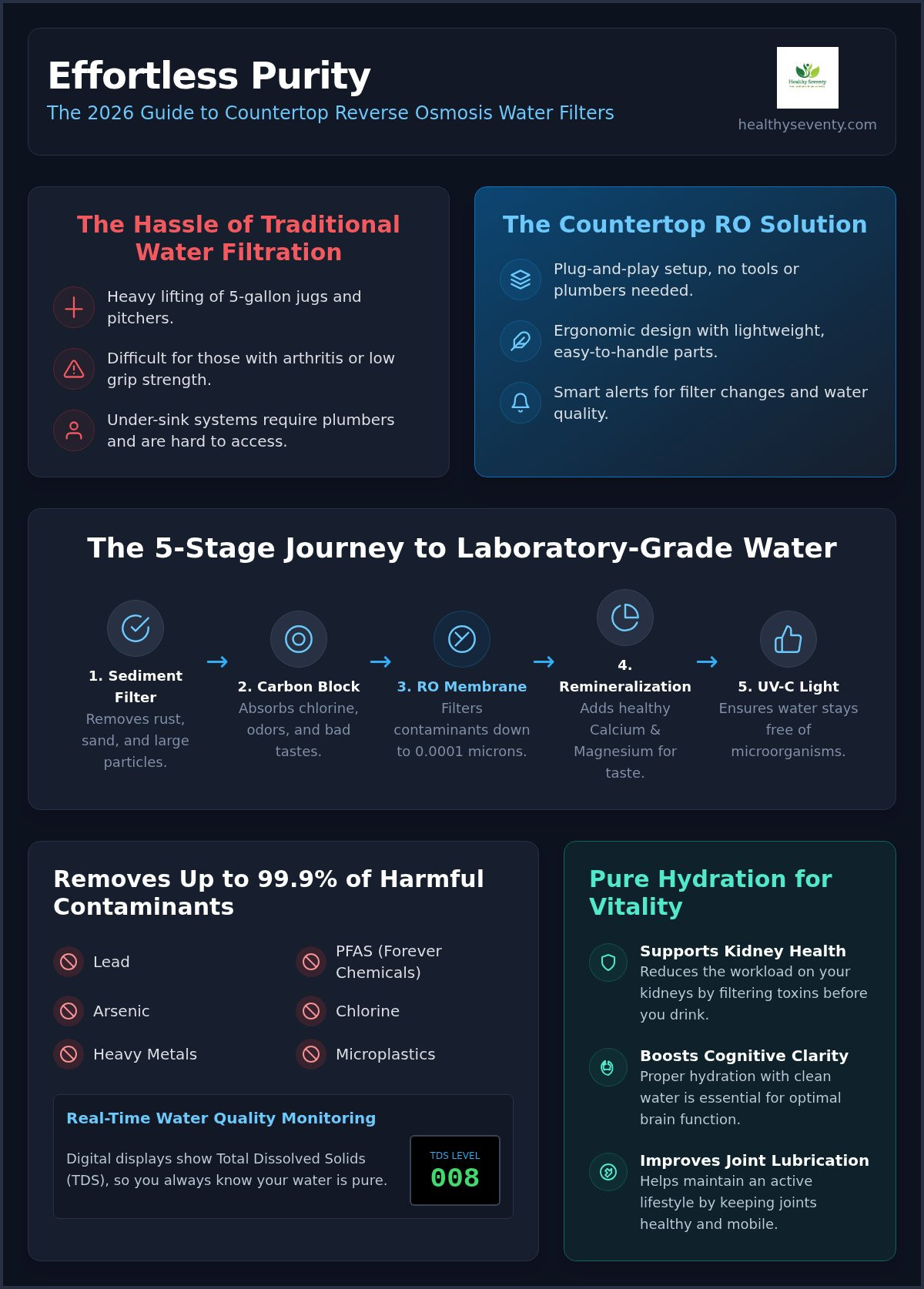
The modern countertop reverse osmosis water filter has evolved significantly over the last few years. In 2026, these systems are more than just filters; they are intelligent water processors that fit right on your kitchen island. The journey begins with a sediment filter that captures larger particles like rust or sand. Next, a carbon block filter removes chlorine and unpleasant odors that can ruin the taste of your morning tea. The heart of the system remains the reverse osmosis membrane, which filters out contaminants as small as 0.0001 microns.
What makes 2026 models stand out is how they handle what's left behind. Older units often wasted three gallons for every gallon produced, but current systems feature advanced internal recycling loops. This brine is processed again to maximize every drop. Additionally, many units now include a UV-C light stage. This provides bacteriostatic protection, ensuring that no microorganisms can grow inside the storage tank while the water sits. It's a layer of safety that provides incredible peace of mind.
The Role of Remineralization
Because reverse osmosis is so effective, it can strip away the beneficial minerals that give water its natural character. This often leads to a "flat" or slightly acidic taste. To combat this, high-quality units include a remineralization stage. This process reintroduces essential minerals like calcium and magnesium back into the water. Not only does this improve the flavor profile to a crisp, refreshing quality, but it also helps maintain a healthy pH balance. For seniors, these added minerals contribute to daily nutritional intake and support bone health, making the water as functional as it is pure.
Understanding TDS and Water Quality Sensors
One of the most empowering features of 2026 technology is the integration of real-time monitoring. Most units now feature digital displays that show the Total Dissolved Solids (TDS) level of your water. TDS is a measure of dissolved inorganic salts and organic matter present in the liquid. By seeing a low number on your screen, you get immediate, visual confirmation that your system is performing correctly. These sensors take the guesswork out of maintenance, alerting you exactly when it's time to swap a cartridge. If you're looking for more ways to simplify your daily wellness routine, you can explore our curated wellness resources designed specifically for your lifestyle.
Choosing the Best Countertop RO System for Your Kitchen
Selecting the right countertop reverse osmosis water filter requires looking beyond the technical specifications. While filtration power is essential, your physical interaction with the device determines its long-term value. A "Senior-First" evaluation framework shifts the focus toward how much effort is required to maintain the system. Does the unit fit comfortably in your space? Can you operate it without straining your hands or back? These are the questions that ensure your investment supports your independence rather than creating a new chore.
Spatial awareness is your first priority. Most standard kitchen cabinets are installed 18 inches above the countertop. To avoid the frustration of a unit that is too tall, verify the dimensions before purchasing. You should also consider the "Pure-to-Waste" ratio. In 2026, top-performing models have achieved ratios of 3:1 or even 4:1. This efficiency means you'll spend less time refilling the reservoir and more time enjoying pure hydration. Choosing a model that slides easily across the counter on rubberized feet also makes cleaning the area behind the machine a simple task that doesn't require heavy lifting.
Ergonomics and Ease of Use
For those managing arthritis or reduced grip strength, the design of the filter cartridges is a deal-breaker. Look for "twist-and-pull" designs. These allow you to swap out components with a simple quarter-turn, requiring no specialized tools or significant force. The dispensing mechanism matters too. A high-set button or a light-touch lever is much easier to use than a stiff dial. Pay close attention to the water tank. A removable reservoir with a sturdy, ergonomic handle allows you to carry it with a secure grip, distributing the weight evenly to prevent wrist strain. It's these small details that make a system truly user-friendly.
Certifications to Look For: NSF and WQA
Trust is built on verification. When researching models, prioritize those with the NSF/ANSI 58 certification. This specific standard is the benchmark for reverse osmosis systems, confirming they effectively reduce contaminants like lead and arsenic. A WQA (Water Quality Association) Gold Seal is another hallmark of reliability, indicating the product has passed rigorous testing for structural integrity. You can easily verify these claims by visiting the official NSF or WQA online databases. Checking these resources ensures the manufacturer's promises are backed by independent, professional research, giving you total confidence in every glass you drink.
Maintenance and Setup: A Stress-Free Routine
Setting up your countertop reverse osmosis water filter is designed to be a moment of empowerment, not a technical struggle. Most units arrive nearly ready to use, requiring just a few minutes of your time to begin producing pure water. Follow this simple five-step process to get started:
Unbox: Place the unit on a level surface near an electrical outlet, ensuring there's enough clearance to remove the water tank.
Sanitize: Remove the water reservoir and wash it with mild dish soap and warm water to remove any dust from shipping.
Prime: Fill the tank to the "max" line with cold tap water and plug the system into the wall.
Flush: Run two or three full cycles of water through the machine to prime the internal filters. Don't drink this first batch.
Enjoy: Refill the tank once more, and your system is ready to provide crisp, clean hydration.
Maintaining your system is equally straightforward. To prevent biofilm buildup, aim for a quick monthly cleaning of the water tank using a soft sponge and a splash of white vinegar. You'll also notice a small amount of wastewater, known as brine, left in the tank after filtration. Instead of pouring it down the drain, consider using it to water your non-edible household plants. This brine is rich in minerals and perfectly safe for your favorite ferns or flowers.
Changing Filters Without Tools
By 2026, "Quick-Connect" technology has become the industry standard, making filter replacements a breeze. You won't need a wrench or significant hand strength. Most cartridges simply require a gentle twist to release and a firm push to secure the new one. Once the new filter is in place, you'll need to reset the filter life indicator on the digital display. This is usually done by holding down the "filter" button for three seconds until the light turns green. To ensure you're getting the highest level of protection, always purchase genuine replacement filters directly through a trusted wellness partner like Healthy Seventy.
Troubleshooting Common Issues
If you notice your system becoming noisy or vibrating, check that it's sitting perfectly flat on the counter. Sometimes a slight adjustment in position is all it takes to quiet the internal pump. If the water flow seems slower than usual, it's likely a signal that one of the pre-filters is reaching the end of its life. You might also encounter "TDS Creep," which happens when the system sits idle for several days and dissolved solids concentrate near the membrane. If you've been away for a weekend, simply run one quick flush cycle to restore the water to its peak purity levels.
Investing in Your Longevity with Healthy Seventy
Choosing a countertop reverse osmosis water filter is more than a kitchen upgrade. It's a commitment to a lifestyle of proactive wellness and independence. When you remove the physical and chemical barriers to pure hydration, you're setting a foundation for every other health choice you make. At Healthy Seventy, we believe that the later stages of life should be defined by vitality and ease. That's why we meticulously research every product we recommend, ensuring that the "ease of use" is a reality rather than just a marketing claim.
Consider how this fits into your broader wellness strategy. Just as you might select the best walking sneakers for balance to ensure your safety during a morning stroll, choosing a high-quality water source protects your internal systems. Pure water supports your kidneys, aids digestion, and keeps your cognitive function sharp. By investing in a system that requires no plumbing and no heavy lifting, you're choosing a path that preserves your energy for the activities you love most.
Creating a Safe and Accessible Kitchen
A senior-friendly kitchen is one that adapts to your needs, rather than forcing you to adapt to its layout. Integrating a filtration system is a key part of maintaining a safe and accessible home environment. To maximize the benefits, place your unit on a counter that is at a comfortable waist height. This prevents the need for reaching or straining your back when refilling the reservoir. When clean water is this accessible, it becomes effortless to integrate it into a nutritional plan focused on long-term vitality.
Next Steps for Your Hydration Journey
As you move forward, keep the key selection criteria we've discussed in mind. Prioritize ergonomic designs with "twist-and-pull" filters, ensure the unit carries an NSF/ANSI 58 certification, and verify that the footprint fits your specific cabinet height. Taking control of your water quality today is a powerful step toward a healthier 2026 and beyond. You don't have to find these solutions alone; our research is here to act as your guide. If you're ready to upgrade your home, explore our curated selection of senior-friendly water filtration systems to find the perfect fit for your lifestyle.
Empower Your Daily Wellness Routine
Pure water is a fundamental pillar of senior health, yet it shouldn't come at the cost of your comfort or independence. By choosing a countertop reverse osmosis water filter, you're opting for a solution that balances sophisticated 2026 technology with physical ease. We've explored how these modern systems provide laboratory-grade purity while remaining entirely tool-free to maintain. This allows you to focus on what matters most: your vitality and your continued independence. You deserve a home environment that supports you without creating new chores or physical strain.
Healthy Seventy is dedicated to researching and curating only the most reliable, senior-friendly options for adults over 60. Our focus remains on ergonomic designs and providing national US guidance to ensure you feel supported through every step of your health journey. You have the wisdom to prioritize your well-being; now you have the accessible technology to make it effortless. Take the next step toward a cleaner, more vibrant home today.
Find the Perfect Senior-Friendly Water Filter for Your Home
Your journey toward better hydration starts with a single, simple choice that respects both your home and your health.
Frequently Asked Questions
Is reverse osmosis water better for seniors than bottled water?
RO water is often superior because it provides the same purity without the physical strain of carrying heavy cases or the environmental impact of plastic. It ensures a consistent supply of laboratory-grade water right at home. This is particularly beneficial for those managing kidney health or sensitive systems. You also avoid potential microplastics found in some bottled brands while maintaining your independence from grocery store logistics and the burden of heavy lifting.
How often do I really need to change the filters on a countertop RO system?
Most 2026 systems require a pre-filter change every 6 to 12 months and a membrane replacement every 2 years. However, you don't have to guess. Modern units include smart sensors that monitor water quality and usage, flashing a light when it's time for a swap. Keeping up with this schedule ensures your countertop reverse osmosis water filter continues to remove contaminants effectively and prevents slow flow rates that can occur with clogged cartridges.
Does a countertop reverse osmosis filter remove healthy minerals?
Yes, the RO process is so thorough that it removes almost everything, including beneficial minerals like calcium and magnesium. To address this, high-quality senior-friendly models feature a remineralization stage. This specific filter adds these essential minerals back into the water after purification. This improves the taste from flat to crisp and refreshing while supporting your daily nutritional needs and helping to maintain a healthy alkaline pH balance for your body's overall vitality.
Are countertop RO systems loud when they are running?
Modern units are remarkably quiet, typically producing a low hum similar to a small refrigerator. The sound comes from the internal pump that pushes water through the membrane. Most people find it easily ignorable during a conversation or while watching television. If you notice a sudden increase in noise or vibration, it's usually a sign that the unit needs to be adjusted on the counter or that a filter is improperly seated.
Can I use a countertop RO system if I have a water softener installed?
You absolutely can, and it's actually beneficial for the system. A water softener removes hard minerals like excess calcium that can eventually clog the RO membrane. By using softened water as your source, you'll likely extend the life of your filters. The RO system will then remove any residual sodium added by the softening process, leaving you with the purest possible drinking water for your daily hydration needs and long-term health.
How much water does a countertop RO system waste compared to under-sink models?
Countertop units in 2026 are significantly more efficient than older under-sink versions. While traditional systems might waste four gallons for every one produced, modern countertop models often achieve a 3:1 or 4:1 pure-to-waste ratio. This efficiency is achieved through internal recycling loops. You can also repurpose the remaining brine water for household tasks like watering your garden or cleaning, ensuring that no drop goes to waste in your home or community.
Is it difficult to lift the water tank when it is full?
Ergonomics are a priority for senior-focused designs, so most tanks are built to be manageable. A full three-liter tank weighs approximately six pounds, which is lighter than a standard gallon of milk. These reservoirs feature sturdy, wrap-around handles that allow you to use your whole hand for a secure grip rather than just your fingers. This design choice significantly reduces the risk of wrist strain or accidental spills during your daily refill routine.
Do I need a plumber to help me set up a countertop RO filter?
No professional help is required for these systems. A countertop reverse osmosis water filter is a plug-and-play device that works entirely independently of your home's plumbing. You simply place it on the counter, fill the reservoir, and plug it into a standard electrical outlet. This makes it an ideal choice for renters or anyone who wants to avoid the cost and complexity of permanent home modifications or drilling into expensive kitchen cabinets.



Comments