


Travel Mobility Scooters: 2026 Guide to Independence
Updated: 2 days ago

What if your next family holiday wasn't defined by the distance to the nearest park bench, but by the memories you created without a single moment of physical exhaustion? Finding the right mobility scooters for travel is often the difference between staying home and seeing the world with your loved ones. You likely worry about being a burden to your children or feel anxious about whether your equipment will meet strict airline battery regulations. It's a heavy weight to carry when you should be focusing on your itinerary and the quiet joy of a new destination.
We understand that maintaining your dignity and independence is non-negotiable. That's why we've carefully researched the latest 2026 travel standards to help you select a perfect, travel-ready companion that restores your freedom. In this guide, you'll discover how to choose a scooter that fits effortlessly into a car trunk or plane cargo hold. We'll walk through the current FAA battery limits, tips for stress-free vacation planning, and the specific steps you can take to ensure your device arrives as safely as you do.
Table of Contents
The Role of Travel Mobility Scooters in Active Aging
Travel isn't a luxury. It's medicine. For many of us, the ability to explore new environments is a cornerstone of mental clarity and emotional wellness. As the global mobility scooter market is projected to reach USD 1.71 billion in 2026, it's clear that a growing number of seniors are refusing to let physical limitations dictate the boundaries of their world. This year marks a significant shift toward the "active senior" traveler, where age is viewed as a season of legacy and continued discovery rather than a period of withdrawal.
The primary hurdle to these experiences is often "travel fatigue," a state of exhaustion that can lead to social isolation. When the fear of walking long distances through an airport or a museum becomes too great, we tend to stay home. Choosing the right mobility scooters for travel solves this challenge by preserving your energy for the moments that matter. Instead of focusing on the pain in your legs, you can focus on the laughter of your grandchildren or the beauty of a coastal sunset. It's about moving from a place of physical strain to a state of proactive living.
Independence Beyond the Living Room
True independence shouldn't end at your front door. Breaking the boundaries of home-based mobility is essential for maintaining a high quality of life as we age. While many people start their journey by looking for general mobility aids for seniors, travel-specific solutions offer a unique level of freedom. These devices aren't just about getting from point A to point B; they're about the confidence to visit a national park, navigate a busy cruise ship, or attend a destination wedding. By extending your reach, you ensure that your social world remains large and vibrant.
The "Freedom Vehicle" Mindset
It's time to reframe how we view assistive technology. A scooter isn't a sign of decline; it's a "freedom vehicle" that fuels your vitality. This psychological shift is powerful. It moves you from "needing help" to "taking the lead" in your own life. When you have a reliable companion for your journeys, you'll find yourself saying "yes" to invitations you previously declined. You can consult Wikipedia's overview of mobility scooters to understand the various configurations available, but the emotional benefit remains the same: empowerment. Having the right mobility scooters for travel encourages frequent family engagement and ensures you remain an active participant in life's most cherished memories. You aren't a burden when you're the one leading the way to the next landmark.
Choosing Your Companion: Folding vs. Disassembling Scooters
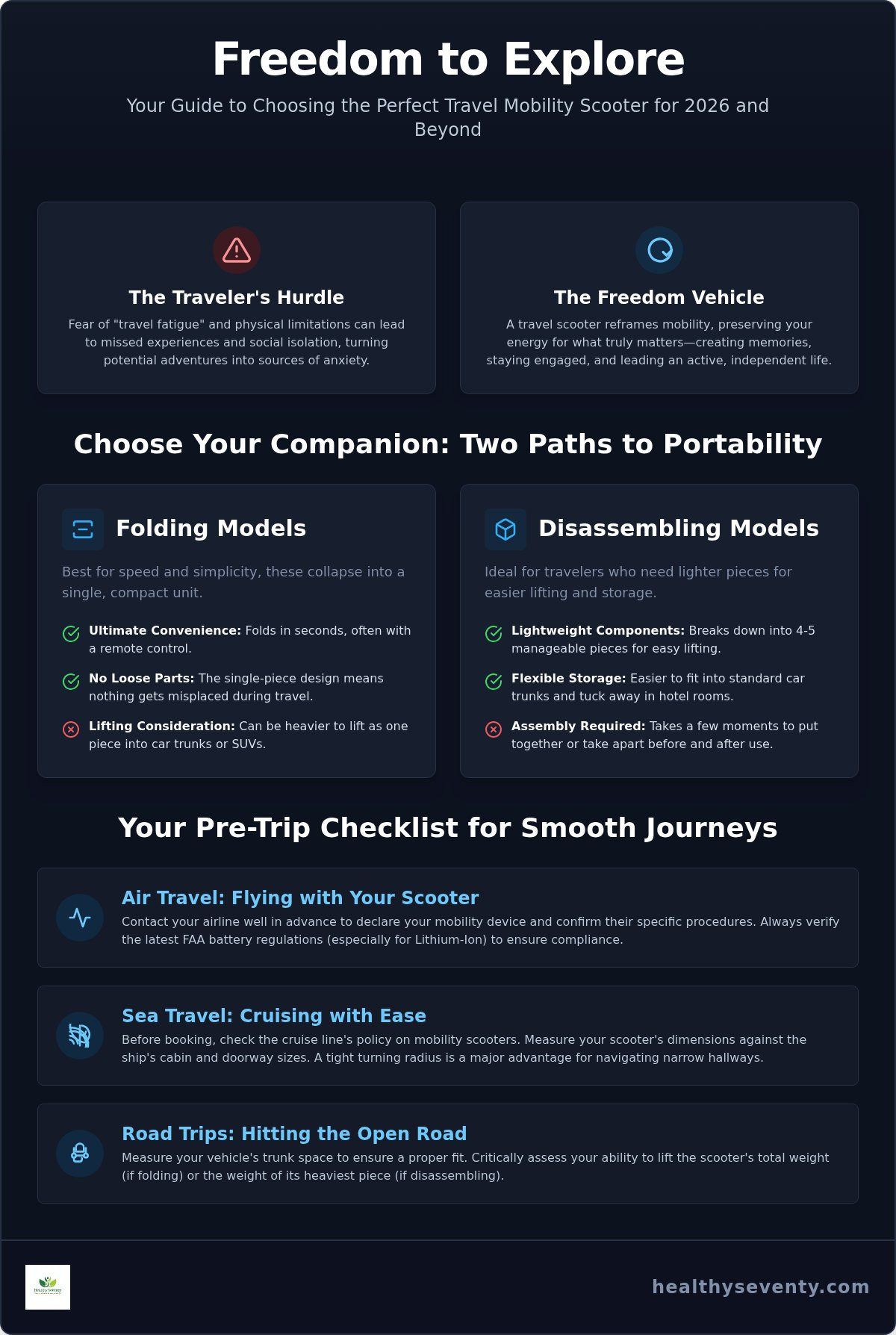
Selecting the right equipment is a deeply personal decision that balances your desire for adventure with your physical comfort. When you're comparing mobility scooters for travel, you'll generally find two paths: models that fold into a single unit and those that disassemble into several lighter components. Each category offers distinct advantages designed to support your independence in different ways. Understanding these nuances helps you choose a companion that feels like a natural extension of your lifestyle rather than a logistical hurdle.
Automatic and Manual Folding Models
The year 2026 has introduced remarkable advancements in remote-control folding technology. Many modern units now fold at the touch of a button, eliminating the need for you to bend down or exert significant physical force. These one-piece designs are incredibly convenient for quick transitions, such as boarding a bus or moving through a cruise ship terminal. However, because they remain a single unit, they can be heavier to lift into a high SUV or truck. As highlighted in the Forbes Health review of best mobility scooters, the primary benefit here is the speed of use and the lack of loose parts that could be misplaced during a busy travel day.
The Benefits of Disassembly
Disassembling models are often the preferred choice if you are traveling solo or have limited lifting strength. These scooters typically break down into four or five manageable pieces, with the "heaviest part" often weighing significantly less than a fully assembled folding model. This modular approach makes it much easier to fit your equipment into a standard car trunk alongside your luggage. Beyond the car, these smaller pieces are easier to tuck away in a compact hotel room or a cozy cruise cabin, ensuring your living space remains clear and safe. If you're looking for a curated selection, our Foldable Mobility Scooter for Seniors provides a reliable starting point for your research.
How do you decide which is right for you? Start by considering your daily routine and your primary mode of transport. If you frequently use public transit or cruises, the one-piece folding design often wins for sheer convenience. If you rely on a personal vehicle with a small trunk, a disassembling model might be your best ally. We recommend testing the weight of the heaviest component before making your final choice. This ensures you feel confident and capable every time you prepare to head out on a new journey.
Navigating Travel Modes: Air, Sea, and Road Trips
The journey is just as significant as the destination. Your choice of equipment depends heavily on how you plan to get there, as each mode of transport presents its own set of logistical puzzles. Whether you are flying across the Atlantic, cruising through the Caribbean, or driving across state lines, your strategy for using mobility scooters for travel must adapt to the environment. Understanding these specific requirements beforehand ensures that your transition from home to holiday is as smooth and dignified as possible.
Cruising with Confidence
Cruise ships are magnificent floating cities, but they often feature narrow corridors and tight turns. If you're staying in a standard cabin, dimensions are critical. For example, Carnival Cruise Line requires scooters to be no wider than 21 to 22 inches to fit through standard cabin doors. Royal Caribbean allows for a slightly wider 23-inch doorway in their standard rooms. If your scooter exceeds these widths, you'll need to book an accessible stateroom, which typically offers a much wider 32-inch entry.
Three-wheel models are often the preferred choice for cruisers because of their superior turning radius in crowded dining rooms or elevators. It's also vital to consider shore excursions. While many modern ships are fully accessible, some ports require the use of smaller "tender" boats to reach the dock. In many cases, these smaller vessels cannot accommodate mobility scooters, so always check with the Guest Access department before you book your excursions.
The Ultimate Road Trip Setup
For those who prefer the freedom of the open road, charging and storage are your primary concerns. Multi-day drives require a proactive approach to battery management. We recommend investing in a dedicated car charger accessory that allows you to top up your battery from the vehicle’s power outlet while you're moving between landmarks. This ensures you're at full power the moment you arrive at a park or museum.
When it comes to loading, you'll need to decide between a vehicle lift system or manual trunk loading. If you're traveling with family, a foldable model that fits into a standard trunk is often the simplest solution. Planning your stops is also essential. Use travel apps to identify accessible rest areas and visitor centers that offer level ground and easy entry points. This methodical approach keeps the focus on the scenery rather than the logistics.
Exploring historic cities often means encountering cobblestones, steep ramps, or uneven terrain. While mobility scooters for travel are built for portability, they also need enough ground clearance to handle small thresholds and bumpy paths. By choosing a model with flat-free tires and a sturdy frame, you can navigate these charming but challenging environments with total peace of mind.
Airline Regulations and Battery Safety for Seniors
The thought of handing over your mobility device at an airport gate can be a significant source of anxiety. It's a natural concern; you're trusting a vital part of your independence to a complex system of baggage handlers and cargo holds. In 2024, U.S. airlines mishandled 11,357 wheelchairs and scooters, which averages out to approximately one incident every eight minutes. While this statistic is sobering, it has fueled a movement for better protection. New Department of Transportation rules, which began enforcement on August 1, 2025, have significantly strengthened airline accountability and mandated improved staff training. By mastering the current 2026 regulations, you can ensure your mobility scooters for travel are handled with the care they deserve.
The 300Wh Rule: What You Need to Know
The Federal Aviation Administration (FAA) has specific requirements for the lithium-ion batteries that power modern, lightweight scooters. For a single battery, the limit is 300 watt-hours (Wh). If your device uses two batteries, each one must not exceed 160Wh. While batteries under 160Wh generally don't require prior notice, those between 160Wh and 300Wh need airline approval before your travel date. You'll also need to remove these lithium-ion batteries and carry them into the passenger cabin with you; they aren't allowed to stay in the cargo hold due to safety protocols. If you're looking for a device designed with these rules in mind, our Foldable Mobility Scooter for Seniors is an excellent choice for frequent flyers.
Sealed Lead Acid (SLA) batteries are an alternative, but they're much heavier and less common in travel-specific models. Regardless of your battery type, always bring the manufacturer’s specification sheet to the check-in counter. This simple piece of documentation proves your scooter meets safety standards and prevents unnecessary delays during the boarding process. It's a proactive step that builds confidence for both you and the airline staff.
Gate Checking Your Scooter
Checking your scooter at the gate, rather than with your regular luggage, allows you to maintain your mobility until the very last moment before you board the plane. To protect your motor, always locate the "freewheel" lever and ensure it's in the locked position once the device is handed over. This prevents the wheels from spinning freely, which can cause internal damage if the scooter is moved manually by handlers. We also recommend taking clear, time-stamped photos of your device from multiple angles before you leave the jet bridge. These photos serve as a digital record of your scooter's condition, providing peace of mind and essential evidence should you need to file a claim under the new 2025 DOT protections.
Labeling is your final line of defense. Attach a durable tag with your name, phone number, and specific instructions on how to fold or lift the device. This ensures that even in a busy cargo environment, the handlers have a guide on how to treat your equipment. When you land, perform a quick inspection before leaving the jet bridge. Check the throttle, the seat, and the battery connection to ensure everything is in working order for the next leg of your journey.
Healthy Seventy’s Curated Travel Mobility Solutions
At Healthy Seventy, we don't just provide a catalog of products; we act as a dedicated partner in your wellness journey. Our researchers focus on a specific metric we call the weight-to-range ratio. We know that for a device to be truly useful, it must be light enough for easy transport while offering enough battery life to last through a full day of sightseeing. By prioritizing these factors, we ensure that your mobility scooters for travel remain a source of joy rather than a logistical burden. Our promise to you is built on the pillars of reliability, comfort, and vitality, treating this stage of your life as a time for continued legacy and adventure.
Our top recommendation for the active traveler is the Foldable Mobility Scooter for Seniors. This model has been selected for its intuitive design and its ability to handle the diverse environments we’ve discussed, from cruise ship corridors to city sidewalks. Many members of our community find that their mobility needs change depending on the setting. For this reason, we often suggest pairing your scooter with other aids, such as upright walkers. Having both options allows you to maintain your posture during short indoor walks while relying on your scooter for longer excursions.
Expert-Selected Travel Models
How do we decide which models earn our "Travel-Ready" badge of approval? Our criteria are rigorous. We analyze frame durability, the ease of the folding mechanism, and, most importantly, battery compliance with 2026 aviation standards. We believe in balancing price with long-term durability. While budget-friendly options exist, we prioritize equipment that won't fail you when you're miles from home. Our active senior community frequently provides feedback on these models, helping us refine our selections based on real-world use in airports and on cobblestone streets. This collective wisdom makes our platform a trusted resource for those who value quality and reliability.
Preparing for Your Next Journey
Before you book your next set of tickets, take a moment to run through a final readiness checklist. Confirm that your battery meets the 300Wh limit and that you have a printed copy of the manufacturer's specifications. Contact your airline or cruise line at least 48 hours in advance to register your device. If you feel overwhelmed by the technical details, our team is here to help. You can reach out to us for personalized mobility advice tailored to your specific travel plans and physical needs. We're here to bridge the gap between complex regulations and your everyday lifestyle choices.
Reclaiming your travel dreams is about more than just equipment. It's about the confidence to say "yes" to the world again. Whether it's a quiet weekend away or a bucket-list international tour, you deserve to explore with dignity and ease. Let 2026 be the year you lead the way, supported by technology that empowers your spirit and protects your independence.
Lead the Way on Your Next Adventure
Choosing the right mobility scooters for travel is the first step toward a world without physical boundaries. By mastering the 2026 airline battery standards and selecting a device that aligns with your specific mode of transport, you move from being a spectator to the lead explorer in your own life. Whether you are navigating a narrow cruise ship corridor or loading a lightweight frame into a car trunk, the right equipment ensures your focus remains on the destination. It's about preserving your energy for the moments that truly matter, like a sunset dinner or a walk through a historic plaza.
Since 2024, Healthy Seventy has focused on empowering independence by providing resources curated by senior health experts. We've done the deep research into current travel standards so you don't have to worry about the fine print. You deserve a journey that is defined by discovery and the joy of shared experiences with your family. Explore our curated selection of foldable mobility scooters for seniors and start planning your next getaway with total confidence. Your next great memory is just a journey away, and we're honored to be your partner in vitality.
Frequently Asked Questions
Can I take my mobility scooter on a plane in 2026?
Yes, you can take your mobility scooter on a plane in 2026, provided it meets FAA lithium-ion battery limits. Specifically, a single battery must not exceed 300 watt-hours. If your device uses two batteries, each must stay under 160 watt-hours. You'll need to remove the battery and carry it into the cabin. It's always best to contact your airline 48 hours before departure to confirm their specific approval process for your device.
How much does a lightweight travel mobility scooter weigh?
Most lightweight travel mobility scooters weigh between 45 and 60 pounds when fully assembled. If you choose a disassembling model, the heaviest individual piece often weighs between 25 and 35 pounds. This modular design makes it much easier to lift the components into a vehicle without straining your back. Weight is a critical factor for maintaining your independence, so always check the specifications for the "heaviest part" before purchasing.
Do I need a special car to transport a folding mobility scooter?
You don't need a special vehicle to transport most folding mobility scooters. These models are designed to fit into the trunk of a standard sedan or the cargo area of a compact SUV. If you have a very small vehicle, a disassembling scooter might be a better choice as it breaks into smaller, flatter pieces. This flexibility allows you to travel in your own car or even a standard rideshare vehicle without needing expensive modifications.
What happens if my scooter battery dies while I am sightseeing?
If your battery dies while sightseeing, you should switch the device into "freewheel" mode using the manual lever. This allows the scooter to be pushed easily by a companion without damaging the motor. To prevent this, we recommend planning your route around accessible charging points or carrying a spare battery pack. Many modern mobility scooters for travel also feature a battery gauge to help you monitor your power levels throughout the day.
Are three-wheel or four-wheel scooters better for travel?
The best choice depends on where you plan to go. Three-wheel scooters offer a tighter turning radius, making them ideal for narrow cruise ship corridors and indoor museums. Four-wheel models provide superior stability and are better suited for outdoor sightseeing on uneven terrain or gravel paths. Consider your primary destination; if you'll be spending most of your time on flat, indoor surfaces, the maneuverability of a three-wheel model is often superior.
Does Medicare cover mobility scooters for travel purposes?
Medicare typically doesn't cover mobility scooters for travel because they are classified as a convenience rather than a medical necessity for use within the home. Medicare Part B only covers power-operated vehicles if you have a medical condition that prevents you from performing daily activities inside your house. For travel-specific needs, you'll generally need to look at private insurance or personal funding options to secure a lightweight, portable device for your adventures.
How do I charge my mobility scooter in a foreign country?
To charge your scooter in a foreign country, you'll need a plug adapter that matches the local outlets and potentially a voltage converter. Most modern scooter chargers are dual-voltage, meaning they can handle both 110V and 240V power. However, you must verify this by checking the "Input" label on your charging brick. If it doesn't say 110V-240V, using a simple adapter could damage your battery, so a dedicated transformer would be required.
What is the best way to protect my scooter from damage during a flight?
The best way to protect your device is to take time-stamped photos of it at the gate before handing it over to staff. Use bubble wrap or foam pipe insulation to cover the tiller and joystick, as these are the most vulnerable parts. Attach clear, waterproof instructions for the baggage handlers on how to fold and lift the frame. These proactive steps, combined with current DOT protections, significantly reduce the risk of transit damage.



Comments