


Upright Walker Guide 2026: Pain-Free Mobility
- healthyseventy3
- 5 hours ago
- 12 min read
What if the very tool meant to help you move was actually the reason your back and neck feel so heavy by the end of the day? It's a common frustration for many who rely on traditional equipment. You want to stay active, but the constant hunching and weight-bearing on your wrists often lead to more fatigue than freedom. Choosing an upright walker for posture support changes this dynamic entirely, allowing you to stop staring at your shoes and start looking at the world around you again.
We understand that maintaining your independence shouldn't come at the cost of physical comfort. We've researched the latest 2026 innovations to show you how these devices shift weight to your forearms, effectively reducing spinal compression and hand fatigue. This guide will walk you through the benefits of ergonomic models like the VOCIC Upright Walker, which are specifically designed to help you reclaim a natural line of sight. You're about to discover how to move with grace, stability, and the quiet confidence that comes from walking tall.
Table of Contents
The Posture Problem: Why Traditional Walkers Often Lead to Hunching
Have you noticed that after a short walk with a standard rollator, your lower back feels tight and your neck aches? This isn't just a sign of time passing; it's often the physical result of how traditional mobility aids are designed. Many standard walkers require you to lean forward to reach the hand-grips. This hunched position compresses the lumbar spine and places unnecessary strain on your skeletal frame. While these devices provide stability, they often sacrifice your alignment to get it. You're moving, but you're not moving comfortably.
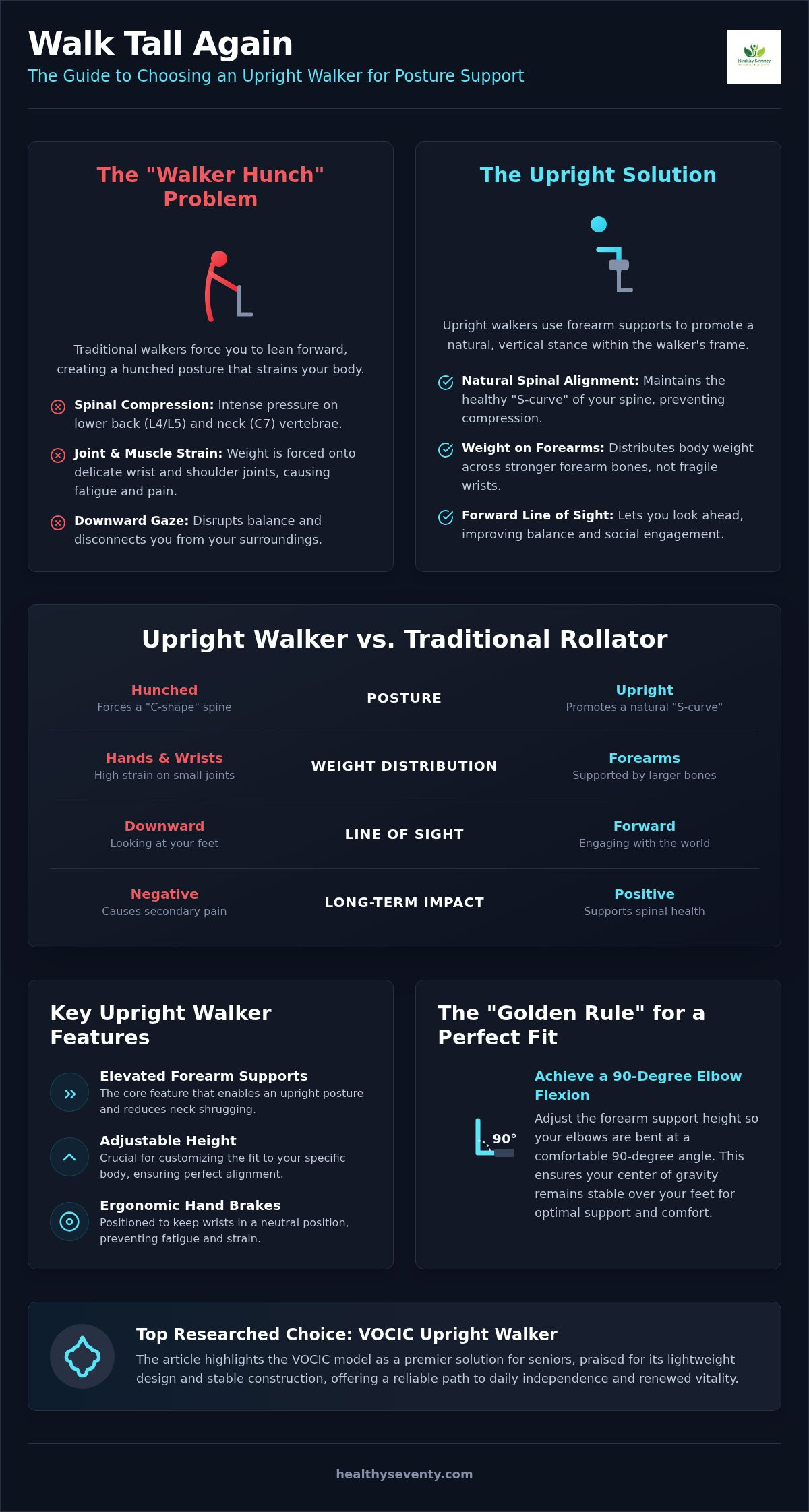
This "walker hunch" happens because the grips are typically set at wrist or hip height. To maintain control, you're forced to bend at the waist. This shift in your center of gravity is counterintuitive. Instead of feeling secure, you're constantly leaning into a potential forward fall. Over time, this posture leads to secondary pain in the shoulders and wrists as they bear weight they weren't meant to carry. You don't have to accept this strain as a permanent part of your journey. Choosing an upright walker for posture support can break this cycle by realigning your body and distributing your weight more naturally.
The Biomechanics of the "Walker Hunch"
When you bend forward, your spinal extensors, the muscles running along your back, must work overtime to keep you upright. This constant tension leads to rapid fatigue. Looking down at your feet also disrupts your vestibular orientation, which is your body's internal sense of balance. The pressure is particularly intense on the L4 and L5 vertebrae in the lower back and the C7 vertebra at the base of the neck. By forcing a downward gaze, traditional walkers actually make it harder for your brain to process your position in space, which can lead to a feeling of instability.
How Poor Posture Impacts Long-Term Senior Health
The effects of hunching go beyond simple muscle soreness. A compressed chest cavity limits your lung capacity, making it harder to take deep, restorative breaths during your daily walk. Your internal organs also feel the squeeze; abdominal compression can lead to slower digestion and general discomfort. Perhaps most importantly, looking at the floor instead of the horizon can make you feel disconnected from your surroundings. An upright walker for posture support helps you look people in the eye again, restoring both your physical health and your social confidence. It's about more than just walking; it's about staying engaged with your world.
How Upright Walkers Provide Targeted Posture Support
What exactly makes a walker "upright"? At its core, this is a mobility device designed with elevated forearm cradles that promote a vertical stance. By lifting your point of contact from your hands to your forearms, an upright walker for posture support allows you to stand tall within the safety of the frame. This design ensures that your spine remains in its natural "S-curve" rather than being forced into a "C-shape" hunch. Additionally, ergonomic hand-brakes are positioned specifically to keep your wrists in a neutral alignment. This prevents carpal tunnel irritation and hand fatigue during longer outings, making every step feel more secure.
Adjustable height settings are another critical feature of these devices. Because no two bodies are exactly alike, being able to fine-tune the height of the forearm supports is essential for maintaining that neutral spinal position. When the device is adjusted correctly, you aren't just leaning on a tool; you're using a structural extension of your own body that encourages healthy movement patterns. It's a proactive way to maintain your vitality without the typical aches that follow a long walk.
The Role of Forearm Supports in Spinal Alignment
When you use a traditional walker, you often unconsciously shrug your shoulders to compensate for the low handle height. This tension travels straight to your neck and upper back. Elevated cradles eliminate this shrugging motion by providing a stable base for your arms. For the best experience, pad density is key. You want a material that's firm enough to support your weight without "bottoming out" against the hard frame over time. Following the "golden rule" of a 90-degree elbow flexion ensures your center of gravity stays centered over your feet. This alignment transforms your walk from a chore into a comfortable, healthy exercise.
Redistributing Body Weight to Reduce Joint Strain
The most significant benefit of this design is how it shifts the burden of your weight. Instead of forcing small, delicate wrist bones to bear the pressure, the weight is distributed across the larger radius and ulna bones in your forearms. Spinal decompression in an upright gait means the vertical pressure on your vertebrae is physically reduced as the walker’s frame absorbs your upper body weight through the armrests. Because your joints aren't bearing the full brunt of gravity, the "perceived exertion" of walking long distances drops significantly. You'll likely find you can stay on your feet longer while feeling less tired afterward. If you're ready to see how this technology feels in practice, you might want to explore our researched mobility solutions to find the right fit for your lifestyle.
Upright Walker vs. Traditional Rollator: A Comparison for Posture
While traditional rollators provide a basic sense of security, they often prioritize floor-level stability at the expense of your spine. In contrast, choosing an upright walker for posture support places your long-term skeletal health at the forefront. These devices are typically engineered with a wider, more robust frame. This design allows for higher weight capacities, often supporting between 300 and 500 pounds. It's a level of durability that standard models sometimes lack. Understanding the different types of mobility aids for seniors is essential for maintaining an active lifestyle without compromising your physical alignment.
The core difference lies in where your body weight rests. Traditional rollators force you to lean forward, which can lead to chronic fatigue. Upright walkers use a more stable base and elevated supports to keep you centered. While the turning radius might be slightly larger than a compact rollator, the increased stability often makes it a safer choice for those who worry about tipping. You aren't just buying a tool for walking; you're investing in a system that protects your back while you move.
Line of Sight and Balance Benefits
Most walkers keep your focus about three feet in front of your toes. This downward gaze isn't just bad for your neck; it's a safety hazard. Walking upright expands your peripheral vision. It makes it much easier to spot obstacles or uneven pavement before they become a problem. There's a profound social benefit here, too. You can finally look your friends and grandchildren in the eye while you stroll together. This higher eye level naturally boosts your confidence in crowded grocery stores or busy parks. You no longer feel like you're hiding behind your equipment.
Indoor vs. Outdoor Performance
When it comes to the outdoors, wheel size matters. Many upright models feature 10-inch wheels as a standard. These larger wheels glide over cracked sidewalks and grass far better than the smaller wheels found on basic rollators. While the wider base of an upright walker provides superior stability on uneven terrain, it does require a bit more room to maneuver. You might find that cornering in a tight hallway takes a slightly wider turn than with a narrow rollator. Most users find this a fair trade-off for the increased safety and reduced risk of tipping during outdoor excursions.
Choosing the Right Upright Walker for Your Specific Needs
Finding the perfect mobility aid isn't about picking the first model you see. It's about finding a partner for your daily adventures. To ensure you get the best upright walker for posture support, follow these five essential steps before making your choice. Taking a few minutes to measure and evaluate now will save you from physical discomfort later.
Measure accurately: Stand as straight as you can and have someone measure the distance from the floor to your elbow. This measurement determines the ideal height for your forearm cradles.
Verify weight capacity: Don't just look at your own body weight. Remember to account for the weight of groceries, water bottles, or heavy bags you plan to carry in the storage pouch.
Evaluate seat height: Upright walkers often feature higher seats than traditional rollators. Ensure you can sit down and stand back up comfortably without straining your hips or knees.
Test the folding mechanism: If you travel often, you need a frame that's easy to collapse. Make sure you or your caregiver can lift the folded unit into a car trunk without struggle.
Review accessory options: Practical additions like cane attachments, cup holders, and removable storage bags keep your hands free and your essentials within reach.
Evaluating Height Adjustability and Forearm Fit
A "one size fits all" approach simply fails when it comes to posture correction. If the forearm cradles are too narrow, they'll pinch your arms; if they're too wide, you'll lose the stability needed to stay vertical. You'll know the fit is right when your shoulders feel relaxed and your elbows rest naturally at a 90-degree angle. It's also vital to check the locking mechanisms. They must be robust enough to stay in place without slipping under your weight, as a sudden height drop can lead to a loss of balance.
Terrain Considerations: Indoor vs. Outdoor Wheels
Where do you plan to walk most often? Indoor-focused walkers often use soft-grip tires to protect hardwood floors, while outdoor models require rugged treads for gravel or park paths. Many premium models now include shock-absorbing materials in the front fork to dampen vibrations from uneven sidewalks. While the walker provides the frame, your footwear provides the foundation. Pairing your device with the best walking sneakers for balance creates a complete system for fall prevention. If you're ready to find a curated fit, browse our researcher-vetted upright walkers today to reclaim your mobility.
The VOCIC Upright Walker: A Curated Solution for Posture and Vitality
At Healthy Seventy, we act as your dedicated researchers to find tools that truly support a life of vitality. The VOCIC Upright Walker for Seniors is our primary recommendation for those who refuse to let back pain dictate their daily schedule. This specific upright walker for posture support was selected because it balances professional-grade ergonomics with a warm, user-friendly design. It features a lightweight aluminum frame that's easy to maneuver, yet robust enough to support up to 300 lbs. It's a tool designed for seniors who are ready to transition from simply "getting by" to truly thriving in their active years.
For those moments when you need a brief rest during your stroll, the VOCIC model includes a comfortable padded seat and a supportive backrest. These features ensure that you can enjoy longer outings without the fear of overexertion. You aren't just using a mobility aid; you're gaining a mobile resting station that encourages you to stay out longer and explore further. It's about maintaining your independence while knowing you have a place to sit whenever you need it.
Key Features of the VOCIC Model for Seniors
Setting up a new piece of equipment shouldn't feel like a complex engineering project. The VOCIC model features tool-free assembly and easy-adjust knobs that allow you to find your perfect fit in minutes. We also value your safety during those quiet evening walks, which is why this model includes high-visibility reflectors to keep you seen. A detachable storage bag is included as well, giving you the hands-free independence needed to carry your phone, water, or personal items without cluttering your grip or affecting your balance.
Why Posture Correction Leads to Greater Independence
Standing taller does more than just help your back; it changes how you interact with the world around you. When you use an upright walker, you reduce the physical fatigue that comes from constant hunching and spinal compression. This energy shift allows for longer walks and more meaningful social engagements with friends and neighbors. There's a powerful connection between your physical stance and your mental well-being. By looking forward instead of down at your feet, you reclaim a sense of confidence and clarity. We encourage you to view this device as a vital tool for your legacy of vitality. It's an investment in your ability to move through life with your head held high.
Reclaiming Your Mobility and Confidence
You've spent years looking forward to your later chapters, and your mobility equipment should support that vision, not hinder it. By choosing an upright walker for posture support, you're making a conscious decision to protect your spine and reclaim your natural line of sight. We've explored how these devices shift weight from your delicate wrists to your stronger skeletal structure, effectively reducing the "walker hunch" that so often leads to chronic neck and back pain. Whether you're navigating a narrow hallway or a gravel park path, the right support makes all the difference.
Our researchers have curated the VOCIC model because it's ergonomically tested for senior comfort and designed for both indoor stability and outdoor adventure. It's time to stop looking at the floor and start engaging with the world again. If you're ready to walk with your head held high, View the VOCIC Upright Walker and Regain Your Posture Today. Your journey toward pain-free movement and renewed independence starts with a single, upright step. You deserve to move through your day with vitality and grace.
Frequently Asked Questions
Is an upright walker safer than a traditional rollator?
Upright walkers provide enhanced safety by shifting your center of gravity backward, which prevents the forward-leaning "pitch" common with rollators. Because you're standing within the frame rather than behind it, you're less likely to lose your balance during sudden stops. The wider wheel base also offers superior lateral stability on uneven surfaces. This design makes an upright walker for posture support a reliable choice for those worried about tipping or falling.
Can I use an upright walker if I have severe arthritis in my hands?
These devices are specifically designed to alleviate pressure on small finger and wrist joints. By resting your weight on padded forearm cradles, you bypass the need for a tight, weight-bearing grip. Most models, including the VOCIC, feature loop-style brakes that require minimal hand strength to operate. This makes them much more accessible for individuals managing severe arthritis or carpal tunnel syndrome compared to standard walkers that put all the strain on your palms.
Will an upright walker fit through standard 28-inch bathroom doors?
Most standard upright walkers have an external width of approximately 25 to 27 inches. This allows them to pass through a standard 28-inch bathroom door, though it may be a tight fit. It's always best to measure your specific doorway at home before purchasing. If your home has exceptionally narrow passages, many models offer a partial-fold feature that can help you navigate through restricted spaces safely without losing the stability you need to stand.
How much does a typical upright walker weigh, and can a senior lift it?
A typical upright walker weighs between 20 and 26 pounds. Thanks to modern aluminum frames, they remain manageable for many seniors or caregivers to lift into a vehicle. The VOCIC model is designed with portability in mind, featuring a side-to-side folding mechanism that makes it easier to grasp. If lifting is a primary concern, look for a model with a removable storage bag to help reduce the initial weight during transport or storage.
Does Medicare or insurance usually cover the cost of an upright walker?
Medicare Part B generally covers upright walkers as Durable Medical Equipment when a doctor prescribes them for use inside the home. For 2026, the Part B deductible is $283. Once you've met this, Medicare typically pays 80% of the approved amount, leaving you responsible for the remaining 20% coinsurance. Ensure your supplier is Medicare-approved to avoid unexpected costs. Coverage usually allows for a replacement walker every five years if medically necessary.
What is the height range for most upright walkers?
Most models accommodate users ranging from 5'0" to 6'2" tall. The adjustable armrests typically offer a range of 10 to 12 inches of vertical travel to ensure your elbows stay at the recommended 90-degree angle. Finding an upright walker for posture support that matches your specific height is vital for spinal alignment. Always check the manufacturer’s specifications to ensure the lowest and highest settings meet your physical requirements before you make a final decision.
Can I use an upright walker for rehabilitation after back surgery?
These walkers are excellent tools for post-surgical recovery because they promote spinal decompression. By offloading weight from the vertebrae to the forearms, you reduce the stress on healing tissues in the lower back. This vertical alignment helps you regain a natural gait faster than hunched-over alternatives. Always consult your physical therapist to ensure your specific recovery plan includes the use of an upright device for safe mobilization during your healing journey.
How do I maintain the brakes on an upright walker for maximum safety?
To keep your brakes in top condition, perform a quick check once a month. Ensure the pads grip the wheels firmly when you squeeze the levers. This simple routine ensures your walker remains a reliable partner for your safety.
Clean the wheel surfaces of hair and dirt regularly.
Test the "parking" lock to ensure it clicks securely.
Tighten the tension nut if the cables feel loose.

Comments