


Upright Walker vs. Rollator: Which Mobility Aid Restores Your Independence in 2026?
Updated: 2 days ago

What if the tool designed to help you move is actually the thing stopping you from looking the world in the eye? Many people believe that using a mobility aid means accepting a life of hunching over and staring at the pavement. When comparing an upright walker vs rollator, you might wonder if one can truly solve the persistent strain in your neck and back. It's a common struggle to feel "frail" because you can't stand tall during a simple conversation, but it isn't a trade-off you have to accept to stay mobile.
In this guide, we'll show you how the right choice can eliminate chronic pain and help you reclaim your active lifestyle. We've done the research to help you understand how these devices differ in support and comfort. You'll discover the specific design features that protect your posture, allowing you to walk longer distances and maintain the social life you cherish. We'll break down the pros and cons of each option so you can make an informed choice for your independence and vitality in 2026.
Table of Contents
The Silent Cost of Hunching: Why Traditional Rollators Aren't Always Enough
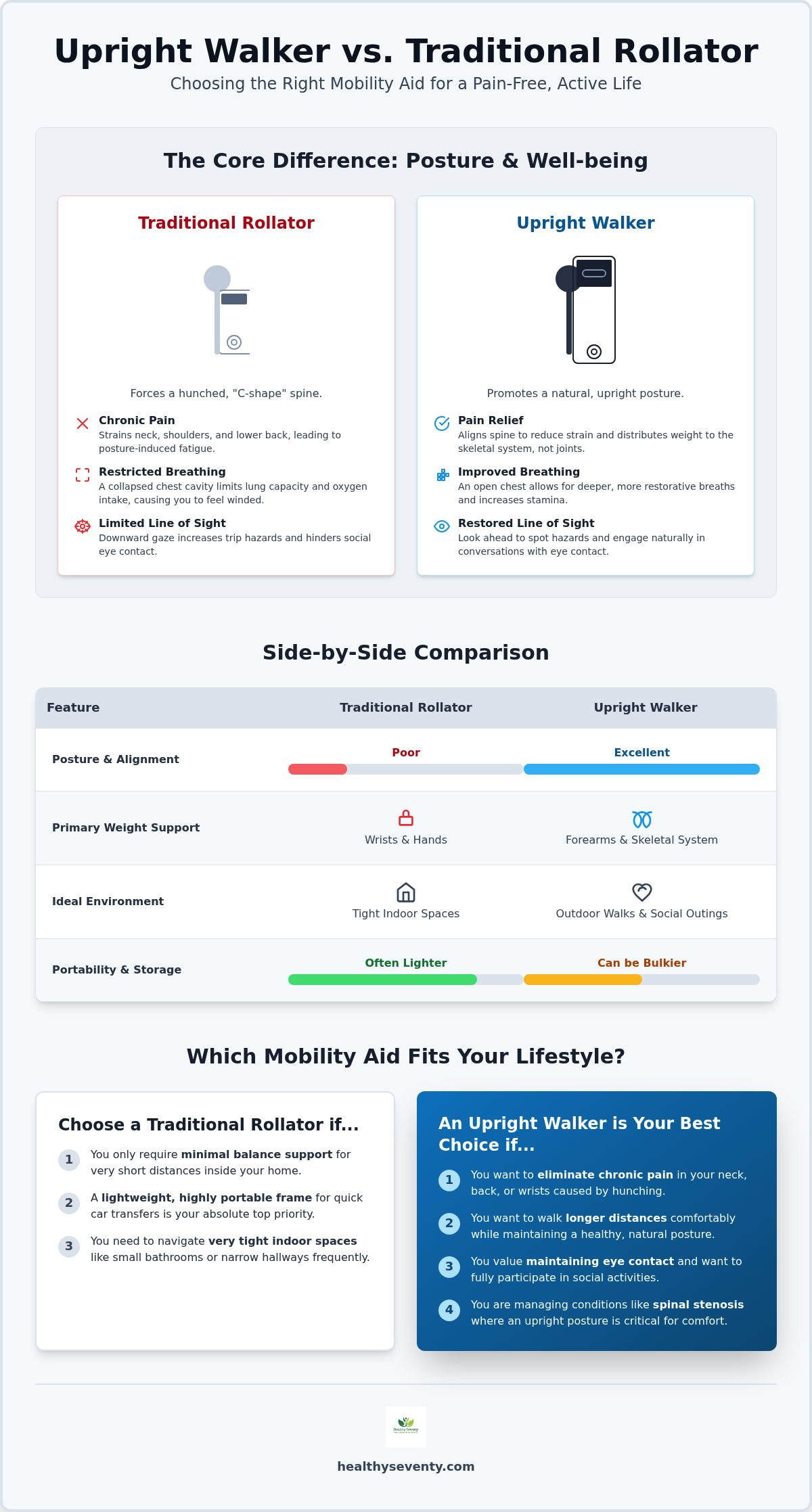
A traditional rollator is a familiar sight: a four-wheeled frame with a seat and handles set at wrist height. While it offers essential balance, it often forces you into a "hunched" position. This "Rollator Slouch" happens because your center of gravity shifts forward as you lean on the low handles, pulling your spine into a C-shape. When evaluating an upright walker vs rollator, it's vital to consider how this posture affects your daily life and overall vitality.
Beyond the visible slouch, there's a hidden cost to your health. A collapsed chest cavity physically restricts your lungs, making it difficult to take the deep, restorative breaths your body needs. You might find yourself winded sooner than expected because your oxygen intake is limited by your posture. Additionally, staring at the ground to navigate your wheels means you miss obstacles at eye level, increasing your risk of a stumble. This downward gaze also makes it harder to look friends and family in the eye, which can make a simple walk feel like a lonely task rather than a social joy.
The Physical Toll of Long-Term Hunching
The strain of leaning forward doesn't just stay in your shoulders. It travels up to the cervical spine, causing chronic neck pain similar to "tech neck." At the same time, your lower back must work overtime to support your tilted torso, leading to persistent aches. Posture-induced fatigue is the primary reason seniors stop walking early.
When a Standard Rollator Still Makes Sense
Despite these challenges, traditional models still have a place in a well-rounded mobility plan. Their compact frames are often easier to maneuver in very tight indoor spaces, such as small bathrooms or narrow kitchen galleys. They remain a practical choice for certain situations where portability is the main concern. You might still consider a standard model if you fit the following criteria:
Individuals who only require minimal balance support for very short distances inside the home.
Users with limited upper body or arm strength who find wrist-level support easier to manage initially.
Situations where a lightweight, highly portable frame is the top priority for quick car transfers.
Choosing between an upright walker vs rollator depends on your specific physical needs and where you plan to spend your time. While the rollator offers convenience in tight quarters, the long-term impact on your posture is a factor that deserves careful thought as you plan for an active 2026.
The Mechanics of Standing Tall: How Upright Walkers Transform Your Gait
While traditional models serve a specific purpose, the shift in design found in an upright walker vs rollator is revolutionary for your daily mobility. The core difference lies in the adjustable forearm cradles. Instead of gripping handles at waist height and leaning into them, you rest your weight comfortably on your forearms. This mechanical shift moves the burden from your delicate wrist joints to your stronger skeletal structure. By distributing your weight this way, you can maintain a "stand-up" posture that aligns your ears over your shoulders and hips.
This alignment isn't just about looking better; it's about efficiency. When your body is stacked correctly, your muscles don't have to work as hard to keep you upright. This reduces the strain on your lower back and allows you to focus your energy on moving forward. It's a proactive approach to wellness that prioritizes your body's natural mechanics.
Forearm Support vs. Wrist Support
Standard walkers often aggravate carpal tunnel or arthritis because they force the small joints of the hand and wrist to bear significant weight. By using a padded cradle, you distribute that pressure across the larger surface area of the arm. This design allows for a more relaxed, upright torso because you aren't leaning down to find stability. It's about working with your body's natural strength rather than fighting against gravity. If you've felt that familiar ache in your hands after a short walk, switching to this forearm-centric design can offer immediate relief.
Restoring Your Natural Line of Sight
Standing tall does more than just help your back; it changes how you see the world. When your spine is neutral, your gaze naturally lifts. Instead of watching your toes, you can look 20 feet ahead to spot potential hazards like uneven pavement or curbs early. This posture also restores the simple dignity of eye contact. You can engage with neighbors and friends at their level, making social interactions feel effortless and natural again. Proprioception, which is your body's ability to sense its position in space, improves significantly when your head is held high.
This improved alignment directly impacts your gait. Because you aren't leaning forward, your legs have the space to swing through a full, natural stride. You'll likely find that you can walk longer distances with less effort. It's about the psychological boost of moving with confidence. Choosing a device that supports this vitality, such as the VOCIC Upright Walker, can be the catalyst for reclaiming the outdoor activities you love. When you stand tall, you aren't just managing a condition; you're projecting independence to everyone you meet.
Upright Walker vs. Rollator: A Side-by-Side Comparison for 2026
Choosing between an upright walker vs rollator often comes down to the specific environment where you spend your time. While both utilize wheeled frames to assist with movement, their physical footprints and transport features differ significantly. Most modern models in 2026 utilize high-grade aluminum, which balances structural strength with a light enough weight for easy lifting into a car trunk. Side-folding mechanisms have become the gold standard for both types, allowing the device to stand independently even when collapsed, which is a major convenience in restaurants or narrow entryways.
Stability is another area where the designs diverge. Upright models typically feature a wider base and a larger frame to accommodate the forearm cradles and provide a secure center of gravity. This provides a rock-solid stability profile that feels more secure when you're navigating uneven surfaces. Standard rollators are often narrower, which makes them nimble in small rooms but potentially less stable if you tend to lean heavily to one side for support.
Terrain versatility depends heavily on wheel size. When comparing an upright walker vs rollator for outdoor use, look for 8-inch to 10-inch wheels to handle cracked sidewalks, gravel paths, or thick carpets. Upright walkers often come standard with these larger wheels, whereas some basic rollators use smaller 6-inch wheels that can get caught in sidewalk gaps. Comfort also sees a major upgrade in upright designs; while rollators offer a basic bench, many upright models include padded ergonomic backrests that support your spine while you rest.
Maneuverability in the Real World
Navigating a crowded grocery store aisle requires a tight turning radius. Standard rollators often excel in these tight spaces due to their smaller overall dimensions. However, upright walkers have improved significantly, using 360-degree front swivel wheels to manage corners efficiently. Braking is another critical safety factor. Most 2026 models feature hidden cable systems to prevent snagging on furniture, paired with easy-to-use loop brakes. For storage, you'll find a variety of options to suit your lifestyle:
Front-mounted bags: Common on upright models for easy access to your belongings while standing.
Under-seat pouches: Typical for rollators, keeping items secure but requiring you to stand up to reach them.
Weight Capacity and Build Quality
Finding the right fit for your body type is essential for safety and longevity. Most high-quality frames support up to 300 pounds, but bariatric options are available for those requiring extra width and reinforcement. Using high-grade aluminum ensures that the device remains a durable, long-term companion rather than a temporary fix. For a deeper look at how these tools fit into a broader lifestyle plan, explore our Mobility Aids for Seniors: A 2026 Comprehensive Resource for Independence. Understanding these technical specs ensures your choice supports your vitality for years to come.
Making the Right Choice: Matching Your Mobility Aid to Your Lifestyle
Choosing between an upright walker vs rollator isn't just about the price tag; it's about where your feet will take you. If you spend most of your time indoors navigating tight kitchen corners, a standard rollator's small footprint might feel more natural. But if your heart is set on exploring local parks, the stability and posture support of an upright model become essential. Test it thoroughly. Spend the first 10 minutes of use checking if your shoulders feel relaxed and if the brakes respond smoothly to a light touch. While an upright model may require a higher initial investment, the long-term health benefits of reduced back pain often outweigh the cost. It's about your future.
Medical Conditions and Mobility
Your specific health needs play a major role in this decision. For those managing Spinal Stenosis, maintaining an upright posture is often a critical medical recommendation to reduce nerve compression and discomfort. Similarly, individuals with COPD find that the open-chest design of an upright walker makes breathing easier compared to the collapsed posture of a traditional model. If you struggle with Parkinson's, the wider base of an upright walker provides the grounding support necessary to manage balance issues. To maximize your stability, don't forget to pair your device with the Best Walking Sneakers for Balance. Proper footwear is your foundation.
The Learning Curve: Adjusting to Your New Device
Adjusting to a new device takes a little patience. When setting up your walker, ensure the forearm cradles are at a height where your elbows form a 90-degree angle. This alignment is the key to maximum posture correction. Be mindful when navigating curbs; the higher center of gravity means you should approach uneven surfaces slowly and head-on. Don't rush the process. During your first week, set small goals, like walking for ten minutes twice a day, to build the muscle memory needed for your new, taller stride. You'll soon find that comparing an upright walker vs rollator was the first step toward a much more active life.
Ready to see the difference for yourself? You can explore our curated selection of mobility aids to find the perfect partner for your journey toward independence.
Reclaiming Your Vitality with the VOCIC Upright Walker
After weighing the benefits of an upright walker vs rollator, the choice often leads to a single, standout recommendation for those who refuse to let mobility challenges define their lifestyle. The VOCIC Upright Walker has emerged as a premier choice for 2026, specifically designed to bridge the gap between safety and high-level activity. At Healthy Seventy, we trust this model for our community because it doesn't just manage a decline; it actively supports a life without limits. By focusing on ergonomic handgrips and a sturdy, comfortable seat, this device ensures that your daily excursions are defined by comfort rather than endurance.
The "Active Independence" promise is at the heart of this design. It's built for the person who wants to continue attending gallery openings, visiting grandchildren, or walking the local botanical gardens. While a standard rollator might get you there, the VOCIC model ensures you arrive with your head held high and your energy preserved. It's a curated solution for those over 70 who value quality and reliability in every piece of equipment they own. We've done the research so you can move forward with confidence.
Design Excellence for Posture Correction
One of the most significant advantages of this model is its commitment to joint health. The padded forearm rests are engineered to alleviate pressure on the wrists and shoulders, allowing your skeletal structure to take the lead. Finding your perfect fit is simple thanks to a tool-free adjustment system that adapts to your height in seconds. Beyond the mechanics, the sleek, Red Dot-style design ensures the walker looks modern and sophisticated rather than clinical. It feels like a premium piece of lifestyle equipment that complements your wardrobe and your dignity.
Taking the Next Step Toward Independence
Independence also means being able to take your support with you wherever you go. The VOCIC model folds compactly with a single motion, fitting easily into the trunk of any standard car for day trips or vacations. Safety remains paramount, which is why it features a 2026-standard braking system with internal cables that won't snag on furniture or doorways. This level of detail provides the peace of mind you need to focus on the world around you rather than the device beneath your hands. Discover how the VOCIC Upright Walker can transform your daily walks today.
Step Into a Future of Standing Tall
Reclaiming your mobility is a journey that starts with choosing the right support. When you evaluate the upright walker vs rollator, the true value lies in how you feel at the end of the day. You've learned that while a standard rollator offers basic balance, it often comes at the cost of your posture and comfort. By shifting your weight to your forearms, you align your spine and open your chest for better breathing. This simple mechanical change transforms a walk from a chore into a social opportunity.
You deserve a device that matches your ambition to stay active. The VOCIC Upright Walker is recommended by senior mobility experts because it combines a durable, travel-friendly folding design with specific posture correction features. It's a tool for pain relief and renewed confidence. You can view the VOCIC Upright Walker for Seniors to see how this design supports your vitality. Your best walks are still ahead of you.
Frequently Asked Questions
Is an upright walker better than a rollator for someone with back pain?
An upright walker is generally superior for back pain because it shifts your weight from your wrists to your forearms. This alignment prevents the "rollator slouch" that strains the lower back and neck. By standing tall, you reduce the pressure on your spine, which often provides immediate relief during longer walks. It's a proactive way to manage chronic discomfort while staying mobile and independent in your daily life.
Are upright walkers heavier than standard rollators?
Upright walkers are typically a few pounds heavier than standard rollators due to their larger frames and forearm support structures. However, most 2026 models use high-grade aluminum to keep the weight manageable for transport. When comparing an upright walker vs rollator, check the specific weight of the model. Many are still light enough to fold and lift into a car trunk without excessive physical strain or needing additional help.
Can an upright walker be used indoors in a small apartment?
You can use an upright walker indoors, though its wider base requires more space than a standard rollator. It's important to measure your narrowest doorways and hallways before choosing a specific model. Most modern designs feature 360-degree swivel wheels that make navigating tight corners easier. If your apartment has very narrow passages, you might need to plan your route or look for a model designed with a more compact footprint.
Will Medicare or insurance cover the cost of an upright walker?
Medicare often covers basic walkers and rollators if they are deemed medically necessary by a healthcare professional. However, upright walkers are sometimes classified as premium upgrades, meaning you might only receive partial reimbursement for the cost. It's best to check with your specific insurance provider or Medicare Part B representative to see their current policy. Having a detailed prescription from your physician can help support your claim for a specialized device.
Is an upright walker safe for someone with Parkinson's disease?
An upright walker is often a safe and helpful choice for individuals with Parkinson's because it offers a wider, more stable base of support. The forearm cradles help ground the user and can reduce the forward-leaning posture often associated with the condition. Since balance is a primary concern, the added stability of an upright model provides extra security. Always consult with your physical therapist to ensure the device matches your specific gait needs.
How do I know what size upright walker I need?
Finding the right size depends on your height and the weight capacity of the device. Most upright walkers feature adjustable armrests that should be set so your elbows are at a 90-degree angle while standing tall. You should also check that the seat height allows your feet to rest flat on the ground. Most standard models support up to 300 pounds, but bariatric versions are available if you require a wider frame.
Can I use an upright walker on grass or gravel paths?
You can use an upright walker on grass or gravel if the model is equipped with large, all-terrain wheels. Look for wheels that are at least 8 to 10 inches in diameter to handle uneven surfaces without getting stuck. When comparing an upright walker vs rollator for outdoor use, the upright's stability often makes it the better choice for park paths. Just remember to move slowly on loose gravel to maintain your balance.
How long does it take to get used to walking with an upright aid?
Most people adjust to an upright walker within a few days to a week of consistent use. It takes a little time for your body to build muscle memory for a taller, more natural stride. Start with short walks around your home to get comfortable with the braking system and the higher center of gravity. Gradually increase your distance as you feel more confident in your balance and posture correction over time.


Comments