


Upright Walker vs Traditional Walker: Which Mobility Aid Wins in 2026?

Why does choosing a mobility aid often feel like a compromise between your safety and your dignity? If you've spent years hunched over a standard frame, you're likely familiar with the physical toll of staring at the ground, the chronic neck strain, and that persistent numbness in your wrists. It's a common struggle, and you aren't alone in searching for a way to walk with more confidence as you weigh the benefits of an upright walker vs traditional walker. You deserve a solution that supports your body and your spirit simultaneously.
In this guide, we'll explore the essential differences between these two designs to help you decide which tool best fits your unique lifestyle. We'll examine how modern mobility aids impact your spinal health, why maintaining eye contact is vital for your social well-being, and which option truly empowers you to walk longer distances without fatigue. Whether you're moving through your home or enjoying a stroll through the park, our goal is to provide the clarity you need to move through 2026 with grace and vitality.
Key Takeaways
Understand how the design of your mobility aid directly impacts your spinal alignment and helps prevent the discomfort of a forward-leaning posture.
Discover the practical trade-offs of an upright walker vs traditional walker when navigating different environments, from gravel paths to tight hallways.
Use our decision framework to determine if a lightweight frame or a more robust, forearm-supported device is the right choice for your strength and balance.
Explore how modern features like cushioned armrests can eliminate the hand and wrist numbness often associated with standard weight-bearing grips.
Learn why choosing a mobility aid that restores your natural line of sight can significantly boost your confidence and social engagement.
Table of Contents
Understanding the Evolution: What Is an Upright Walker vs Traditional Walker?
Anatomical Impact: How Your Choice Affects Posture and Health
Practical Comparison: Maneuverability, Terrain, and Daily Use
Decision Framework: Which Walker Is Right for Your Specific Needs?
The 2026 Gold Standard: Why the VOCIC Upright Walker Leads the Way
Understanding the Evolution: What Is an Upright Walker vs Traditional Walker?
The journey toward better mobility has seen a remarkable shift in recent years. For a long time, the choices were limited, and the focus was almost entirely on preventing falls rather than promoting comfort. When we look at the Walker (mobility) as a category, it encompasses a wide range of designs, each serving a specific purpose. However, the choice between an upright walker vs traditional walker is where most people find themselves making a significant decision about their daily quality of life. The core difference lies in how your body interacts with the machine. While one relies on your hands and wrists for stability, the other invites your forearms and shoulders to share the load. Understanding the nuances of an upright walker vs traditional walker is the first step toward reclaiming your stride.
In 2026, the goal of mobility technology has shifted toward "active independence." This concept means your aid shouldn't just keep you upright; it should help you thrive, stay engaged with your surroundings, and walk further without the nagging pain that often comes from poor alignment. It's about moving from a mindset of limitation to one of exploration.
The Traditional Walker: Stability at a Cost
Traditional walkers are the reliable workhorses of the mobility world. You'll generally see two types: the standard walker, which has no wheels and requires a lift-and-place motion, and the traditional rollator, which features four wheels and a built-in seat. These tools provide exceptional stability, especially for those with significant balance concerns or those recovering from acute surgery.
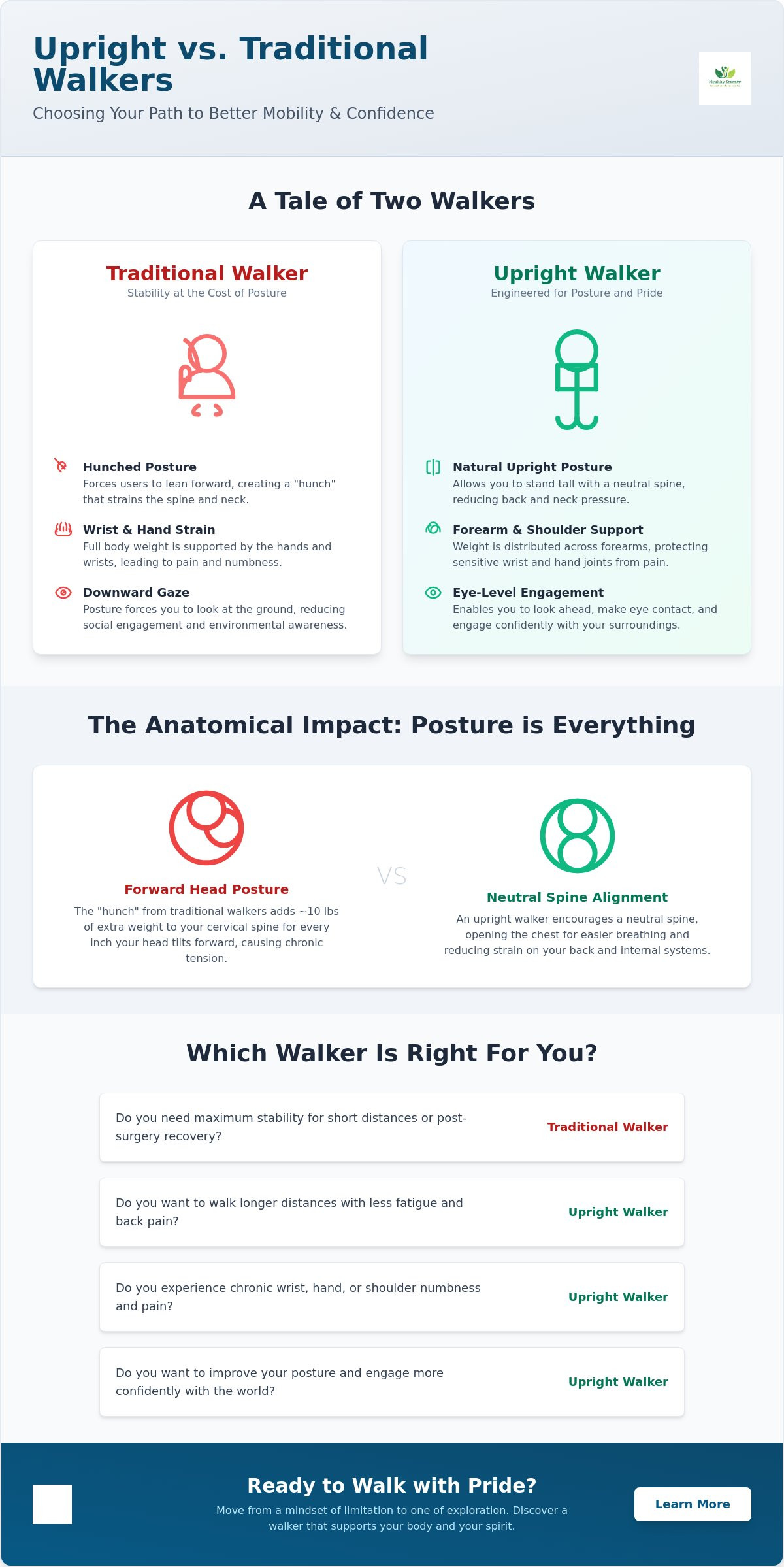
The challenge, however, is often physical. Because the handgrips are positioned at hip level, most users naturally lean forward to find their balance. This creates a "hunch" that puts immense pressure on the lower back and neck. While they're excellent for short distances or navigating tight indoor spaces, using them for long periods can lead to fatigue and wrist strain. They're built for safety, but often at the expense of your posture.
The Upright Walker: A New Perspective on Mobility
The upright walker, sometimes called a posture walker or platform walker, represents a modern evolution in design. Instead of gripping handles at your waist, you rest your forearms in padded cradles at chest height. This simple mechanical shift moves your center of gravity back over your hips, allowing you to stand tall. It's a design that prioritizes your line of sight, making it easier to look ahead and engage with the world around you rather than staring at your feet.
These devices often include specific features designed for long-term comfort:
Padded Forearm Cradles: These distribute your weight across a larger surface area, protecting sensitive joints.
Vertical Handgrips: These allow for a neutral wrist position, which helps prevent the numbness and tingling common with standard grips.
Adjustable Height Tiers: These ensure the frame fits your unique torso length, preventing shoulder shrugging or slouching.
By shifting the weight distribution from your wrists to your forearms, these "stand-up walkers" help eliminate the joint pain that often limits how far you can go. It's a change that doesn't just help you walk; it helps you walk with pride.
Anatomical Impact: How Your Choice Affects Posture and Health
Choosing between an upright walker vs traditional walker isn't just about how you get from point A to point B; it's about how your body feels when you arrive. When you use a standard walker, you're often forced into what specialists call Forward Head Posture (FHP). This "hunch" causes your head to sit several inches in front of your shoulders. For every inch your head tilts forward, it adds roughly 10 pounds of extra weight to your cervical spine. Over time, this creates chronic tension in your neck and upper back, leading to fatigue that often cuts your daily walks short.
The impact of this posture extends down to your lumbar and thoracic spine. Leaning forward compresses your chest cavity, which can subtly restrict your lung capacity and even slow your digestion. By contrast, the upright design encourages a neutral spine. This alignment opens up your chest, making it easier to take deep, life-giving breaths. It's a holistic shift that supports your internal systems while you move, ensuring your mobility aid helps your health rather than hindering it.
Protecting Your Wrists and Shoulders
Traditional walkers require you to grip handles with your hands, placing a heavy burden of your upper body weight directly on your small wrist joints. For those living with arthritis or carpal tunnel, this pressure can be agonizing. Upright models solve this by utilizing forearm platforms. This design distributes your weight across the larger surface area of your arms, which significantly reduces the risk of "walker-induced" tendonitis. It allows you to lean into the support without punishing your joints, making longer excursions feel much more manageable.
The Social and Psychological Edge of Eye Contact
Perhaps the most overlooked benefit of choosing an upright walker vs traditional walker is the psychological shift. Standard walkers often trap you in a "downward line of sight." You spend your walk looking at the floor to avoid tripping, which can make you feel disconnected from your environment. Reclaiming your height through posture correction for seniors does more than just help your back; it restores your confidence. You can finally look friends and family in the eye while you stroll, turning a solitary task into a social experience. If you're ready to see the world from a new perspective, you might want to explore curated mobility solutions that prioritize your dignity as much as your safety.
Practical Comparison: Maneuverability, Terrain, and Daily Use
The choice between an upright walker vs traditional walker often shifts once you move beyond the anatomy of posture and into the reality of daily life. While the health benefits of standing tall are clear, your mobility aid must also function as a practical partner in your home and community. Every doorway, curb, and carpeted hallway presents a different challenge. Finding the right balance between a compact design and outdoor stability is essential for maintaining your active lifestyle without frustration.
Indoor vs. Outdoor Performance
Standard walkers are celebrated for their slim profile. They can easily slide through a narrow 24-inch bathroom door or pivot in a tight kitchen corner where space is at a premium. However, this compact size can sometimes feel less stable on uneven ground. Upright walkers generally have a larger footprint and a wider wheelbase. This design makes them much harder to tip, providing a sense of security when you're crossing a gravel driveway or walking on a grassy path at the park. Many 2026 models also feature "curb-climbing" pedals, which allow you to use your foot to tilt the front wheels over small obstacles without lifting the entire frame. If you're someone who loves the outdoors, these features are a game changer for your independence.
Weight and Transportability
For many seniors, the weight of the device is the deciding factor for daily use. Traditional aluminum walkers are incredibly light, often weighing between 7 and 10 pounds. This makes them easy to toss into a back seat, but they lack the robust features of newer technology. Modern upright rollators are more substantial, typically ranging from 20 to 25 pounds. If you travel frequently or enjoy day trips, looking for lightweight mobility aids for seniors is a wise move. You'll want to ensure you can lift the device into a car trunk or navigate it onto public transit without needing constant assistance.
The ease of transport often depends on the folding mechanism. In 2026, the gold standard is the "one-hand folding" feature. This allows the walker to collapse side-to-side with a simple pull of a seat strap, keeping the device in a standing position even when it's folded. This is incredibly helpful in crowded restaurants or narrow hallways where you don't want your aid to become a tripping hazard for others. Additionally, consider the built-in storage. Upright walkers usually offer larger, enclosed bags that keep your personal items secure and out of sight, whereas traditional walkers often require after-market baskets that can feel clunky or unbalanced.
Decision Framework: Which Walker Is Right for Your Specific Needs?
Deciding between an upright walker vs traditional walker is a personal journey that depends entirely on your daily goals and physical requirements. It's about matching the tool to the life you want to lead. While we've explored the mechanical and anatomical differences, the final choice often comes down to a simple question: what is the primary obstacle between you and your independence? By evaluating your specific health conditions and living environment, you can select the aid that feels like a natural extension of your body.
Who Should Choose a Traditional Walker?
Traditional walkers remain the gold standard for those in the early stages of post-operative recovery. If you've recently had a hip or knee replacement, the high level of stability provided by a standard frame is often necessary while you regain your initial strength. These models are also ideal for individuals living in very small environments, such as studio apartments or assisted living suites with tight bathroom turns. When "simple is better," a traditional walker offers a straightforward braking system and a lightweight frame that is easy to manage for those with cognitive considerations or those who primarily need a "lifting" aid to help them stand from a seated position.
Who Should Choose an Upright Walker?
The upright walker is the premium choice for the active senior who refuses to let chronic pain dictate their schedule. It's particularly beneficial for individuals managing long-term conditions like Parkinson’s, Multiple Sclerosis, or chronic lower back pain. If your goal is to enjoy long strolls through the neighborhood or attend outdoor community events, the forearm support allows you to walk further with less fatigue. This model is designed for those who prioritize their long-term joint health and want to maintain a confident, forward-facing perspective on the world.
Making the switch often involves a short learning curve. Many users wonder if the sturdier frame will be too heavy to manage. While an upright model has more substance, its weight is distributed for better balance. It usually takes about a week of consistent use to feel fully "at home" with the new height and forearm engagement. During this transition, focusing on how to improve mobility in seniors through gentle core exercises can help you feel more stable. If you're ready to reclaim your posture and walk with renewed energy, you can explore our curated selection of mobility aids to find the perfect fit for your lifestyle.
The 2026 Gold Standard: Why the VOCIC Upright Walker Leads the Way
As we weigh the benefits of an upright walker vs traditional walker, it's clear that the right technology can transform your daily experience. The VOCIC Upright Walker for Seniors has emerged as a leader in this space, specifically designed to address the posture and comfort issues that often limit independence. It isn't just a frame; it's a carefully engineered tool that supports your desire for an active, upright life. This model serves as the cornerstone of our curated best upright walkers for seniors list because it balances professional-grade stability with a warm, lifestyle-focused design.
Choosing the right aid often comes down to the details that make daily use a pleasure rather than a chore. While the general debate of an upright walker vs traditional walker highlights broad differences, the VOCIC model solves specific pain points through thoughtful innovation. It's built for the senior who values their vitality and refuses to let a mobility challenge dampen their spirit.
Premium Features for Independence
Independence requires a device that fits your unique body perfectly. The VOCIC model features height-adjustable tiers that accommodate a wide range of users, ensuring that whether you're petite or tall, your shoulders remain relaxed and your spine stays neutral. The forearm cradles are lined with high-density foam padding. This choice prevents the skin irritation and joint pressure that can occur with lower-quality materials during long walks. Additionally, the integrated storage bag and user-friendly accessories ensure you can carry your essentials securely, making daily errands feel effortless and organized.
Safety and Reliability
Safety is the foundation of confidence. VOCIC utilizes a stability-first wheelbase design that is specifically engineered to prevent the forward-tipping risk sometimes associated with taller mobility aids. This is paired with a sophisticated dual-braking system for total control. You can use the feather-touch triggers for immediate speed management on inclines, while the loop locks provide a secure parking brake when you need to rest on the built-in seat. Beyond the home, the all-terrain wheels handle transitions from paved sidewalks to gravel paths with ease. It's this commitment to reliability that has made VOCIC the trusted choice for Healthy Seventy community members who seek a holistic approach to their well-being and social freedom.
Reclaiming Your Stride and Perspective
Choosing the right mobility aid is a profound step toward preserving your vitality and independence. We've explored how the anatomical shift of an upright walker vs traditional walker can alleviate chronic neck and back pain by restoring your natural alignment. Whether you prioritize the lightweight agility of a standard frame or the advanced forearm support of a posture-focused model, your decision should center on how you want to feel at the end of each day. It's about more than just movement; it's about looking forward with clarity and social dignity.
You deserve a solution that honors your journey and supports your long-term joint health. Our resources are expertly curated for seniors 70+ to ensure every tool leads to a more vibrant lifestyle. As a trusted partner for the Healthy Seventy community, we're dedicated to helping you find the perfect fit for your needs. Discover the VOCIC Upright Walker for Seniors today and take the first step toward a more comfortable future. You have many more horizons to explore, and we're here to help you reach them.
Frequently Asked Questions
Is an upright walker safer than a traditional rollator?
Safety depends on your specific balance needs and where you plan to walk. While upright walkers improve your line of sight and prevent the hunched posture that causes neck strain, they do have a higher center of gravity. Traditional rollators are often more stable on steep inclines or very uneven ground. However, for many seniors, the ability to look forward rather than at the floor makes the upright model a safer option for avoiding trips and obstacles.
Can I use an upright walker inside a small apartment?
You can use an upright walker in an apartment, but it's wise to measure your doorways first. These models typically have a wider wheelbase than standard frames, which can make navigating narrow bathroom doors or tight kitchen corners a bit of a challenge. If your living space is very compact, the smaller footprint of a traditional walker might be more practical for moving through confined indoor areas without scuffing your furniture.
Does Medicare or insurance cover the cost of an upright walker?
Medicare Part B generally covers 80 percent of the approved cost for both traditional and upright walkers as Durable Medical Equipment. In 2026, the annual Part B deductible is $283. Once you've met this amount, you're responsible for the remaining 20 percent of the cost. You'll need a prescription from a Medicare-approved doctor stating that the device is medically necessary for use inside your home to qualify for this coverage.
How do I know what height to set my upright walker armrests at?
Your armrests should be set at a height that allows your elbows to bend at a natural 90 degree angle. When standing inside the frame, your forearms should rest comfortably in the cradles without causing your shoulders to shrug upward or your back to lean forward. This neutral position is key to the health benefits of an upright walker vs traditional walker, as it protects your spine and prevents unnecessary joint pressure.
Are upright walkers too heavy for a senior to lift into a car?
Upright walkers are generally heavier than traditional aluminum models, typically weighing between 20 and 25 pounds. While many feature a convenient folding mechanism for transport, you should consider your own lifting strength before purchasing. If you often travel alone and find lifting a 25 pound object into a trunk difficult, it's helpful to have a family member assist you or look for models specifically designed with lightweight frames.
What is the weight capacity for a standard VOCIC upright walker?
The standard weight capacity for a mobility aid like the VOCIC model is typically between 250 and 300 pounds. This range is designed to provide stable support for most users while maintaining the structural integrity of the frame during daily use. If you require a higher capacity, bariatric models are available that can support up to 500 pounds, ensuring that every individual has access to a tool that feels safe and reliable.
Can an upright walker help with my chronic lower back pain?
An upright walker can significantly reduce chronic lower back pain by correcting the forward-leaning "hunch" common with older designs. By shifting your weight to your forearms, the device allows you to stand with a straight, neutral spine. This alignment reduces the pressure on your lumbar region and neck, which is a major factor when comparing an upright walker vs traditional walker for long-term comfort and joint preservation.
Do upright walkers work well on carpeted floors?
Upright walkers work well on most carpeted surfaces, especially those with a low to medium pile. Because they often feature larger, all-terrain wheels, they can glide more easily over rugs than standard walkers with small, thin wheels. You might find that very thick or shaggy carpeting requires a bit more effort to navigate. It's always a good idea to test the device in your most-used rooms to ensure you feel confident moving between different floor types.


Comments