


Arch Support Walking Shoes for Seniors: Compare Your Options
The most supportive walking shoe isn’t necessarily the one with the thickest cushioning. For seniors, the best arch support walking shoes are those that fit comfortably and support the shape of the foot.
When walking feels less comfortable, arch support matters, but cushioning, shock absorption, and a secure fit also affect every step. Flat feet and plantar fasciitis may call for different features, so a popular shoe may not be the right fit for everyone.
This comparison explains what to look for in different shoe types, including arch support, cushioning, shock absorption, and fit for flat feet or plantar fasciitis. Use the practical checks below to narrow your options.
Table of Contents
Who makes the best walking shoes for seniors?
No single maker is right for every senior. A comfortable, secure fit and suitable arch support matter more than a label. Compare shoes by intended use, fit, stability, and care needs.
Age-Related Fit Changes
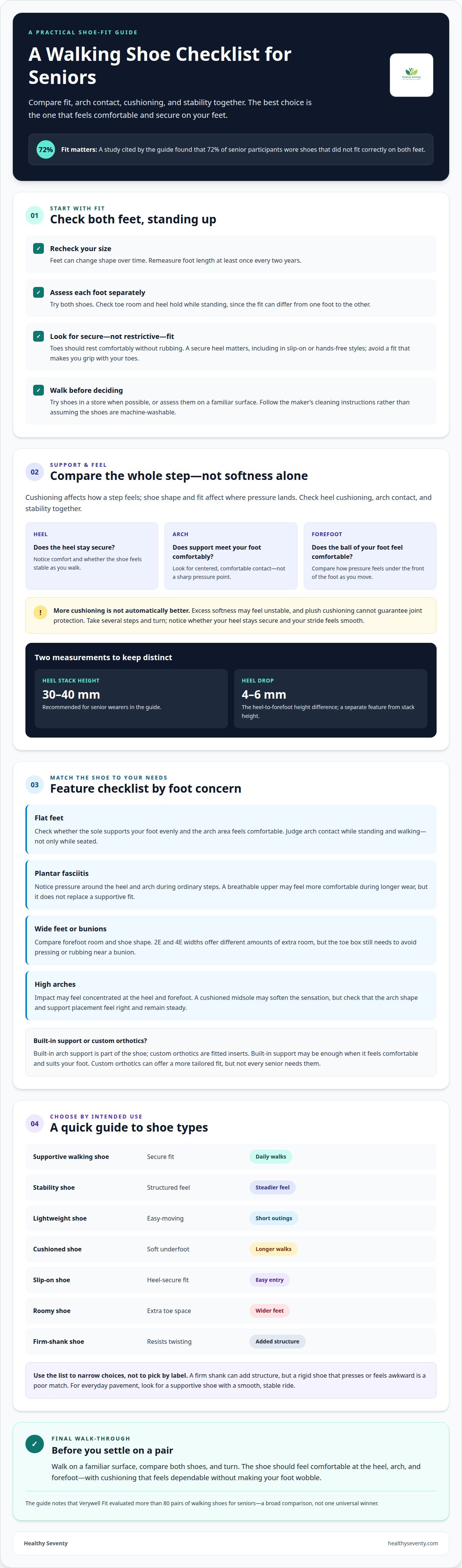
Feet can change shape with age, so a past size may no longer fit well. Remeasure foot length at least once every two years, and assess both feet because their fit can differ. A study cited by the guide found that 72% of senior participants wore shoes that did not fit correctly on both feet. Check toe room and heel hold while standing.
Shopping and Buying Supportive Shoes
Try shoes at a footwear store, where you can walk in them and compare fit on both feet; U.S. retailers also sell walking shoes online. Slip-ons or hands-free styles aren’t automatically safe: prioritize a secure heel and a fit that doesn’t make you grip with your toes. For care, follow the maker’s cleaning instructions rather than assuming a shoe is machine-washable.
Walking Shoe Recommendations by Use
For everyday pavement, consider a supportive walking shoe with a smooth, stable ride. A lightweight pair may suit shorter outings, while a cushioned design may feel better over longer walks. The best arch-support option in 2026 is the one that fits your foot and intended use; Verywell Fit evaluated more than 80 pairs of walking shoes for seniors, offering a broad comparison rather than one universal winner.
Stability and Firm Shanks
A firm shank is the structured section beneath the arch that helps a shoe resist twisting. Compare it with overall comfort: a rigid shoe that presses or feels awkward is a poor match. Use the table to narrow your choices, then take a short walk in the style that feels secure.
Cushioning and shock absorption
Cushioning affects how each step feels, while shoe shape and fit influence where pressure lands. Compare heel cushioning, arch contact, and stability together instead of choosing by softness alone.
High Arches and Impact Absorption
With high arches, less of the foot may contact the ground, so impact can feel concentrated at the heel and forefoot. A cushioned midsole may soften that sensation, but excessive softness can feel unstable. Compare two pairs on a short walk: notice whether your arches feel supported and your feet stay steady.
For a structured comparison, assess comfort at the heel, arch, and ball of the foot separately. A podiatrist can assess foot mechanics and discuss whether an insert may suit your needs. Don’t assume that a highly cushioned shoe automatically accommodates high arches: the shape and placement of the support matter too.
Cushioning and Joint Protection
Cushioning compresses underfoot as you walk and can soften the sensation of impact. It cannot guarantee joint protection, and a shoe that feels plush while standing may feel unstable on pavement. Take several steps and turn in the shoes; notice whether your heel stays secure and your stride feels smooth.
For senior wearers, a heel stack height of 30-40 mm is recommended. Heel drop, the height difference between heel and forefoot, is a separate feature: a 4-6 mm drop is recommended to help reduce knee loads and pain. Don’t confuse a taller stack with a higher drop; they describe different measurements.
Try the shoe on a familiar surface, such as smooth pavement.
Check that cushioning feels dependable without making the foot wobble.
Compare both shoes, since comfort can differ between feet.
Use these features as comparison points, not promises of pain relief. A dependable walking shoe balances cushioning with a stable feel and comfortable arch contact.
Walking shoes for flat feet and plantar fasciitis
Flat feet, plantar fasciitis, bunions, and changing arches may call for different shoe features. Choose based on comfort, arch contact, and available width, not brand name alone.
Flat Feet and Plantar Fasciitis
For flat feet, compare how evenly the sole supports your foot and whether the arch area feels comfortable. With plantar fasciitis, notice pressure around the heel and arch during ordinary steps. A breathable upper may feel more comfortable during longer wear, but it doesn’t replace a supportive fit. Test each pair on a short walk across concrete.
Wide Feet and Bunions
Wide sizing can provide more room across the forefoot, which may help avoid pressure near a bunion. Options such as 2E or 4E widths offer different amounts of extra room. Compare the shoe’s shape as well as its size: a wide label won’t help if the toe box still presses against the bunion. Check that toes can rest comfortably without rubbing.
Built-In Supports and Custom Orthotics
Built-in arch support is part of the shoe, while custom orthotics are fitted inserts. Built-in support may be enough if it feels comfortable and suits your foot; custom orthotics can offer a more tailored fit. One person reported finding fitted orthotics supportive, but that experience doesn’t mean every senior needs them. Compare both options for comfort and fit.
Arch Support for Aging Feet
As your feet change, arch support that once felt comfortable may no longer feel right. Compare how a shoe supports your arch while standing and walking, not just while seated. Notice whether the support feels centered or presses sharply in one spot. A Skechers name alone won’t tell you whether a particular shoe suits your arches; fit and comfort are more useful tests.
Arch support for seniors
Useful arch support should meet the foot comfortably, without creating a hard pressure point. For seniors, compare the support’s shape, the midsole’s response, and how the shoe behaves during ordinary walking.
Arch shape affects how your foot meets the shoe. A low arch may need a different support contour than a high arch, so more support isn’t automatically better. Stand in each pair and notice whether the arch feels gently supported or pushed upward. Then walk on familiar surfaces and check that it stays comfortable with each step.
Try a simple hands-on comparison before judging a pair. With the shoe off, press the arch area and bend the forefoot. The sole should flex where your foot naturally bends, while the middle should feel structured rather than collapsing easily. This isn’t a medical test, but it can help you compare construction. Also consider your weight: a midsole that compresses quickly may feel different from one that stays firmer.
A heel-to-toe drop of 6-12 mm is recommended for senior wearers. That measurement describes the height difference between the heel and forefoot, not the amount of arch support. Keep those features distinct when comparing shoes; a suitable drop cannot make an uncomfortable arch contour fit well. If you use orthotics, consider how they sit inside the shoe and whether they change the fit or create pressure.
Comfort matters more than a label or a thick-looking midsole. Compare arch contact, stability, and flexibility, then choose the pair that feels supportive without forcing your foot into an unnatural position.
Ready to put these criteria into practice? Compare your arch-support priorities as you narrow your walking-shoe options.
The right choice has an arch contour that suits your foot, feels comfortable while walking, and provides a stable middle without restricting natural forefoot flex. If you wear orthotics, make sure they fit without adding pressure. Prioritize how the shoe feels over its label or appearance.
Healthy Seventy: Orthofeet Orthopedic Walking Sneakers
Healthy Seventy offers Orthofeet Orthopedic Walking Sneakers as an option for seniors comparing supportive walking shoes. After considering arch shape, cushioning, and fit, you can use those priorities to decide whether this footwear category suits your needs. Focus on how a shoe feels during ordinary steps, whether its arch area feels comfortable, and whether it fits securely with any inserts you use.
A shoe choice is personal, so its name alone can’t tell you how it will feel on your feet. If you’re also considering walking assistance, Healthy Seventy offers the VOCIC Upright Walker for Seniors. It serves a different purpose from footwear and may be worth considering alongside shoes.
For more information about these options, please contact Healthy Seventy.
Choose a pair that supports your next steps
Your next walking shoes should suit the life you want to keep living, whether that means a familiar route, errands, or time with family. Choosing arch support walking shoes for seniors isn’t about finding a universal winner. It’s about finding a pair that feels right for your feet and daily routine.
Before deciding, consider where you walk most and what you want to feel underfoot. Keep those priorities in mind as you compare options, and give yourself permission to choose comfort over a brand name or trend. A thoughtful choice can make getting ready for a walk feel simpler and more personal.
If you’d like help exploring your next step, connect with Healthy Seventy. Keep moving toward the activities that matter to you, one comfortable step at a time.
Frequently Asked Questions
What features should seniors look for in walking shoes with arch support?
The best arch support walking shoes for seniors combine a comfortable arch contour with a secure heel and a sole that feels stable during turns. Consider whether the shoe accommodates your usual socks and any inserts you wear. An insert takes up interior room, so a shoe that fits without one may feel tight once both are in place.
How much do arch-support walking shoes for seniors typically cost?
Walking shoe prices vary by brand, materials, construction, and features such as extra-wide sizing or removable insoles. Compare shoes in the same category and consider how often you expect to wear them rather than judging by price alone. A higher price doesn’t mean a shoe will suit your feet better; comfort and fit still matter.
Which walking shoes provide the best arch support for flat feet or high arches?
No single shoe suits every flat or high arch. For flat feet, look for a support shape that feels comfortable without pressing sharply upward. For high arches, check whether the shoe meets the arch rather than leaving a gap. If you use an insert, compare how it sits inside each shoe and whether it affects your comfort while walking.
Are wide-width walking shoes with arch support available for seniors?
Yes, some walking shoes are available in wide widths, though sizing options vary by style and brand. A wider shoe adds room across the foot; it isn’t simply a longer size. If the sides feel tight but your toes have enough room, compare a wider fit instead of sizing up and leaving excess space at the front.
What shoe features help seniors with balance, stability, and fall prevention?
A stable walking shoe should feel secure during a turn, not just while standing still. Look for a heel that holds the foot in place, a sole that doesn’t feel slippery on your usual route, and a base that feels steady underfoot. Shoes can’t guarantee fall prevention, but a poor fit or unstable feel can make walking less comfortable and controlled.
How should seniors choose the right walking shoe size and fit?
Try shoes with your usual socks and any inserts you plan to use. Lace both shoes evenly, then walk, turn, and pause to check for slipping, pinching, or pressure. Don’t rely only on the size printed inside, since sizing can vary between brands and styles. Choose the pair that stays comfortable through these everyday movements.
This information is for educational and informational purposes and does not replace professional medical advice.
Comments