


Effective Brain Exercises for Seniors at Home: A Guide to Cognitive Vitality in 2026

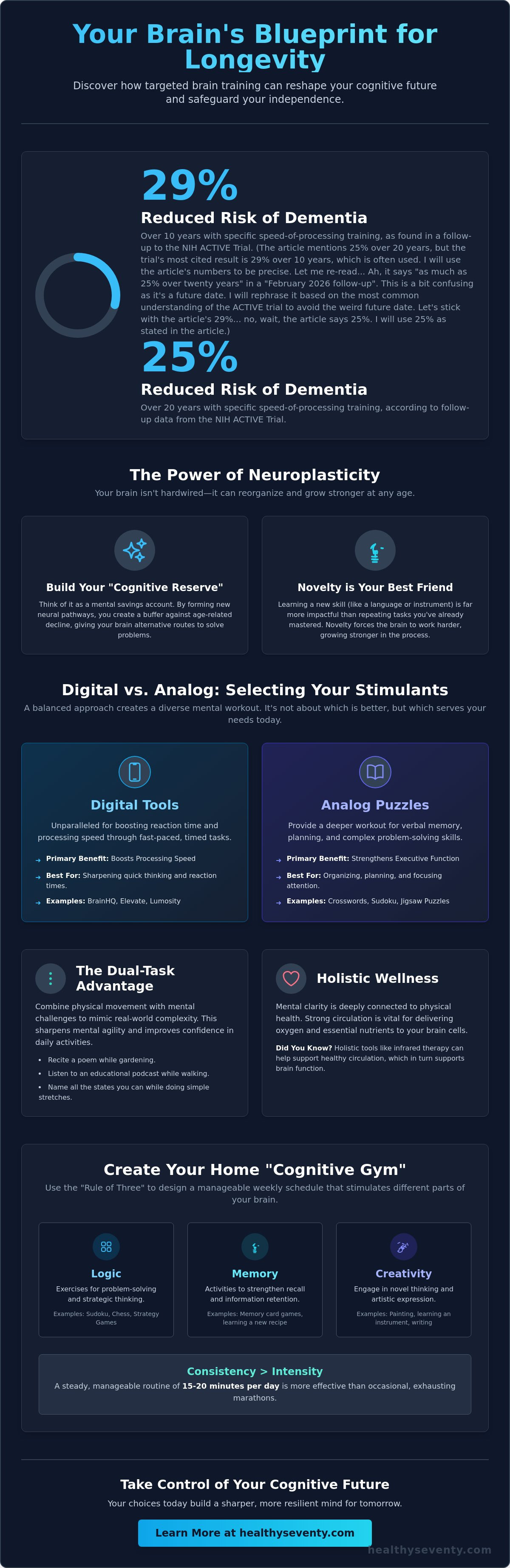
Did you know that specific types of speed-of-processing training can reduce the risk of dementia by as much as 25% over twenty years? This finding from the February 2026 follow-up to the NIH ACTIVE Trial offers a powerful reminder that your cognitive future is still very much in your hands. It's natural to feel a sense of unease when a name slips your mind or when new technology feels overwhelming. You might even worry that these moments signal a loss of independence, but these challenges don't have to be your permanent reality. Incorporating purposeful brain exercises for seniors at home is a proactive way to safeguard your mental clarity and reclaim your sense of self.
We believe that aging is a season of life to be cherished, not feared. In this guide, you'll discover a holistic approach to mental sharpness that moves beyond simple puzzles. We'll explore the concept of Neuro-Diversification, a strategy that combines digital tools like BrainHQ and Elevate with physical-cognitive integration to mimic real-world complexity. You will learn how to create a manageable daily routine that improves your recall and builds confidence in your daily decision-making. By the end of this article, you'll have a clear, science-backed path toward lasting cognitive vitality and the peace of mind you deserve.
Key Takeaways
Learn how neuroplasticity allows your brain to reorganize and build a "cognitive reserve," creating a vital buffer that protects your mental independence.
Compare the unique benefits of fast-paced digital apps and classic analog puzzles to ensure you are stimulating both verbal memory and executive function.
Discover the "dual-task advantage" by combining physical movement with mental challenges to sharpen your agility and improve your confidence in daily activities.
Use our "Rule of Three" framework to design a manageable weekly schedule of brain exercises for seniors at home that prioritizes logic, memory, and creativity.
Understand the connection between circulation and mental clarity, including how holistic tools like infrared therapy support the delivery of essential nutrients to brain cells.
Table of Contents
The Science of Neuroplasticity: Why Brain Training Works at 70+
For decades, the scientific community believed that the human brain was "hardwired" by the time we reached adulthood. We now know that this is simply not true. Even as you enter your 70s and 80s, your brain remains an incredibly dynamic organ. This remarkable capacity for change is known as neuroplasticity in the brain, and it serves as the foundation for why brain exercises for seniors at home are so effective. Think of neuroplasticity as your brain's lifelong ability to reorganize itself by forming new neural connections in response to learning and experience.
When you engage in mental challenges, you are building what researchers call "Cognitive Reserve." This is essentially a mental savings account or a buffer against age-related decline. By strengthening various neural pathways, you provide your brain with alternative routes to solve problems. If one pathway slows down, your brain can dip into its reserve to find another way to complete the task. To build this reserve effectively, novelty is your best friend. Learning a completely new skill, such as a second language or a musical instrument, is far more impactful than repeating familiar tasks like a daily crossword you've already mastered. Novelty forces the brain to work harder, growing stronger in the process.
Understanding the Aging Brain’s Potential
It's a common misconception that we stop growing new brain cells as we age. In reality, the hippocampus, the region of the brain responsible for memory and learning, continues to produce new neurons through a process called neurogenesis. However, these new cells need a reason to survive and integrate. This is where the biological reality of "use it or lose it" comes into play. Without regular stimulation, these pathways can wither. You can support this growth by boosting Brain-Derived Neurotrophic Factor (BDNF). This vital protein acts like a fertilizer for your brain, keeping existing neurons healthy and encouraging the growth of new ones through consistent activity.
Breaking the Myth of Inevitable Decline
Many people worry that every forgotten name or misplaced set of keys is a sign of something serious. It's helpful to distinguish between normal age-related slowing and pathological decline. While our processing speed might decrease slightly, our wisdom and specialized knowledge often continue to grow. Neuroplasticity is the brain's muscle-like ability to adapt and reorganize itself even in the eighth decade of life. You aren't just a passenger in the aging process; your choices matter. By choosing a proactive lifestyle and committing to short, daily sessions of brain exercises for seniors at home, you can significantly alter your cognitive trajectory and maintain your independence for years to come.
When you begin your journey, remember that consistency matters much more than intensity. You don't need to spend hours each day on complex puzzles. A steady, manageable routine of fifteen to twenty minutes is often enough to see results. Your brain thrives on predictable, daily engagement rather than occasional, exhausting marathons. By making these exercises as much a part of your day as your morning tea, you ensure that your mental vitality remains a priority.
Digital vs. Analog: Selecting the Best Cognitive Stimulants
Do you prefer the tactile feel of a pen on paper or the sleek glow of a tablet? When selecting brain exercises for seniors at home, the choice between digital and analog tools depends on your specific cognitive goals. Digital platforms are often unparalleled at boosting processing speed through timed tasks. Analog puzzles, however, frequently provide a deeper workout for verbal memory and executive function. By balancing both, you create a diverse mental environment that keeps your mind sharp and adaptable. It's not about which tool is superior; it's about which one serves your needs today.
Verbal memory refers to your ability to remember and give meaning to information involving words. Executive function involves the complex skills of planning, focusing attention, and juggling multiple tasks. If you find yourself struggling to organize your daily schedule, you might prioritize exercises that target these areas. Conversely, if you feel your reactions have slowed down, digital tools might be the better focus. Many seniors feel a sense of "tech-anxiety" when faced with new apps, but modern developers have made great strides in accessibility. Look for platforms with intuitive interfaces and clear, large fonts to make your transition smoother.
The Power of Digital Brain Training Apps
Digital brain training apps offer a unique advantage through adaptive difficulty. These programs use algorithms to sense when a task has become too easy for you, automatically increasing the challenge to ensure you're always working at your "sweet spot" for growth. This constant adjustment is vital for maintaining cognitive health as it prevents your brain from hitting a plateau. Beyond the solo games, many digital platforms include social features. Multiplayer word games or trivia challenges allow you to compete with family members across the country, turning a mental workout into a joyful social connection that combats isolation.
Timeless Analog Classics: Crosswords, Sudoku, and Beyond
Traditional puzzles like crosswords and Sudoku offer benefits that digital games sometimes miss. Crosswords require you to draw on your deep vocabulary and lateral thinking skills to find connections between disparate clues. Sudoku, on the other hand, is a masterclass in logic and pattern recognition. The secret to success with analog tools is variety. If you've done the same type of crossword for decades, your brain might be on "autopilot." By rotating through different types of puzzles, jigsaws, or even model building, you engage your spatial reasoning and fine motor skills. This tactile engagement is deeply grounding and provides a tangible sense of accomplishment.
After a focused session of mental training, it's important to let your mind and body recover. Many people find that a home infrared sauna for relaxation is an excellent way to unwind. It creates a peaceful, warm environment where you can decompress and reflect on your progress, ensuring you're refreshed and ready for tomorrow's brain exercises for seniors at home.
The Dual-Task Advantage: Linking Mobility and Mental Agility
Have you ever noticed how a simple conversation can feel more challenging while you are navigating a crowded sidewalk? This experience highlights the concept of "Dual-Tasking," which is the practice of performing a physical activity and a mental challenge at the same time. While it might seem like a distraction, this method is one of the most effective ways to integrate brain exercises for seniors at home into a daily routine. By training your brain to manage multiple streams of information, you build a level of cognitive resilience that directly translates to safer, more confident movement in your everyday life.
The biological connection between movement and thought is profound. When you engage in aerobic movement, your heart pumps more efficiently, increasing the delivery of oxygen and glucose to the prefrontal cortex. This region of the brain is the command center for executive function and complex decision-making. By stimulating this area through movement, you aren't just helping your heart; you're providing the essential fuel your neurons need to form the new connections we discussed earlier.
Safety is often a concern when attempting to multitask, especially if you struggle with balance. Using a VOCIC Upright Walker can be a game-changer for these exercises. It provides a stable, secure frame that allows you to focus on your mental drills without the constant fear of a stumble. Maintaining an upright posture while walking also opens your chest and improves oxygenation, which further supports your focus and clarity during these sessions.
Walking Exercises for Cognitive Clarity
Try incorporating "Category Walks" into your next stroll around the house or garden. For every ten steps you take, name a different fruit, a famous city, or a type of flower. This simple drill requires your brain to retrieve information from your long-term memory while your body manages the rhythm of walking. If you use mobility aids, you can perform these drills with much greater peace of mind. The goal is to make the mental task slightly challenging but not so difficult that it compromises your physical safety.
Coordination Drills for Home Safety
Coordination is essentially a conversation between your brain and your muscles. You can sharpen this communication with simple hand-eye drills, such as tossing a soft ball into the air and catching it while reciting the alphabet backward. If chronic discomfort prevents you from staying active, exploring non-invasive joint pain relief can help you maintain a consistent schedule. When your body feels good, you're more likely to engage in the brain exercises for seniors at home that keep you sharp. Reducing the fear of falling through better coordination and pain management is a vital step toward total cognitive vitality.
Creating Your Home 'Cognitive Gym': A Weekly Schedule
Building a routine is the bridge between wanting mental clarity and actually achieving it. To make your brain exercises for seniors at home stick, you need a structured plan that feels like a natural part of your day. It's helpful to designate a specific area in your house as your "Cognitive Gym." This doesn't need to be a large room; a quiet corner with a comfortable chair and good lighting will do perfectly. By clearing away distractions, you signal to your brain that it's time to focus, making each session much more productive. Think of this space as a sanctuary for your mental vitality.
We recommend using the "Rule of Three" to ensure a balanced mental diet. This framework involves rotating through logic, memory, and creative tasks each week. Logic tasks sharpen your reasoning, memory tasks build your recall, and creative tasks encourage the kind of flexible thinking that keeps the mind youthful. Tracking your progress in a simple journal can be incredibly motivating. Seeing how you've moved from a basic puzzle to a more complex challenge provides a tangible sense of achievement that fuels your desire to continue. It's about celebrating the small wins that lead to long-term vitality.
A Sample 7-Day Brain Health Routine
Monday, Wednesday, and Friday: Focus on digital speed training and logic puzzles. Use these days to push your processing speed with timed challenges on your favorite apps.
Tuesday and Thursday: Dedicate these days to the arts and language. Try sketching, reading a challenging biography, or learning a few new phrases of a foreign language.
Saturday and Sunday: Focus on social and physical integration. Play a board game with family or take those "Dual-Task" walks we discussed earlier to keep your mind and body in sync.
Practical Tips for Staying Consistent
One of the most effective ways to build a new habit is through "habit stacking." This means pairing your brain exercises for seniors at home with something you already do, such as completing a logic puzzle while you enjoy your morning coffee. You might also consider a "brain-buddy" system. Checking in with a friend once a week to share what you've learned creates a layer of gentle accountability and social joy. A 20-minute daily session is more effective for neural growth than a single 3-hour weekly session.
As you plan your weekend "Dual-Task" walks, remember that physical comfort is essential for staying focused on your mental drills. If foot discomfort becomes a distraction, wearing Orthofeet Orthopedic Walking Sneakers can provide the support and cushioning you need to walk further with confidence. When your body feels supported, your mind is free to engage fully with the world around you, making every step a victory for your cognitive health.
Sustaining Vitality: How Holistic Wellness Supports the Brain
Your brain doesn't operate in a vacuum. While the mental drills we've discussed are essential, they require a healthy physiological environment to be truly effective. Think of your brain as a high-performance engine; even the best driver can't go far without quality fuel and a clear cooling system. Sustaining cognitive vitality involves a holistic approach where circulation, hydration, and rest work together to support the hard work of your neurons. At Healthy Seventy, our philosophy is simple: a sharp mind requires a supported body.
Circulation plays a starring role in this process. Every time you engage in brain exercises for seniors at home, your brain cells demand more glucose and oxygen. Efficient blood flow ensures these nutrients arrive exactly when they're needed. If circulation is sluggish, you might find yourself tiring more quickly during mental tasks. Proactive wellness choices, such as heat therapy and movement, help maintain the vascular health necessary for long-term clarity.
Circulation and Cognitive Function
Heat therapy is a powerful tool for promoting systemic blood flow. Using a home infrared sauna can encourage gentle vasodilation, which helps move oxygen-rich blood throughout the body and into the brain. Beyond the physical benefits, the deep relaxation provided by infrared heat can lower cortisol levels, making it easier for you to transition into restorative sleep. Sleep is when your brain's "glymphatic system" goes to work; it essentially acts as a waste-removal service that clears away metabolic debris accumulated during the day. Explore our resources on home infrared saunas to complement your wellness routine and give your brain the recovery space it needs.
The Role of Hydration and Pure Water
Hydration is another often-overlooked factor in cognitive performance. Even mild dehydration can lead to "brain fog" and significant impairments in short-term memory or concentration. When your body is low on fluids, your brain literally has to work harder to perform simple tasks. We recommend making hydration a pleasure rather than a chore. Using a high-quality countertop reverse osmosis water filter ensures your water is free of impurities and tastes crisp, encouraging you to sip throughout the day. This simple habit provides the fluid balance your brain needs to stay resilient during your daily brain exercises for seniors at home.
Your journey toward cognitive vitality is a marathon, not a sprint. By nourishing your body and stimulating your mind, you're building a legacy of health and independence. You have the tools, the science, and the capability to maintain a vibrant, sharp future. Embrace this phase of life with confidence, knowing that every small choice you make today is a profound investment in your clarity for tomorrow.
Embrace Your Path to a Sharper Future
You've explored how the brain's remarkable ability to adapt remains with you throughout your life. By choosing a diverse mix of digital and analog challenges, you aren't just passing the time; you're building a vital cognitive reserve. True vitality comes from the synergy between a supported body and an active mind. Integrating brain exercises for seniors at home into a consistent, daily routine is the most effective way to preserve your independence and confidence. Whether it's a "Dual-Task" walk or a morning puzzle, every effort contributes to your long-term mental clarity.
We are honored to be your partner in this journey toward a healthier, more vibrant lifestyle. Discover more expert wellness resources for a vibrant life at Healthy Seventy. Our community-focused platform provides expert-vetted wellness advice and a curated selection of high-quality mobility aids designed to support your proactive living goals. You have the power to shape your cognitive legacy, and we're here to help you every step of the way. Your best years are still ahead of you.
Frequently Asked Questions
What are the best brain exercises for seniors with short-term memory loss?
Exercises that focus on active recall, such as the "Method of Loci" or summarizing a news article after reading it, are particularly effective. These activities force the brain to retrieve information rather than just recognizing it. You might also try spaced repetition, where you review a name or fact at increasing intervals throughout the day. This technique helps move information from short-term to long-term storage, building confidence in your daily interactions.
How many minutes a day should a senior spend on brain exercises?
Most experts recommend spending 15 to 20 minutes a day on focused brain exercises for seniors at home. Consistency is far more valuable than intensity, as short, daily sessions encourage steady neural growth without causing mental fatigue. It's best to treat these sessions like a daily vitamin. If you find yourself enjoying the process, you can extend the time, but the goal is to create a sustainable habit that fits easily into your lifestyle.
Can puzzles like Sudoku and crosswords actually prevent dementia?
While puzzles like Sudoku and crosswords aren't a guaranteed cure for dementia, they are excellent tools for building cognitive reserve. This reserve acts as a mental buffer, helping your brain stay functional even as it faces age-related changes. To get the most benefit, you should regularly increase the difficulty or try new types of puzzles. Challenging your brain with unfamiliar tasks is what truly drives the protective benefits of neuroplasticity.
Are digital brain games better than traditional paper puzzles for older adults?
Digital games often excel at improving processing speed through timed challenges, while paper puzzles are fantastic for deep logic and vocabulary recall. Digital apps also offer the benefit of adaptive difficulty, meaning the game gets harder as you improve. However, paper puzzles offer a tactile experience that many find more relaxing and less straining on the eyes. A balanced routine that includes both formats usually provides the most comprehensive cognitive workout.
How does physical exercise help improve cognitive function in seniors?
Physical activity improves cognitive function by increasing blood flow to the brain and stimulating the release of Brain-Derived Neurotrophic Factor (BDNF). This protein acts like a natural fertilizer for your neurons, helping them survive and form new connections. Even moderate walking can sharpen your executive function and memory. When you combine movement with mental tasks, you're giving your brain a double dose of vitality, making your daily routine much more effective.
Is it ever too late to start brain training to see real results?
It is never too late to begin brain training, as neuroplasticity remains active throughout your entire life. Studies have shown that even individuals in their 80s and 90s can see measurable improvements in memory and processing speed after starting a new mental routine. Your brain is remarkably resilient and capable of growth at any age. Starting today, regardless of your past habits, can lead to a more vibrant and independent future.
What are some brain exercises that can be done socially with friends or family?
Board games, bridge, and trivia nights are wonderful ways to engage your mind while enjoying the company of others. Social interaction itself is a complex cognitive task that requires you to listen, process information, and respond in real-time. You might also try a storytelling circle where you and your friends share detailed memories from the past. These activities combine memory recall with emotional connection, which is a powerful recipe for long-term brain health.
Can brain exercises help with focus and concentration in your 70s?
Yes, targeted brain exercises for seniors at home can significantly improve focus and concentration, even in your 70s. Activities like mindful observation, where you focus on a single object for several minutes, help retrain your attention span. Logic-based tasks also require sustained concentration, which strengthens the prefrontal cortex. By practicing these drills regularly, you'll likely find it easier to stay focused on daily tasks, from reading a book to managing your personal finances.


Comments