


Empowering Your Journey: A 2026 Guide to Mobility Equipment for Independent Living
Updated: Sep 16

What if the tools you once perceived as signs of slowing down were actually the keys to unlocking your most vibrant and active years? For many, the thought of introducing mobility equipment for independent living into the home feels like a surrender of autonomy. You might worry about complex clinical jargon or equipment that looks better suited for a hospital ward than your own living room. It's a common concern, and your desire to maintain a home that reflects your personality and your strength is completely valid.
We believe that aging is a cherished phase of life that deserves to be lived with confidence and grace. In this 2026 guide, you'll discover how the right combination of physical aids and modern wellness technology can preserve your autonomy while preventing falls. We will walk you through a curated selection of reliable products, from smart walkers to advanced recovery tools, that fit seamlessly into a sophisticated lifestyle. By the end of this article, you'll have a clear roadmap for staying active, safe, and entirely in control of your journey.
Table of Contents
What is Mobility Equipment for Independent Living in 2026?
In 2026, the way we perceive aging has undergone a profound transformation. We no longer view assistance as a sign of decline, but as a strategic choice for sustained vitality. The modern mobility ecosystem is a holistic blend of physical aids, environmental safety measures, and recovery tools designed to work in harmony. This shift represents the dawn of "Lifestyle Mobility," an era where the tools you use are as much a reflection of your personal style as your home decor. Ultimately, mobility equipment for independent living is a proactive investment in your long-term autonomy, ensuring that your environment adapts to your needs rather than the other way around.
Choosing the right support requires understanding the full spectrum of options available. While many people start with a comprehensive overview of mobility aids to understand basic categories, the current landscape offers much more than simple canes or frames. It's about bridging the gap between your physical capabilities and the activities that bring you joy, whether that's gardening, traveling, or visiting family. The psychological impact of the right equipment cannot be overstated. When you feel secure in your movement, the fear of falling recedes, replaced by the confidence to engage with the world. This confidence is the bridge to maintaining your social connections and hobbies, ensuring that your later years remain a significant and cherished phase of your life.
The Shift from Clinical to Lifestyle Aids
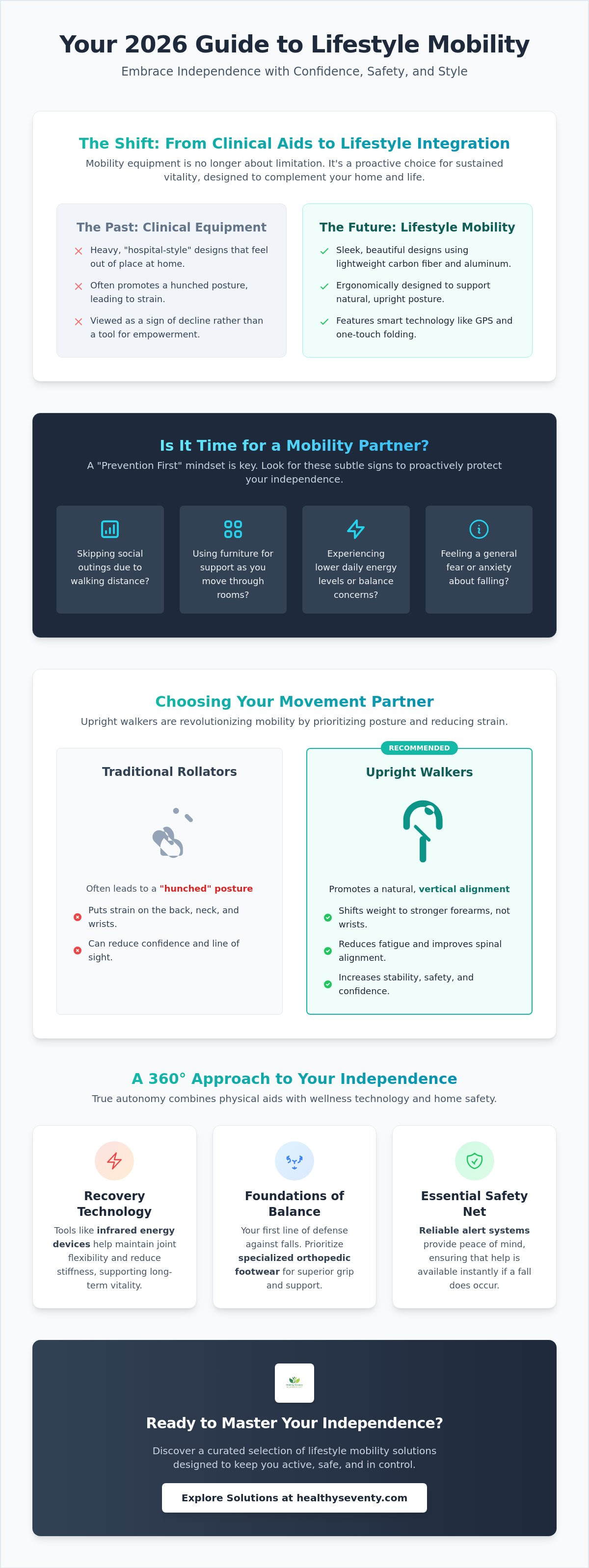
Gone are the days of heavy, grey, "hospital-style" equipment that feels out of place in a warm home. Today's designers prioritize aesthetics, using lightweight carbon fiber and sleek aluminum alloys to create pieces that are both beautiful and functional. Smart technology has also become standard. You'll find walkers with integrated GPS and scooters that fold at the touch of a button, allowing you to maintain a travel-ready lifestyle. This integration of design and utility means that aging in place starts with choosing equipment that you actually enjoy using every day. It's about empowerment, not just medical necessity.
Identifying When It’s Time for Support
Recognizing the need for a little extra help isn't always about a sudden event. It often shows up in subtle ways. Perhaps you're skipping social outings because the walk feels too long, or you're holding onto furniture as you move through the house. Adopting a "Prevention First" mindset is crucial. Waiting for a fall is a common mistake that can lead to a loss of confidence and long-term injury. Instead, a self-assessment of your daily energy levels and balance can reveal where a small adjustment, like better footwear or a more supportive walker, could make a significant difference. Consulting with a professional can help, but being honest about your own daily comfort is the first step toward improvement.
For those who require more structured assistance, it's worth exploring professional support options; for example, you can learn more about Accessible Care to understand how registered providers facilitate independent living through tailored NDIS services.
Physical Mobility Aids: Navigating Your Options for Active Movement
Movement is the foundation of vitality. It allows you to engage with your community, visit friends, and maintain the hobbies that define your lifestyle. Choosing the right physical aid isn't just about finding a tool to help you get from point A to point B; it's about selecting a partner that supports your body's natural mechanics. When you invest in high-quality mobility equipment for independent living, you're choosing to prioritize your comfort and safety during every outing.
Upright Walkers vs. Traditional Rollators
Traditional rollators have long been a staple for support, but they often lead to a "hunched" posture that can cause back and neck strain. The VOCIC Upright Walker addresses this challenge by allowing you to walk with a more natural, vertical alignment. By utilizing padded forearm supports, this design shifts your weight from your wrists to your stronger upper arms. This ergonomic shift reduces fatigue in your joints and improves overall spinal alignment. When evaluating these devices, look for intuitive braking systems and a sturdy weight capacity that ensures you feel secure on various terrains.
Weight is perhaps the most critical specification for any independent user. Even the most advanced mobility equipment for independent living can become a burden if it's too heavy to lift. Modern aids now utilize lightweight aluminum alloys that provide strength without the bulk. This makes it much easier to navigate curbs or lift your equipment into a vehicle without needing outside assistance. Selecting a device that weighs under 20 pounds can significantly enhance your daily autonomy.
Portable Scooters for Active Lifestyles
For those who wish to maintain a travel-ready lifestyle, mobility scooters for travel offer a sense of freedom that walkers alone cannot provide. These scooters are designed to navigate everything from airport terminals to local parks. You should consider whether a folding mechanism or a disassembly model fits your needs better. Folding models are incredibly convenient for quick storage, while disassembly models often break down into lighter individual pieces, which can be easier to manage if you're loading a car trunk alone.
If you're an adventurous spirit, pay close attention to battery range and airline compliance. Many modern scooters use lithium-ion batteries that are safe for air travel, allowing you to bring your mobility aid on your next vacation. Understanding your rights, such as the ADA requirements for mobility devices, ensures you can confidently access public spaces like museums and theaters. Accessories like storage baskets or oxygen tank holders can further customize your scooter to fit your specific daily routine. You can explore a variety of reliable mobility solutions to find the perfect match for your next adventure.
Recovery and Wellness Tech: Supporting Mobility from Within
True independence is more than just having the right wheels or handles; it's about how your body feels when you use them. We often view mobility as a purely mechanical challenge, yet your biological foundation dictates how effectively you can navigate your world. If your joints are stiff or your muscles are fatigued, even the most advanced mobility equipment for independent living can only do so much. By focusing on recovery and wellness technology, you support your movement from the inside out, ensuring your body remains a capable partner in your daily adventures.
Infrared Therapy for Joint Flexibility
Morning stiffness is a common frustration that can delay your start to the day. Integrating a home infrared sauna for elderly users into your routine offers a gentle way to soothe these aches. Unlike traditional saunas, infrared energy penetrates deep into the tissues to improve circulation and promote muscle relaxation. This deep-tissue warmth helps "thaw" stiff joints, making it easier to step into your walker and head out for a walk. When using heat therapy at home, it's vital to follow safety protocols. Always stay hydrated, limit sessions to 15 to 20 minutes initially, and consult with your healthcare provider if you have any cardiovascular concerns.
Non-Invasive Pain Management Tools
Chronic pain often leads to a sedentary lifestyle, which ironically makes mobility challenges worse. Many people are now turning to at-home shockwave therapy to address persistent heel and joint discomfort without relying solely on pharmaceutical interventions. These non invasive joint pain relief methods use pressure waves to stimulate the body's natural healing processes. By addressing the source of the pain directly, you're able to stay active for longer periods and reduce the risk of secondary injuries caused by overcompensating for a sore limb.
A dual-action strategy is the most effective way to sustain your vitality. This involves combining recovery devices with physical aids. For example, using a shockwave therapy device in the evening can prepare your feet for a day of walking in supportive sneakers the following morning. Think of these recovery sessions as "mobility maintenance." They aren't just a luxury; they are essential components of a modern plan for mobility equipment for independent living. When you care for your body's internal needs, your external equipment becomes even more powerful in helping you maintain your legacy of active living.
Essential Home Safety and Foundations for Balance
Your home should be your sanctuary; it shouldn't feel like a series of obstacles that challenge your confidence. While we've discussed how upright walkers and recovery tech support your movement, these tools rely on a stable environment and a solid connection to the ground. This "Balance Foundation" is the often-overlooked secret to successful mobility equipment for independent living. If you're using a top-tier walker but wearing worn-out slippers, you're essentially building a house on sand. Creating a safe space requires looking at your environment and your personal gear as a single, unified system.
Footwear as a Foundation for Balance
Choosing the best walking sneakers for balance is a mobility requirement rather than a simple fashion choice. Your feet provide the sensory input your brain needs to maintain equilibrium. Orthopedic sneakers, such as those from Orthofeet, are engineered to stabilize the gait and prevent the subtle trips that lead to major falls. These shoes feature wide toe boxes to prevent pinching, robust arch support to align the ankles, and slip-resistant outsoles that grip various home surfaces. When your footwear is designed to work with your body's mechanics, every step with your walker becomes more secure and less tiring.
Emergency Alert Systems and Fall Prevention
Peace of mind is an essential component of independence. The evolution of personal emergency alert devices has moved beyond simple buttons; today's technology offers layers of protection that act as a safety net. Whether you prefer a Landline Personal Emergency Alert Device for its reliability at home or a mobile GPS unit for outings, these tools ensure that help is never more than a button press away. Modern systems are often equipped with fall detection sensors. These sensors can identify the specific motion of a fall and contact emergency services even if you're unable to do so yourself, providing a critical layer of security for those living alone.
Integrating these alerts into a comprehensive home safety audit is a wise step toward proactive living. This audit should also include environmental adaptations like reachers to prevent overextending, grab bars in high-moisture areas like the bathroom, and significant lighting upgrades in hallways. Shadows can hide trip hazards, so increasing the brightness of your paths is a simple yet powerful way to prevent accidents. By combining these environmental shifts with the right gear, you create a home that truly supports your vitality and protects your legacy of independence. You can explore curated stability solutions here to start building your foundation today.
Building Your Personalized Independence Plan
Researching is the first step, but the true transformation happens when you move from curiosity to commitment. Creating a plan for your future self isn't just about buying gadgets; it's about designing a lifestyle that protects your freedom. When you approach mobility equipment for independent living with a clear strategy, you ensure that every choice you make supports your specific goals, whether that's continuing to travel the world or simply enjoying a daily walk through your neighborhood. This plan acts as your personal roadmap, helping you navigate the transition from managing challenges to mastering your environment.
Viewing your equipment as a financial strategy is a smart way to approach your long-term wellness. While high-quality aids require an initial investment, they often represent a significant long-term savings on care costs. By preventing a single fall or delaying the need for intensive in-home assistance, you're not just saving money; you're preserving your legacy of autonomy. It's a proactive choice that pays dividends in both your bank account and your quality of life. Thinking of these tools as "independence insurance" helps shift the focus from what you're spending to what you're gaining: time, safety, and vitality. This strategic approach to independence is often championed by healthcare organisations and nonprofits, many of whom partner with Throughmotion Ltd. to better engage their communities and provide clear, nurturing guidance on these life-changing decisions.
Prioritizing Your Equipment Needs
You don't need to overhaul your entire home overnight. A phased rollout is often the most effective way to integrate new tools into your life. Start with the "Must-Haves" that form your foundation, such as supportive orthopedic sneakers and a reliable emergency alert device. These items provide immediate safety and confidence. Once your foundation is secure, move to movement-based tools like an upright walker or a portable scooter. Finally, introduce "Nice-to-Have" recovery tech, like an infrared sauna, to enhance your comfort. When discussing these needs with family, frame the conversation around your desire to stay active and engaged. It's not about needing help; it's about choosing the best tools for the job.
The Healthy Seventy Curated Approach
At Healthy Seventy, we believe in mobility devices for elderly users that empower rather than restrict. Our research focuses on the intersection of modern technology and senior wellness, ensuring that we only recommend products that meet a high standard of reliability and aesthetic appeal. We understand that you want equipment that fits your modern lifestyle, not a clinical setting. Your best years are ahead of you, and they are supported by the thoughtful choices you make today. Trust your wisdom, lean on the research we've gathered, and take that first step toward a more vibrant, independent future. You've earned the right to move through the world with confidence, and we're honored to be your partner on this journey.
Embrace Your Future with Confidence and Vitality
Choosing the right tools is about more than just safety; it's about honoring your desire to remain an active participant in your own story. You've spent a lifetime building your legacy, and your environment should reflect that strength. By integrating ergonomic physical aids with modern recovery technology, you create a comprehensive support system that works with your body. This holistic approach to mobility equipment for independent living ensures that you don't just move through your home, but you thrive within it.
At Healthy Seventy, we provide trusted guidance for active independent living by offering products expertly researched for the 60+ community. Our focus on Red Dot design and ergonomic excellence ensures that your equipment looks as good as it performs. Explore our curated selection of mobility and wellness tools at Healthy Seventy and take the next step toward your most vibrant years. Your journey is significant, and we're here to support every step you take.
Frequently Asked Questions
What is the most important piece of mobility equipment for aging in place?
The most important piece of equipment is often the one that provides immediate safety and a reliable connection to help, such as a personal emergency alert device. While physical aids help you move, an alert system ensures that living alone doesn't mean being isolated in a crisis. It acts as a primary safety net, allowing you to maintain your daily routine with the confidence that assistance is just a button press away.
Does Medicare cover mobility equipment for independent living?
Medicare often covers mobility equipment for independent living if it's deemed medically necessary and prescribed by a doctor as Durable Medical Equipment (DME). For 2026, the DMEPOS fee schedule has been updated with a net increase of 2.0% for many items. It's best to check with your specific provider to see if a device, like a manual wheelchair or walker, meets their criteria for reimbursement in your zip code.
How do I know if I need an upright walker or a standard rollator?
You should choose an upright walker if you find yourself hunching over or experiencing wrist pain while using a traditional rollator. Upright models are designed to support your forearms, which naturally aligns your spine and reduces strain on your upper body. If your goal is to walk longer distances with better posture and less fatigue, the vertical support of an upright design is usually the superior choice for your vitality.
Are portable mobility scooters easy to transport for a single person?
Portable mobility scooters are designed specifically for ease of transport by a single individual through folding mechanisms or lightweight disassembly. Many modern travel models utilize aluminum alloys to keep the weight of the heaviest piece manageable. If you frequently load a scooter into a car trunk, look for a model that breaks down into sections under 30 pounds to ensure you can handle it comfortably without needing outside assistance.
How can an infrared sauna help with my mobility issues?
An infrared sauna supports your mobility by using deep-penetrating heat to improve circulation and soothe stiff muscles before you begin your day. This type of therapy helps "thaw" joints that may feel locked or painful in the morning, making it easier to engage in physical activity. By integrating heat therapy into your routine, you're preparing your body to move more fluidly and with a greater range of motion throughout your home.
Is at-home shockwave therapy safe for seniors with joint pain?
At-home shockwave therapy is a safe, non-invasive option for seniors looking to manage chronic joint or heel pain without relying solely on medication. These devices use acoustic pressure waves to stimulate the body's natural repair mechanisms in soft tissues. While it's generally safe for home use, you should always consult with your physician first if you have a pacemaker or are taking certain blood-thinning medications to ensure it's the right fit for your health profile.
What features should I look for in walking shoes to prevent falls?
To prevent falls, look for walking shoes that feature slip-resistant outsoles, firm arch support, and a wide toe box for natural stability. A secure heel counter is also vital, as it prevents your foot from sliding inside the shoe and causing a trip. These features work together to stabilize your gait, providing a solid foundation that complements the support of your other mobility aids and recovery tools.
Can mobility equipment really help me stay in my home longer?
High-quality mobility equipment for independent living is specifically designed to help you age in place by reducing the risk of falls and conserving your energy for daily tasks. By adapting your environment and gear to your physical needs, you remove the barriers that often lead to a move into assisted living. Proactive choices today ensure that your home remains a safe, comfortable space where you can maintain your autonomy and continue your cherished lifestyle.


Comments