
Foldable Mobility Scooter for Seniors: A 2026 Guide to Portability and Independence
- healthyseventy3
- 1 hour ago
- 12 min read
Imagine standing at the entrance of a sprawling botanical garden or a favorite museum, feeling nothing but excitement for the day ahead. For many, that initial spark of joy is often dimmed by the practical worry of how to navigate the distance or the physical strain of lifting heavy equipment into a car trunk. It's a common frustration to feel like your world is shrinking just because traditional mobility aids are too cumbersome to take on the go.
We understand that maintaining your independence shouldn't feel like a logistical puzzle. You've earned the right to travel with your family and visit your favorite landmarks without the anxiety of confusing airline battery regulations or the fear of a tip-over. This 2026 guide helps you find a foldable mobility scooter for seniors that balances a lightweight, portable design with the robust safety features and comfort you need for an active life. We'll walk you through the latest FAA standards for lithium-ion batteries and show you how to choose a model that's as easy to lift as it is to drive, ensuring you can focus on making memories rather than managing machinery.
Table of Contents
What is a Foldable Mobility Scooter for Seniors?
A foldable mobility scooter for seniors is far more than just a piece of medical equipment; it's a sophisticated, battery-powered companion engineered for movement and discovery. Unlike traditional, heavy scooters that require a permanent presence in your entryway, these compact devices are designed to collapse or disassemble in seconds. They serve a vital role in the lives of many, acting as a bridge for those who find walking long distances a challenge but aren't ready for the permanence of a full-time power wheelchair.
By 2026, the technology behind these devices has reached a peak of efficiency. Manufacturers have replaced heavy steel frames with lightweight, aircraft-grade aluminum, while bulky lead-acid batteries have given way to high-capacity lithium-ion power. This shift isn't just about technical specs; it's about making the device manageable for the person using it. For a deeper look at the history and variety of these tools, you can explore this Mobility scooter overview.
Choosing a folding model is an act of reclaiming your active independence. It's about saying "yes" to a family reunion at the park or a trip to a museum without worrying if your legs will hold up. It shifts the narrative from needing assistance to prioritizing vitality. This mindset allows you to maintain your social connections and mental well-being, which are just as critical as your physical health in your later years.
The Core Benefits of the Folding Design
The most significant advantage of a folding design is its sheer versatility in a modern world. You don't need to invest thousands in expensive vehicle lifts or specialized vans to transport your foldable mobility scooter for seniors. Instead, these scooters are designed to fit neatly into a standard car trunk or even a backseat. In the home, they offer peace of mind for those with limited space. You can easily tuck the device into a hallway closet or a corner of the bedroom, keeping your living area clear and safe from tripping hazards. This seamless transition from your car to a shopping mall or a paved park path ensures that your day remains focused on the destination, not the logistics.
Who Should Consider a Foldable Model?
Is this the right choice for your lifestyle? While every individual's needs are unique, certain groups find these models particularly life-changing:
Active Drivers: Seniors who still enjoy driving but find that fatigue sets in after a few blocks of walking.
Travel Enthusiasts: Those who frequent airports, cruise ships, or trains and need a device that meets strict transport regulations.
Space-Conscious Residents: Individuals living in retirement communities or apartments where storage space is a premium.
Key Features to Evaluate Before You Buy
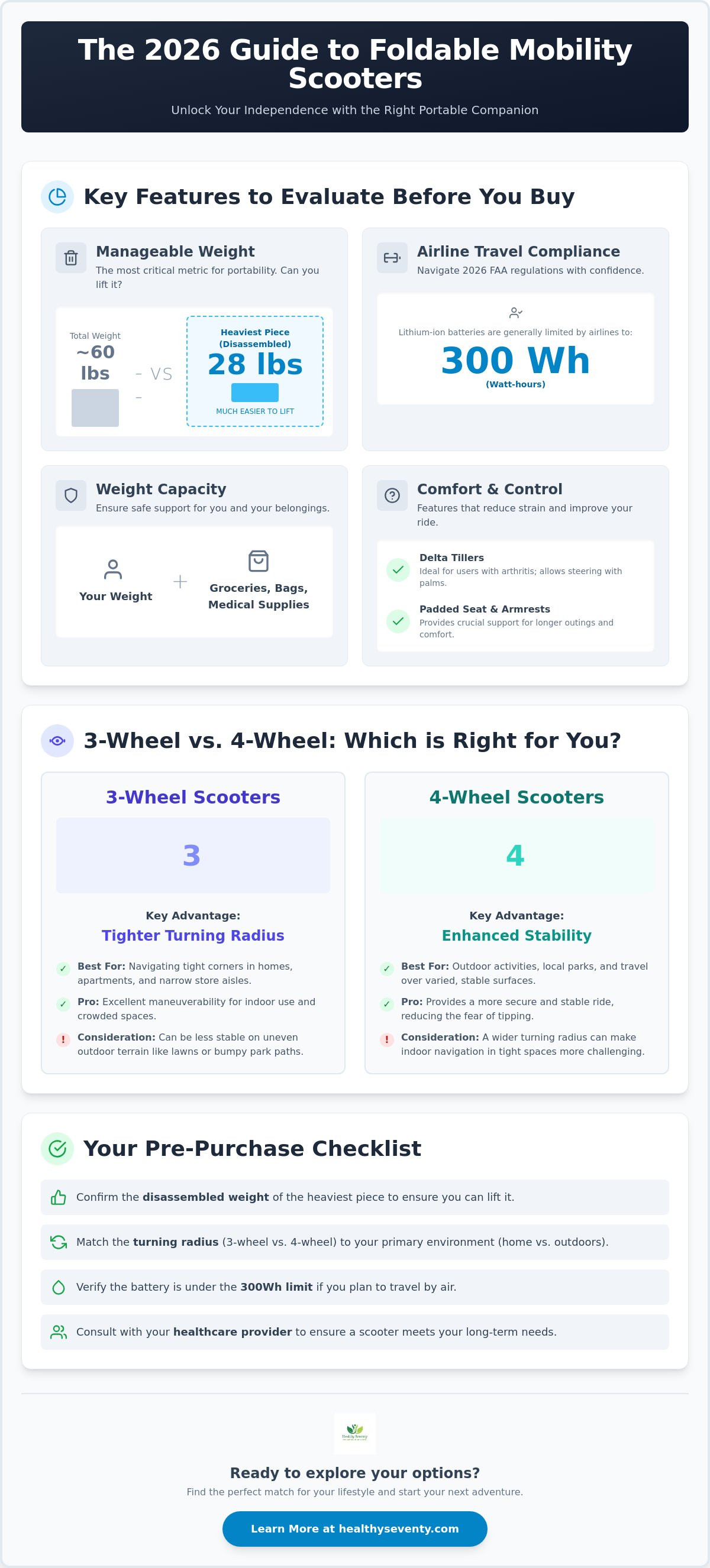
Choosing the right foldable mobility scooter for seniors requires looking beyond the glossy photos and into the technical specifications that dictate your daily comfort. While many manufacturers highlight total weight, the most critical metric is often the weight of the heaviest piece when disassembled. If a scooter weighs 60 pounds total but breaks down into a 28 pound motor section, it becomes much more manageable for a single person to lift into a vehicle trunk. This distinction can be the difference between a spontaneous trip to the park and staying at home because the equipment is too heavy to move.
Weight capacity is another non-negotiable factor. You must account for your own weight plus any additional items you plan to carry, such as a full bag of groceries or an oxygen tank. Similarly, battery range is often listed as a maximum, but real-world performance depends on the user's weight and the steepness of the terrain. If you plan to take your adventures to the skies, keep in mind that FAA travel regulations generally limit lithium-ion batteries to 300 Watt-hours (Wh) for safety. For indoor use, the turning radius determines whether you can easily navigate tight corners in your home or narrow grocery aisles. A tighter radius allows for seamless movement without the need for frustrating multi-point turns.
Ergonomics for Comfort and Control
Standard handlebars can be punishing for those with arthritis. We recommend seeking out delta tillers, which allow you to steer and accelerate using your palms or even just one hand. This design reduces the need for a tight grip, preserving your energy for the destination. Comfort extends to the seat as well; look for high-density padding and adjustable armrests that provide support for outings lasting two hours or more. Finding a foldable mobility scooter for seniors with a customizable tiller height ensures your posture remains natural and relaxed throughout the day.
Safety Mechanisms for Peace of Mind
Reliable braking is essential for confidence on inclines. Regenerative braking systems automatically engage when you release the throttle, preventing the scooter from rolling backward on hills. Stability is further enhanced by anti-tip wheels; these are small, rear-mounted rollers that prevent the frame from leaning too far back on uneven sidewalks or ramps. Ground clearance is the distance between the scooter's undercarriage and the floor to avoid obstacles. A higher clearance helps you navigate small bumps or transitions between carpet and tile without getting stuck or damaging the motor.
3-Wheel vs. 4-Wheel Foldable Scooters: A Comparison
Have you wondered if three wheels are enough to keep you steady, or if four wheels might feel too bulky for your home? When you begin your search for a foldable mobility scooter for seniors, the wheel configuration is one of the most significant choices you'll make. This decision impacts more than just the look of the device; it determines how much space you have for your feet, how tightly you can turn in a hallway, and how the scooter handles the transition from carpet to pavement.
There's a common misconception that three-wheel scooters are inherently unsafe. While it's true that four wheels provide a broader base for stability, three-wheel models are exceptionally secure on the flat, level surfaces found in shopping centers, museums, and homes. They offer a significantly tighter turning radius, which is a blessing when you're navigating a crowded elevator or a narrow kitchen. Additionally, the single front wheel design leaves the sides of the floorboard open. This gives taller users much-needed room to stretch their legs without bumping into front wheel wells, making long outings much more pleasant.
Beyond the wheel count, you should consider the folding mechanism itself, a detail often overlooked in many travel guides. Manual folding models are typically lighter because they don't require the heavy internal motors needed for remote operation. However, automatic folding versions offer a touch-of-a-button convenience that's invaluable if you have limited hand strength or back pain. Regardless of the design you prefer, your right to use these devices in public spaces is protected. Understanding ADA rights for mobility device users ensures you can navigate parks, stores, and theaters with the confidence that you are welcome and supported.
The 3-Wheel Advantage: Agility and Legroom
If your primary goal is reclaiming your ability to visit local galleries, enjoy a cruise, or move freely through a compact apartment, the three-wheel design is often the superior choice. These models are the champions of indoor agility. Because they have a smaller footprint when folded, they tend to slide into car trunks with more room to spare for groceries or luggage. Their lighter total weight also makes them a favorite for those who frequently rely on taxis or rideshare services for their adventures.
The 4-Wheel Advantage: Stability and Outdoor Use
For those who prioritize a rock-solid feel, the four-wheel foldable mobility scooter for seniors is the gold standard. The extra wheel at the front provides a square base that resists tipping, even when you're turning on a slight incline or navigating a transition strip. This makes them better suited for outdoor use on gravel paths, manicured grass, or slightly uneven sidewalks. While they may take up a bit more room in the trunk, the peace of mind they offer to users with significant balance concerns is a worthy trade-off.
Traveling with Your Foldable Mobility Scooter
Airports and train stations shouldn't be barriers to your next grand adventure. Traveling with a foldable mobility scooter for seniors requires a bit of preparation, but the payoff is total freedom once you land. Most airlines allow you to gate-check your device, which means you can ride your scooter right up to the door of the aircraft. Once there, the ground crew will stow it in the cargo hold. If your model is exceptionally compact, some carriers may even allow it in the overhead bin, though this is less common. To ensure your device arrives in perfect condition, we recommend using a padded travel bag and removing the key and any detachable cushions before handing it over to staff.
For more tailored advice on specific travel-friendly models, explore our guide on mobility scooters for travel.
Battery Safety and Compliance
Airlines have become increasingly strict about lithium-ion power sources. As of 2026, the standard limit for a single mobility battery is 300 Watt-hours (Wh). You can usually find this rating on the battery label itself. If the label only shows Volts (V) and Amp-hours (Ah), simply multiply them to find the Watt-hours. It's vital to carry a Material Safety Data Sheet (MSDS) provided by the manufacturer; this document proves your battery is safe for flight. Remember, you must never pack your lithium battery in checked luggage. It must be removed and carried into the cabin with you to comply with safety protocols.
Maintenance for Longevity
Your scooter is a high-performance tool that deserves regular care. Start with routine checks for tire wear and ensure the battery terminals are free from dust or corrosion. Simple cleaning with a damp cloth keeps the folding hinges moving smoothly, preventing the frame from sticking over time. Lithium batteries should be stored with a 50-70% charge to maximize their lifespan during periods of non-use. This small habit prevents the cells from falling into a deep discharge state, which can permanently reduce their capacity. If you're ready to see how these features come together in a reliable package, you can view our foldable mobility scooter for seniors to find a model that fits your travel goals.
Finding the Perfect Match for Your Lifestyle
Selecting the right foldable mobility scooter for seniors is a deeply personal journey. It isn't just about picking the model with the fastest speed or the longest range; it's about finding the tool that fits into the rhythm of your unique life. Whether you want to navigate the cobblestone streets of a historic town or simply want to move through the local supermarket with ease, your choice should reflect your specific mobility goals. There's no one-size-fits-all solution, and the "best" model is simply the one that makes you feel the most confident and capable.
Manual vs. Automatic Folding Mechanisms
One of the most practical decisions you'll face is how the device actually collapses. Manual folding models are often the favorite for those who prioritize a lightweight frame. Because they lack the heavy motors and actuators required for remote operation, they're typically easier to lift into a trunk and have fewer electrical parts that might need maintenance over time. On the other hand, remote-controlled automatic folding scooters offer a touch of modern convenience. If you find that bending over or using your hand strength to engage a latch is difficult, an automatic model does the heavy lifting for you at the press of a button. Your choice here should depend on your personal hand dexterity and how often you'll be folding the device on your own.
Before you make a final commitment, we strongly encourage you to consult with your physical therapist or primary care physician. They can provide professional insight into your posture and stability needs, ensuring your chosen device is the right mobility equipment for independent living. Trying a device in person or spending time with curated, expert reviews can reveal small details, like the plushness of the seat or the responsiveness of the throttle, that technical specifications alone cannot convey.
Final Considerations: Accessories and Support
Once you've selected your base model, think about the small additions that make daily use more enjoyable. A sturdy front basket is essential for carrying your phone and keys, while a cup holder ensures you stay hydrated during long summer outings. Don't forget a weather cover to protect your investment from unexpected showers when parked. Beyond the physical scooter, the quality of the company behind it is just as important. Look for a brand that offers a robust warranty and a responsive customer support team to help with any technical questions that arise.
At Healthy Seventy, we see ourselves as your partner in this process. We've researched the latest 2026 trends to act as a bridge between complex engineering and your daily lifestyle choices. If you're ready to explore even more ways to enhance your freedom, visit our Mobility Aids for Seniors: A 2026 Comprehensive Resource. Your journey toward a more active and vibrant lifestyle is just beginning, and we're here to guide you every step of the way.
Reclaiming Your Freedom of Movement
Your journey toward renewed independence is a significant step, and choosing the right equipment ensures that every mile is filled with comfort. We've explored how prioritizing "disassembled weight" over total weight makes transport manageable, and how staying informed about the 300 Watt-hour airline limit keeps your travel plans seamless. Whether you prefer the agility of a three-wheel design for indoor galleries or the outdoor stability of a four-wheel model, the right foldable mobility scooter for seniors is the one that empowers you to say "yes" to life's invitations.
Since 2024, Healthy Seventy has been a trusted partner in this journey, offering expert wellness advice and empathetic support for active aging. We pride ourselves on providing a curated selection of high-quality mobility aids that meet the rigorous demands of your lifestyle. You don't have to navigate these choices alone. Explore our curated selection of foldable mobility scooters for seniors to find the perfect match for your needs. The world is still yours to discover, and we're here to help you move through it with grace and confidence.
Frequently Asked Questions
Are foldable mobility scooters allowed on airplanes?
Yes, they are generally allowed on airplanes. FAA regulations for 2026 stipulate a limit of 300Wh per battery for lithium-ion power sources on aircraft. Most travelers choose to gate-check their scooter, which allows them to use the device right up to the plane door. It's always a wise choice to notify your airline at least 48 hours in advance so they can prepare for your arrival and boarding needs.
How much does a typical foldable mobility scooter weigh?
Most models weigh between 45 and 65 pounds in total. However, many are designed to separate into smaller pieces, with the heaviest part often weighing under 30 pounds. This makes a foldable mobility scooter for seniors much easier to lift into a trunk without assistance. Using materials like aircraft-grade aluminum helps keep the weight low while maintaining a sturdy frame that supports an active lifestyle.
Can I use a foldable scooter on grass or gravel?
While these scooters excel on flat pavement and indoor floors, they aren't always ideal for thick grass or loose gravel. A 4-wheel model with higher ground clearance will handle firm, even dirt paths better than a 3-wheel version. If you plan to spend significant time outdoors, look for models with solid tires and anti-tip wheels to maintain your stability on varied surfaces like park paths or fairgrounds.
Do I need a special license to drive a mobility scooter?
No, you don't need a driver's license or any special certification to operate a mobility scooter. They are legally classified as medical devices rather than motor vehicles. This means you can use them on sidewalks, in stores, and across public spaces protected by the ADA. It's always a good idea to practice in a quiet area first to get a feel for the controls and the turning radius.
How long does the battery last on a foldable mobility scooter?
Most travel-ready batteries provide a range of 8 to 15 miles on a single charge. Your actual distance will vary based on your weight, the speed you drive, and whether you're navigating hills. Lithium-ion batteries are the current standard because they charge faster and hold their power longer than older lead-acid versions. This ensures you can enjoy a full day of sightseeing without worrying about a mid-afternoon recharge.
Is it difficult to fold and unfold these scooters by myself?
Most modern scooters are designed to be folded or unfolded in less than a minute. Manual models use simple levers that require very little force to engage. If you have limited bending ability or hand strength, automatic folding models allow you to collapse the device using a small remote control. Both options are engineered to be manageable for a single person, giving you the freedom to travel independently.
What happens if my scooter breaks down while I am traveling?
If you experience a mechanical issue while away from home, your first step should be calling the manufacturer's customer service team. Many top brands have national service networks that can direct you to a local repair technician. We recommend carrying a copy of your owner's manual and the manufacturer's contact information in your scooter's basket whenever you travel. This preparation provides peace of mind for any long-distance adventures.
Can Medicare or insurance cover the cost of a foldable scooter?
Medicare Part B may cover 80% of the approved cost if your doctor provides a written prescription stating the device is medically necessary for use in your home. You'll typically be responsible for the remaining 20% and the 2026 deductible of $257. Because every insurance plan varies, you should contact your provider directly to see if a foldable mobility scooter for seniors qualifies under your specific durable medical equipment benefits.


Comments