
Best Upright Walkers for Seniors: Reclaiming Posture and Vitality in 2026
- healthyseventy3
- 12 hours ago
- 12 min read
What if the secret to walking further isn't about trying harder, but simply standing taller? Finding the best upright walkers for seniors is about more than just mobility; it is about reclaiming the posture and dignity that traditional rollators often strip away. It's exhausting to lean forward with your eyes fixed on the ground, feeling more like a patient than an active participant in life. You deserve a tool that feels like a genuine upgrade to your daily routine, not a compromise that highlights physical limitations.
In this guide, we'll show you how the latest designs are restoring vitality by correcting your stance at the source. These innovative aids allow you to look ahead and engage with your community again. We will explore how ergonomic features eliminate wrist pressure and how the new FDA Quality Management System Regulation, implemented in February 2026, ensures your equipment meets the highest international safety standards. From clarifying 2026 Medicare Part B coverage to reviewing curated models like the VOCIC Z22, you'll find the path to walking with renewed confidence and lasting comfort.
Table of Contents
What is an Upright Walker and Why is it Changing Senior Mobility?
An upright walker is a sophisticated mobility aid designed with elevated forearm supports that allow you to maintain a vertical, forward-looking gait. Unlike the different types of walkers that have been the standard for decades, these devices are built to support your body while you stand tall. By 2026, the technology behind the best upright walkers for seniors has shifted toward a focus on both physical health and emotional well-being. Modern designs often utilize carbon-fiber frames for easier transport and adaptive suspension to handle the vibrations of outdoor paths, ensuring your journey is as smooth as it is stable.
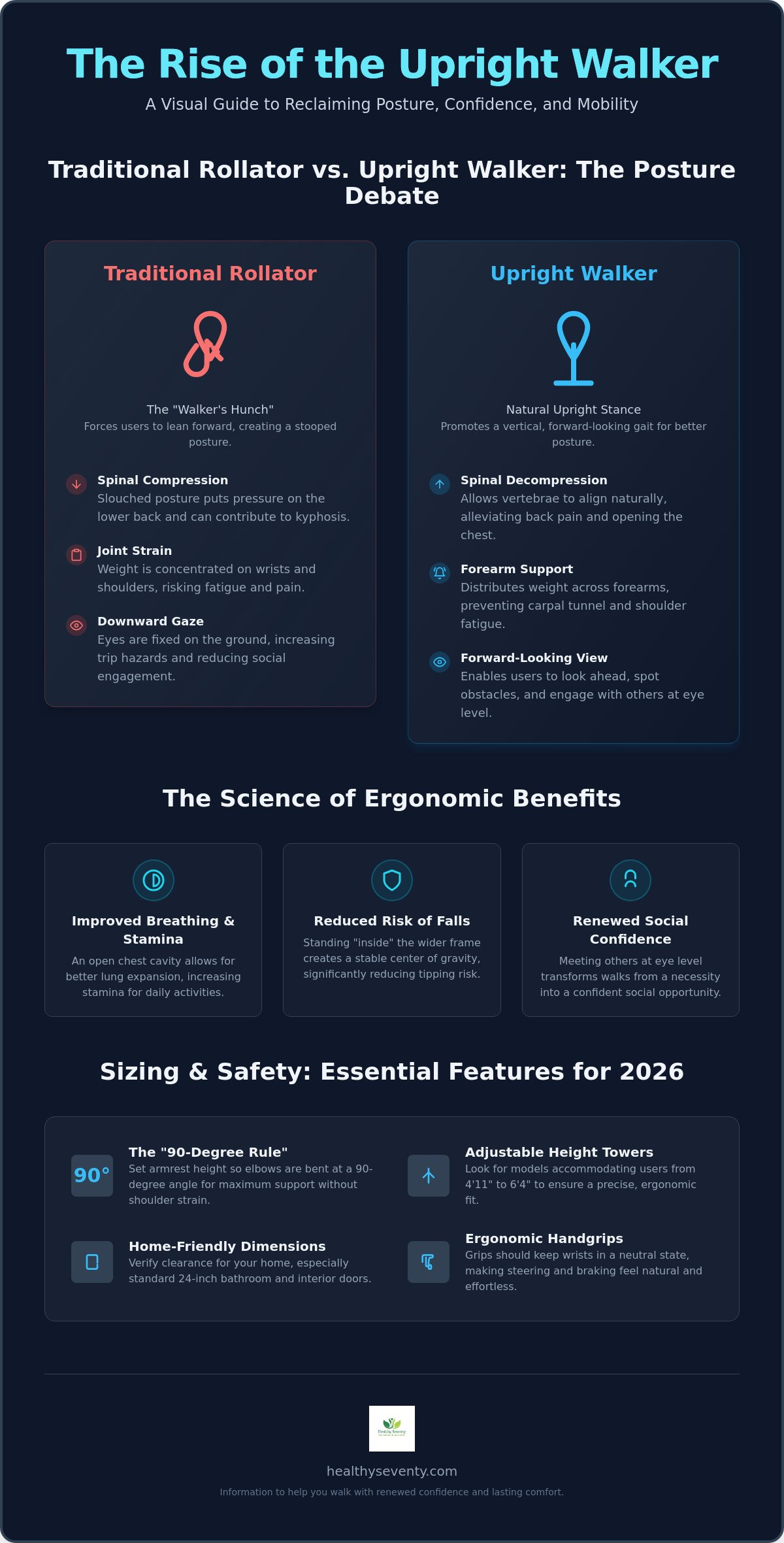
Many people find that traditional rollators eventually lead to the "Walker's Hunch." This happens when you constantly lean forward to reach the handles, a position that can contribute to kyphosis and persistent neck pain over time. It's a frustrating trade-off; you gain mobility but lose your posture. Upright walkers address this by shifting your weight from your wrists and shoulders to your forearms. This simple change provides superior joint protection and helps you walk with a sense of vitality that feels like an upgrade to your lifestyle, not a compromise.
The Anatomy of a Stand-Up Walker
The structure of these devices is built for long-term comfort and precision. Padded armrests act as the primary support system, distributing your weight to prevent carpal tunnel and shoulder fatigue during longer outings. To ensure a proper fit, the best upright walkers for seniors feature adjustable height towers that accommodate users from 4'11" up to 6'4". Additionally, ergonomic handgrips are positioned to keep your wrists in a neutral, relaxed state, making steering and braking feel completely natural and effortless.
Traditional Rollator vs. Upright Walker: The Posture Debate
Safety is often a matter of where your weight is centered. When using a traditional rollator, you're essentially pushing the device in front of you, which can lead to instability if you lose your balance. In contrast, an upright walker allows you to stand "inside" the frame, creating a much more stable center of gravity. This positioning also clears your visual field. Instead of watching the ground to avoid trips, you can look ahead at your path and the people around you. There is a significant psychological benefit to meeting others at eye level; it transforms a walk from a medical necessity into a social opportunity where you feel confident and present.
The Science of Ergonomics: Solving Back Pain and Fatigue
Standing tall changes more than just your perspective; it fundamentally alters your body's internal mechanics. When you use a standard walker, the resulting slouch compresses the spine and puts undue pressure on the lower back. The best upright walkers for seniors are engineered to facilitate spinal decompression. By supporting your weight through the forearms, these devices allow the vertebrae to align naturally. This alignment opens the chest cavity, which leads to improved lung expansion. When your diaphragm isn't compressed by a slouched posture, every breath becomes more efficient, directly increasing your stamina for social outings and daily tasks.
This ergonomic shift also impacts your gait efficiency. A hunched posture often results in short, tentative steps that require more energy and cause faster muscle fatigue. By standing upright, you regain a natural stride length. This reduces the caloric cost of walking, meaning you can travel further without feeling exhausted. Additionally, protecting the delicate bones of your wrists is a major focus of modern design. Utilizing the larger surface area of the forearm for support prevents the chronic strain often associated with traditional mobility aids. If you're ready to experience this physical relief, exploring a high-quality upright mobility solution can be a transformative first step toward lasting comfort.
Reducing the Risk of Falls
Stability is the foundation of confidence. The wider footprint of an upright walker provides a more secure base than traditional models, significantly reducing the risk of tipping during turns. This structural support enhances your proprioception, or your brain's awareness of your body's position in space. When you feel stable, you walk more fluidly. Following essential walker safety tips, such as maintaining an eye-level gaze, helps you spot obstacles early. Maintaining a forward-looking posture is a vital safety habit that reduces trip hazards by allowing you to process your surroundings more effectively than looking down at your feet.
Managing Chronic Conditions
For those living with arthritis, the pressure of gripping traditional handles can be painful. Upright models alleviate this by removing the burden from finger and hand joints. Individuals managing neurological conditions like Parkinson's or MS also find significant support here. The upright stance helps manage a "freezing" gait by encouraging a more rhythmic, forward-moving momentum. Occupational therapists frequently recommend these models during post-surgical recovery, particularly after hip or knee replacements. The vertical support ensures that the surgical site isn't strained by the unnatural leaning required by older walker designs, promoting a faster return to independence with the best upright walkers for seniors currently available.
Evaluating the Best Upright Walkers for Seniors: 2026 Comparison
The standards for mobility aids have evolved rapidly, and by 2026, the criteria for the best upright walkers for seniors have reached new levels of sophistication. Manufacturers have largely moved away from heavy, clunky frames toward ultra-lightweight materials like carbon fiber. Models weighing under 18 lbs now dominate the market, making it significantly easier for you to lift your walker into a car trunk or navigate a few stairs. This weight benchmark is a critical part of the 2026 gold standard; it ensures that your mobility aid remains a tool for freedom rather than a burden to manage.
The VOCIC Upright Walker remains a top-tier choice for those who prioritize balance and posture correction. It is engineered to foster the vertical stance that naturally aligns your spine, building on the ergonomic principles of spinal decompression we explored earlier. While budget-friendly options exist, it's vital to identify where you can safely save and where quality is non-negotiable. A sturdy frame and reliable wheel bearings are essential for your safety. Choosing a premium model often pays off through long-term durability and reduced maintenance over several years of active use.
Key Features to Prioritize
When you're evaluating different models, look for 10-inch front wheels. These larger wheels are essential for crossing gravel paths or uneven sidewalks without the jarring stops common with smaller casters. Comfort is equally important for your daily enjoyment. A well-designed seat provides a secure "perch" for resting during longer walks, while integrated accessories like cane holders and hidden shopping bags keep your hands free and your belongings secure.
2026 Tech Trends in Mobility
Modern technology has introduced smart-lock braking systems that automatically prevent the walker from rolling away on inclines, providing an extra layer of security for your peace of mind. Internal shock-absorption springs are another major advancement; they dampen the vibrations from cracked pavement that can lead to joint pain in your elbows and shoulders. To maximize your stability, pairing these devices with the best walking sneakers for balance ensures that your feet and your walker work together to prevent falls and maintain your vitality.
Sizing and Safety: Matching the Walker to Your Lifestyle
Selecting the right equipment is a personal journey that requires careful attention to your physical dimensions and your home environment. Even the best upright walkers for seniors can only provide maximum benefit if they're calibrated to your specific frame. Proper sizing prevents the very shoulder and neck strain you're trying to avoid. Beyond the device itself, you must consider the spaces where you spend your time. A walker that feels perfect in a wide showroom might struggle in a cozy hallway or a compact bathroom.
To find your ideal fit, use the 90-Degree Rule. Stand as straight as possible with your usual walking shoes on and bend your elbows at a right angle. Have a friend or family member measure the distance from the floor to the bottom of your elbow. This measurement is your target armrest height. When your walker is adjusted correctly, your forearms should rest comfortably without forcing your shoulders to shrug upward or causing you to lean down. It's also wise to choose a frame with a 50-lb weight capacity buffer above your own weight. This extra structural integrity reduces wear on the joints and wheels, significantly increasing the device's longevity.
Don't forget to perform a "Car Trunk" test before making a final decision. Measure the storage area of your vehicle and compare it to the walker's folded dimensions. A lightweight frame is only useful if you can easily transport it to social gatherings or doctor appointments. If you're ready to reclaim your independence, you can explore professionally curated upright walkers that prioritize both safety and ease of transport.
Indoor vs. Outdoor Optimization
Your daily routine should dictate the features you prioritize. Narrow-profile models are excellent for apartment living where you need to navigate tight corners and standard 24-inch bathroom doors. If you're more active outdoors, look for models with heavy-duty treads designed for park trails and community events. For more advice on creating a safe environment, see our mobility aids for seniors guide, which covers essential home safety tips.
The Transition Period: Tips for New Users
Learning to walk with forearm support is a new skill that requires patience. Spend your first 48 hours using the walker in a familiar indoor environment to get used to the shift in your center of gravity. You should also take a moment to customize the brake tension; it should be firm enough to hold steady but light enough for your specific hand strength to operate. The 'break-in' period is the two-week window where your body adapts to its corrected posture and your stabilizing muscles learn to support your new, healthier alignment.
Regaining Your Confidence with the VOCIC Upright Walker
Choosing a mobility aid is about more than just physics. It's an emotional transition. The VOCIC model stands out among the best upright walkers for seniors because it prioritizes your dignity. Its sleek, active aesthetic moves away from the clinical "medical" look of the past. Instead of feeling like you're pushing a piece of hospital equipment, you're using a tool designed for an active lifestyle. This shift in design helps you feel like yourself again, whether you're at a family brunch or a local community center. Standing tall allows you to engage with others at eye level, which is a powerful way to reclaim your social presence and confidence.
The Healthy Seventy verdict is clear: this is our recommended choice for those over 70 who want to maintain their independence. It bridges the gap between high-end professional equipment and user-friendly home design, making it a reliable partner for your daily journey toward better health.
The VOCIC Advantage
Stability is the most frequent concern we hear from our community members. Many cheaper models suffer from a "wobble" that can make you feel less secure. The VOCIC Upright Walker utilizes a reinforced frame that eliminates this instability, providing a rock-solid foundation for every step. User-centric details also set it apart. A breathable mesh seat offers a comfortable place to rest without causing overheating, and the one-hand folding mechanism makes it simple to store. We trust this brand because they focus on the small details that make a big difference in daily life.
A Path Toward Active Aging
Your new walker is just one part of a holistic approach to wellness. To maximize your results, consider combining your improved mobility with non invasive joint pain relief strategies. This dual approach addresses both the mechanical support you need and the underlying comfort of your joints. Once you're comfortable with your new posture, try setting a daily goal. Aiming for 5,000 steps a day is a wonderful way to build stamina and heart health. Your walker isn't just a support; it's your partner in reaching new milestones.
Ready to start your journey? You can Discover the VOCIC Upright Walker and Stand Tall Again to see how it can transform your daily walks into a source of joy and vitality.
Embrace a New Chapter of Confident Movement
Reclaiming your mobility isn't just about moving from place to place; it's about how you feel while you're doing it. We have explored how the right equipment can transform a slouched, painful gait into a confident, upright stride. By prioritizing posture-correcting ergonomics and accurate sizing, you protect your joints and open your chest for better breathing. The best upright walkers for seniors in 2026 are designed to be a partner in your active aging journey, helping you meet the world at eye level once again.
Our team has dedicated countless hours to researching solutions that meet the specific needs of our community. We believe every step you take should feel like a victory for your independence. With expert-vetted options specifically curated for seniors over 70 and the convenience of national US shipping on all mobility aids, the path to a more vibrant life is clearer than ever. You deserve a mobility aid that feels like an upgrade to your lifestyle, not a compromise.
Take the first step toward standing tall and walking with renewed vitality today. View the Curated VOCIC Upright Walker Collection and discover how simple it is to move with grace and strength.
Frequently Asked Questions
Is an upright walker safer than a traditional rollator for someone with balance issues?
An upright walker is generally safer for those with balance concerns because it encourages you to stand inside the base of support. This positioning stabilizes your center of gravity, whereas traditional rollators often lead to leaning forward, which can increase the risk of a forward fall. By keeping your weight centered, you gain better control over the device's movements and feel more secure during turns and transitions.
Can I use an upright walker if I am very tall or very short?
You can absolutely use these devices regardless of your height, as the best upright walkers for seniors are built with telescoping adjustment towers. Most 2026 models accommodate users ranging from 4'11" to 6'4". It's vital to check the specific height range of a model before purchasing to ensure the armrests can be positioned at a level that keeps your spine aligned and your shoulders relaxed.
How much does a high-quality upright walker typically weigh in 2026?
In 2026, a high-quality upright walker typically weighs between 18 and 25 pounds. While older steel models were significantly heavier, modern engineering utilizes aluminum or carbon fiber to keep the weight manageable. Ultra-lightweight models are now a market favorite because they provide the structural integrity needed for safety without becoming a physical burden when you need to lift or transport the device for social outings.
What happens if my upright walker feels too heavy to lift into my car?
If lifting becomes a challenge, you should prioritize models with a one-hand folding mechanism or consider a carbon-fiber frame. These designs are specifically intended to make transport easier for those with limited upper-body strength. You might also explore lightweight ramps or vehicle lifts if you travel frequently. Choosing a device with a compact folded footprint ensures it slides into a trunk or backseat with minimal effort.
Can an upright walker be used on grass, gravel, or uneven park paths?
Yes, an upright walker can navigate varied terrains as long as it is equipped with 10-inch or larger front wheels. These larger casters are designed to roll over grass, gravel, and cracked sidewalks without catching or jarring your arms. If you enjoy park trails or outdoor community events, choosing a model with heavy-duty treads will provide the necessary traction and stability to keep you moving safely.
Is assembly required for most stand-up walkers ordered online?
Most stand-up walkers ordered online require very little assembly and often arrive partially pre-assembled. You will typically only need to click the wheels into place and slide the armrest towers into the frame. Most manufacturers design these for tool-free assembly, meaning you won't need a screwdriver or wrench to get started. It's a straightforward process that usually takes less than 15 minutes for most users to complete.
Will Medicare or insurance cover the cost of an upright walker in 2026?
Medicare Part B covers upright walkers as Durable Medical Equipment (DME) when your doctor provides a prescription stating it is medically necessary. In 2026, after the annual Part B deductible is met, Medicare typically pays 80% of the approved amount for the best upright walkers for seniors, leaving the beneficiary responsible for the remaining 20%. You should verify the exact deductible amount with official Medicare sources before making your purchase.
How do I know if the armrest height is adjusted correctly for my posture?
Your armrest height is adjusted correctly when your elbows are bent at a 90-degree angle while standing straight. Your forearms should rest flat on the pads without causing your shoulders to hunch or your back to lean forward. This alignment ensures that your weight is distributed through the larger surface area of your arms, protecting your wrists and promoting the upright posture that helps restore your daily vitality.
Comments