


How to Choose Orthopedic Sneakers for Fallen Arches: A Senior’s Guide to Comfort (2026)

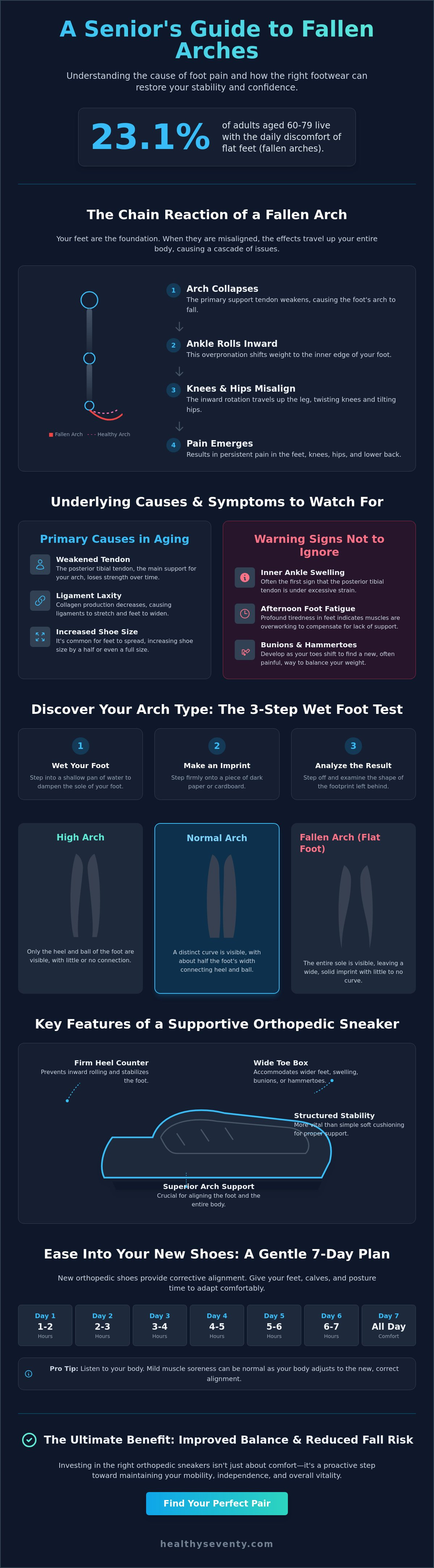
Did you know that 23.1% of adults between the ages of 60 and 79 live with the daily discomfort of flat feet? That sharp, nagging pain in your arch or heel isn't just a minor inconvenience; it's a signal that your foundation needs the specific support of orthopedic sneakers for fallen arches. You might feel frustrated when trying to find shoes that accommodate wider, swollen feet or worry that a lack of stability could lead to a stumble during your favorite morning stroll.
We understand how these challenges can make the world feel smaller, but you don't have to settle for limited mobility. Choosing the right footwear is a proactive step toward restoring your posture and walking with newfound confidence. This guide will show you exactly how to identify superior arch support, evaluate the right fit for your comfort, and select a durable pair that turns every walk into a pain free experience. Let's explore how the right shoes can help you maintain your vitality and stay steady on your feet.
Key Takeaways
Understand how the natural weakening of the posterior tibial tendon affects your gait and why targeted support is essential for long-term mobility.
Learn to perform the simple "Wet Foot Test" at home to accurately identify your footprint and determine your specific arch support needs.
Discover why a firm heel counter and structured stability are more vital than simple cushioning when evaluating orthopedic sneakers for fallen arches.
Follow a gentle 7-day wear schedule to ensure your feet and calves adapt comfortably to the corrective alignment of new footwear.
Explore how bio-mechanical designs, like those from Orthofeet, can significantly improve your balance and reduce the risk of trips or falls.
Table of Contents
Understanding Fallen Arches and Foot Health in Your 60s and 70s
As we embrace our 60s and 70s, our bodies undergo subtle shifts that often begin from the ground up. One of the most common yet overlooked changes is adult-acquired flatfoot, more commonly known as fallen arches. This condition occurs when the medial longitudinal arch, the primary curve on the inside of your foot, begins to collapse toward the floor. While some are born with flat feet, seniors often experience this due to the natural weakening of the posterior tibial tendon. This vital tendon acts as the main suspension cable for your foot; when it loses its strength, the arch follows suit. Understanding Fallen Arches is the first step toward reclaiming your comfort and stability.
Your feet don't work in isolation. They are the base of your kinetic chain. When your arches fall, your ankles roll inward, causing your knees to rotate and your hips to tilt. This misalignment often manifests as persistent lower back pain or stiff knees, making your daily walk feel like a chore. Identifying whether you have flexible flat feet, where the arch returns when you sit, or rigid flat feet, where the foot remains flat regardless of weight, is crucial for selecting the right orthopedic sneakers for fallen arches. Rigid flat feet often require more structured intervention, while flexible arches benefit from dynamic support that mimics the foot's natural movement.
The Role of Ligament Laxity in Aging
As the years pass, our bodies produce less collagen, the protein responsible for keeping our ligaments firm and elastic. In the feet, this leads to ligament laxity, where the structures holding your bones together begin to stretch and widen. It isn't uncommon to find that your shoe size has increased by half a size or even a full size in your 70s because your feet have literally spread out. Overpronation is the natural result of this arch collapse, where your weight shifts too heavily to the inner edge of your foot with every step.
Symptoms You Should Not Ignore
Pay close attention to inner ankle swelling, as this is often the first sign that your posterior tibial tendon is struggling under the pressure. You might also notice a sense of profound foot fatigue by late afternoon, which is a structural warning sign that your muscles are overworking to compensate for a lack of support. Left unaddressed, fallen arches can lead to the development of bunions and hammertoes as your toes shift to find a new, albeit painful, way to balance your weight. Investing in high quality orthopedic sneakers for fallen arches can help mitigate these symptoms and protect your long term mobility.
How to Test Your Arch Type at Home
Before you invest in a new pair of shoes, it's helpful to gain a clear understanding of your current foot structure. While professional consultations are valuable, you can gather significant insights into your foot health in your 60s and 70s by performing a few simple checks at home. These tests help you determine if your arch has truly collapsed or if you simply require a wider fit. Selecting the right orthopedic sneakers for fallen arches becomes much easier when you have visual proof of how your foot interacts with the ground.
To begin your assessment, gather these simple materials from around the house:
A shallow pan or basin filled with a thin layer of water
A piece of heavy brown paper, such as a grocery bag, or a piece of dark cardboard
A flat, hard floor surface where the paper won't slide
The 3-Step Wet Foot Test
This low-tech method is a favorite among researchers for its simplicity and immediate results. First, wet the sole of your foot evenly; you want it damp but not dripping. Second, step firmly onto the brown paper as if you were taking a normal stride. Finally, step off and examine the dark imprint left behind. If you see a very thin line or no connection at all between the heel and the ball of your foot, you have high arches. A neutral arch shows about half of the foot's width in the middle. However, if the imprint looks like a solid, wide rectangle with no curve inward, your arches have likely fallen.
Analyzing Your Current Shoe Wear Patterns
Your old shoes tell a story that your feet might be hiding. Take a pair of sneakers you've worn regularly and place them on a table at eye level. Look closely at the soles for uneven patterns. Excessive wear on the inner edge of the sole, specifically near the big toe and the inside of the heel, is a classic sign of overpronation. This indicates that your foot is rolling inward because the arch is no longer providing a stable platform. Check the back of the shoe as well; if the heel counter is leaning inward rather than standing straight, the structural integrity has vanished.
Mid-sole compression is the primary reason to replace your walking shoes every six months, even if the tread still looks decent. Over time, the foam that provides arch support loses its "memory" and stops rebounding. If your test results show a flat footprint, it's time to consider orthopedic walking sneakers designed to stabilize your gait and protect your joints. Taking this small step now can prevent the "kinetic chain" of pain from reaching your knees and back.
Essential Features of Orthopedic Sneakers for Fallen Arches
When you start your search for the right footwear, it's easy to be seduced by the promise of cloud-like cushioning. While soft foam feels pleasant for a moment, seniors with fallen arches require structural integrity rather than just pillowy softness. Think of your shoe as a house; if the foundation is too soft, the walls will eventually lean. High quality orthopedic sneakers for fallen arches prioritize stability to keep your feet aligned and your gait steady.
A critical feature to look for is a firm heel counter. This is the rigid plastic or composite cup at the back of the shoe that cradles your heel. If you can easily squeeze the back of the shoe and it collapses, it won't provide the control you need to prevent your foot from rolling inward. This support is often paired with a medial post, which is a section of denser foam located on the inner side of the midsole. It acts as a physical barrier that stops the arch from collapsing too far toward the floor during each step.
Don't overlook the importance of a wide toe box. As we discussed earlier, feet naturally spread as we age, and a cramped toe area can exacerbate bunions or hammertoes. A spacious front allows your toes to splay naturally, which actually aids in balance and stability. This extra room is especially important if you experience swelling toward the end of the day.
The Anatomy of a Support Shoe
The hidden strength of a good shoe lies in the shank. This rigid piece is tucked into the mid-foot area to prevent the shoe from twisting or bending where it shouldn't. You might also consider a rocker bottom design. These soles have a gentle curve that helps you roll through your step more easily, reducing the strain on your forefoot and ankles. For those who invest in custom orthotics, which can cost between $200 and $800, ensure the orthopedic sneakers for fallen arches have removable insoles so you can swap them out without making the fit too tight.
Choosing Between Laces, Velcro, and Slip-ons
Laces remain the gold standard for achieving a truly custom fit around the arch. They allow you to tighten specific zones to accommodate swelling or different sock thicknesses throughout the day. If arthritis or limited dexterity makes laces a challenge, high quality Velcro options offer a reliable alternative that stays secure. However, avoid flimsy slip-ons. Most lack the deep heel cup and structured upper required to manage fallen arches effectively. A shoe that is too easy to step into is often too easy to step out of when you need stability most.
A Step-by-Step Guide to Transitioning into Your New Sneakers
It's natural to hope for instant comfort the moment you lace up a pair of orthopedic sneakers for fallen arches. However, your feet and legs have likely spent years compensating for a collapsed arch by shifting your weight in inefficient ways. When you introduce a firm support structure, your muscles are forced to fire differently. This sudden correction often leads to temporary tightness or a dull ache in the calves. Don't be discouraged by this; it's simply your body relearning how to stand and walk with proper alignment.
Because aging skin can be thinner and more sensitive to pressure, pairing your new footwear with high-quality, moisture-wicking socks is a vital step. These socks reduce friction and manage moisture, which are the primary causes of blisters during the initial break-in period. You should also learn to distinguish between "good" adaptation soreness and "bad" injury pain. A mild, muscular tiredness that fades with rest is a sign of progress. In contrast, sharp, stabbing pains or localized swelling that persists are signals to pause and re-evaluate the fit.
The 7-Day Break-In Protocol
Days 1-2: Wear your new sneakers for only one to two hours inside the house on carpeted surfaces. This allows the materials to soften slightly without the stress of hard pavement.
Days 3-5: Increase your wear time to four hours. Take a short walk around the block to see how the arch support feels during active movement.
Days 6-7: Transition to full-day wear. Monitor your skin closely for any redness or "hot spots" that might suggest you need a different width or a specific lacing adjustment.
When to Combine Sneakers with Custom Orthotics
Sometimes, a specialized stability shoe provides all the correction you need. In other instances, a neutral shoe paired with a custom insole offers a more tailored solution for unique foot shapes. If you've invested in custom orthotics, which often range from $200 to $800, ensure they sit perfectly flat against the midsole after you remove the original factory insole. Using these tools together is a highly effective form of non invasive joint pain relief that protects your knees and lower back. If you continue to experience sharp discomfort after the first week of gradual wear, it's time to stop the DIY approach and visit a podiatrist for a professional assessment.
Ready to take the first step toward better stability? Explore our top stability recommendations to find a pair that matches your specific arch type and lifestyle needs.
Finding Your Perfect Pair: The Healthy Seventy Selection
Selecting the right pair of orthopedic sneakers for fallen arches is a deeply personal decision that balances medical necessity with your daily lifestyle. We believe that the best shoe is the one you'll actually wear every single day, not one that sits in the back of your closet. When your arches are properly supported, your entire body feels the difference. This stability is a key component of the best walking sneakers for balance, as a firm foundation significantly reduces the risk of trips and falls that often worry us as we age.
A high-quality shoe does more than just cushion your step; it acts as a corrective tool for your entire posture. By aligning your feet, you're also protecting your knees and lower back from the "kinetic chain" of pain we discussed earlier. Proper footwear is truly the foundation for improving senior mobility, allowing you to stay active and independent for years to come. Whether you're strolling through a local park or navigating your own home, the right support makes every movement feel more secure.
Why We Curate Orthofeet for Our Community
We frequently recommend Orthofeet Orthopedic Walking Sneakers because they are engineered with a sophisticated bio-mechanical design that specifically targets arch collapse. These shoes feature anatomical arch support and multiple layers of cushioning that adapt to your unique foot shape. For many seniors, dexterity can be a concern, which is why we value their "Ease of Use" features like tie-less lacing systems. These allow you to achieve a snug, custom fit without the struggle of traditional laces. They also offer a comprehensive range of widths, from Standard to XX-Wide, ensuring that even those with significant swelling or bunions find a comfortable home for their feet.
Beyond the Shoe: A Holistic Approach to Foot Health
While orthopedic sneakers for fallen arches provide the external support you need, you can also support your feet from the inside out. Simple exercises like "towel curls," where you use your toes to scrunch up a hand towel on the floor, can help maintain the strength of the small muscles in your feet. It's also vital to conduct regular foot inspections, especially if you live with diabetes, to check for any redness or irritation that you might not feel immediately. Remember, your best years are still ahead of you. By taking these small, proactive steps today, you're ensuring that every future step is taken with confidence, comfort, and vitality.
Step Confidently into Your Next Adventure
Your journey toward pain-free movement starts with a single, supported step. By identifying your specific arch type at home and understanding the role of a firm heel counter, you've already taken the most important leap toward reclaiming your independence. Remember that patience is key during your first week of wear. Following a gradual transition protocol allows your body to adapt safely to its new, healthy alignment without unnecessary strain.
Explore Our Curated Selection of Orthopedic Walking Sneakers
Your best years are meant to be active and fulfilling. We're here to provide the empathetic support you need for a lifestyle of wellness, one comfortable stride at a time.
Frequently Asked Questions
Do I really need orthopedic sneakers, or can I just buy better insoles?
You can certainly start with high-quality insoles, but they only perform as well as the shoe they are placed in. Orthopedic sneakers for fallen arches provide a reinforced foundation, including a rigid heel counter and a stable midsole, that an insole alone cannot replicate. If your current shoe's structure is weak or worn, even the most expensive insert will tilt and fail to provide the correction you need.
How can I tell if my arches have actually fallen or if I just have sore feet?
Persistent pain along the inner side of your foot or ankle is a primary indicator of arch collapse rather than simple fatigue. You can use the "Wet Foot Test" we described earlier to see if your footprint shows a full, flat shape with no inward curve. If your discomfort is accompanied by swelling along the posterior tibial tendon, it is likely a structural change that requires targeted support.
Will wearing orthopedic shoes for fallen arches cure my back pain?
While footwear isn't a guaranteed cure for all ailments, correcting your foot alignment often significantly reduces lower back strain. By preventing your ankles from rolling inward, these shoes help straighten your knees and hips. This restoration of your kinetic chain takes the pressure off your lumbar spine, often leading to a noticeable decrease in daily discomfort and improved overall posture during your walks.
How often should I replace my orthopedic walking sneakers?
You should generally replace your walking shoes every six months to ensure the support materials haven't compressed. Even if the outer sole looks intact, the internal foam and the rigid shank lose their ability to resist arch collapse over time. If you walk daily, monitoring for "shoe tilt" or feeling increased foot fatigue by the end of the day are clear signs that the structural integrity has faded.
Can I wear orthopedic sneakers if I have bunions as well as flat feet?
Yes, many seniors manage both conditions by choosing orthopedic sneakers for fallen arches that feature a wide or extra-wide toe box. These designs often include stretchable uppers and a non-binding fit that accommodates bunions without sacrificing the necessary arch support. This combination prevents painful pressure on the toe joints while still keeping your foot from overpronating and causing further structural damage.
Is it normal for my new orthopedic shoes to feel "too high" in the arch at first?
It's very common for new support to feel like there's a "lump" under your arch during the first few days. This sensation occurs because your foot is being lifted back into a healthy position after years of being flat. Following the 7-day break-in protocol helps your muscles and ligaments adjust gradually until the support feels natural and the initial pressure subsides into comfort.
What is the difference between a "stability" shoe and a "motion control" shoe?
Stability shoes are designed for those with mild to moderate arch collapse and provide a balance of cushioning and support. Motion control shoes are much more rigid and are specifically built for severe overpronation or rigid flat feet. Most seniors find that a high-quality stability shoe provides the right level of correction without feeling too heavy or stiff for daily activities and neighborhood walks.
Are expensive orthopedic sneakers actually worth the investment for seniors?
Investing in quality footwear is a proactive choice for your long-term mobility and fall prevention. While specialized shoes may have a higher initial cost, they use durable materials that maintain their shape much longer than standard department store sneakers. When you consider the cost of potential joint pain or the loss of independence due to a fall, the value of a scientifically designed shoe becomes clear.


Comments