


Medical Alert Systems for Seniors: The Complete 2026 Guide to Safety and Independence
Updated: Sep 16

Did you know that one in four Americans aged 65 and older experiences a fall each year? This statistic represents more than just a number; it often reflects a quiet, persistent anxiety about the risks of living independently. You likely cherish your autonomy and the comfort of your own home, yet the fear of being unable to call for help can feel like a heavy weight. It's completely natural to feel overwhelmed by technical requirements or worried that using medical alert systems for seniors might mean surrendering your privacy or being constantly monitored.
We believe that true safety should empower you, not restrict you. In this guide, you'll discover how to choose a reliable safety net that fits your lifestyle perfectly, ensuring you stay protected while your family enjoys total peace of mind. We'll walk through the latest 2026 features like automatic fall detection and clarify the differences between cellular and landline options. By the end of this article, you'll have the clarity and confidence to select a system that acts as a discreet, professional partner in your journey toward a vibrant and secure lifestyle.
Table of Contents
Understanding Medical Alert Systems: More Than Just an Emergency Button
Have you ever considered a safety device to be a key to your personal freedom? For many, the idea of wearing a help button carries a certain weight, often misunderstood as a sign of slowing down. It's time we shift that perspective. Today's medical alert systems for seniors are not badges of frailty; they are "independence insurance." Just as you carry a spare tire in your car or keep a fire extinguisher in the kitchen, these systems provide a layer of protection that allows you to live life on your own terms without compromise.
At its core, a Personal Emergency Response System (PERS) provides a 24/7 link to a professional monitoring center. For a foundational understanding of medical alert systems, it's helpful to recognize that they offer much more than a direct line to 911. When you press that button, you aren't just reaching a dispatcher; you're connecting with a certified specialist who has your medical history, your preferred hospital, and your family's contact information immediately at their fingertips. They provide a calm, reassuring voice that stays with you until help arrives, ensuring that you're never truly alone in a moment of need.
The Evolution of Senior Safety Technology
The landscape of safety has changed dramatically as we move through 2026. The bulky, intrusive equipment of the past has been replaced by sleek, sophisticated devices that blend seamlessly into your daily wardrobe. Modern technology has made these tools smaller, more accurate, and far more stylish. We've seen a significant shift from reactive devices that only work after a fall to proactive wellness ecosystems. These systems are now considered essential assistive technology for seniors living alone, as they can track activity levels and provide peace of mind through subtle, intelligent monitoring that respects your privacy.
Who Should Consider a Medical Alert System?
While these systems offer value to almost everyone, they are particularly beneficial for individuals in specific life stages or health situations. You might find a system especially helpful if you fall into one of these categories:
Seniors living alone with chronic health conditions: If you manage diabetes, heart disease, or respiratory issues, having a direct link to medical professionals can be life-saving.
Active individuals with a sense of adventure: If you enjoy solo walks, gardening in the backyard, or traveling, a mobile system ensures your safety net travels with you.
Those who have experienced a "near-miss": If you've felt dizzy or had a minor stumble in the last 12 months, a system provides the confidence to continue your daily routines without fear.
By choosing one of the modern medical alert systems for seniors, you're making a proactive choice to protect your legacy and your vitality. It's a simple step that yields profound peace of mind for both you and the people who love you.
Comparing System Types: Landline, Cellular, and Mobile GPS
Choosing the right setup for your home and lifestyle is a deeply personal decision. It requires a thoughtful look at where you spend your time and what makes you feel most secure. While the variety of medical alert systems for seniors might seem overwhelming at first, most technology fits into three clear categories: in-home units, mobile pendants, or hybrid systems that offer the best of both worlds. Finding the right fit is less about following trends and more about matching a device to your daily rhythm.
In-Home Systems: The Reliability of the Landline
Despite the rapid shift toward all things digital, many people still find immense comfort in the landline personal emergency alert device. These systems connect directly to your home's existing telephone jack. They are often the most affordable option and are prized for their simplicity. Because they plug into a wall outlet, the base stations don't require frequent charging, and the wearable buttons often have batteries that last for years without maintenance.
The primary trade-off is the physical range. Most in-home systems offer protection within 600 to 1,000 feet of the base station. This is usually plenty of coverage for a house and a small yard, but it won't follow you to the grocery store or a local park. For those who stay primarily at home, the lack of "dead zones" in a landline connection provides a level of consistency that cellular signals sometimes struggle to match. If you are looking for a straightforward, dependable solution for your residence, a landline personal emergency alert device remains a gold-standard choice for domestic safety.
Mobile GPS Systems: Freedom Beyond the Front Door
If your days are filled with gardening, community events, or morning walks, a mobile system might be your ideal companion. These devices use cellular technology to provide two-way communication anywhere there is a signal. A common point of confusion is whether you need a separate cell phone plan to use them. You don't. These pendants come with their own built-in SIM cards, and the cost of the cellular service is included in your monthly monitoring fee.
When looking at expert-tested medical alert systems, the most vital feature for active users is GPS and WiFi triangulation. This allows emergency dispatchers to find your exact location even if you aren't sure where you are or can't speak. When evaluating landline vs cellular medical alert systems, consider your mobility. A mobile unit ensures that your safety net isn't tethered to a single room, allowing you to explore your world with the confidence that help is always just a button press away. These medical alert systems for seniors are designed to support a life in motion, providing protection that is as active and vibrant as you are.
The Science of Fall Detection: Fact vs. Fiction
Have you ever wondered how a small pendant knows the difference between a stumble and a purposeful sit-down? The science behind modern medical alert systems for seniors is quite remarkable. These devices use a combination of accelerometers and barometric sensors to monitor your movement in real time. The accelerometer tracks speed and sudden changes in velocity, while the barometric sensor measures minute changes in air pressure to detect a rapid drop in altitude. This dual-sensor approach helps the system understand the physics of a fall with incredible precision.
However, we must address a common misconception. Some believe that having automatic detection means they never have to worry about pushing their button again. This is a dangerous myth. While 2026 technology is more reliable than ever, it's not perfect. It's vital to remember that fall detection accuracy is a supplement to, not a replacement for, manual alerts. You should always press your button if you're able to do so. Think of the automatic feature as a silent partner that's there specifically for those moments when you can't reach out for help yourself.
This technology is especially crucial for preventing what medical professionals call the "long lie." This refers to the dangerous period spent on the floor after a fall when an individual is unable to call for assistance. The longer you remain down, the higher the risk of complications like dehydration or muscle damage. Automatic detection mitigates this risk by initiating a call for help even if you're disoriented. For additional context on comparing features, you might consult AARP's guide to choosing a medical alert system, which explains how these sensors fit into a broader safety plan.
Many people express concern about privacy, particularly in the bathroom. It's a valid worry, but it's helpful to know that these sensors don't "watch" you. They don't use cameras or microphones to monitor your private moments. Instead, they simply track motion and pressure. Since the bathroom is statistically the most common place for falls to occur, having a waterproof device in that space isn't an intrusion; it's a necessity.
How Fall Detection Sensors Have Improved in 2026
In 2026, the reduction of false alarms has been a major focus. Advanced AI-driven motion algorithms can now distinguish between a dropped device and a genuine emergency. This refinement ensures that you don't feel hesitant to wear your device for fear of accidentally triggering the monitoring center. High-quality, waterproof designs are now non-negotiable, ensuring you're protected in the shower where surfaces are most slippery. Fall detection accuracy is a supplement to, not a replacement for, manual alerts.
When to Choose Automatic Detection Over Standard Buttons
Automatic detection is an essential upgrade for those with a history of fainting, seizures, or cognitive decline. It provides a profound psychological benefit, knowing help is on the way even if you lose consciousness. Integrating fall detection with your fall prevention for elderly at home strategy creates a comprehensive safety net that addresses both the causes and the consequences of a stumble. By combining smart medical alert systems for seniors with proactive home modifications, you're building an environment where you can truly thrive.
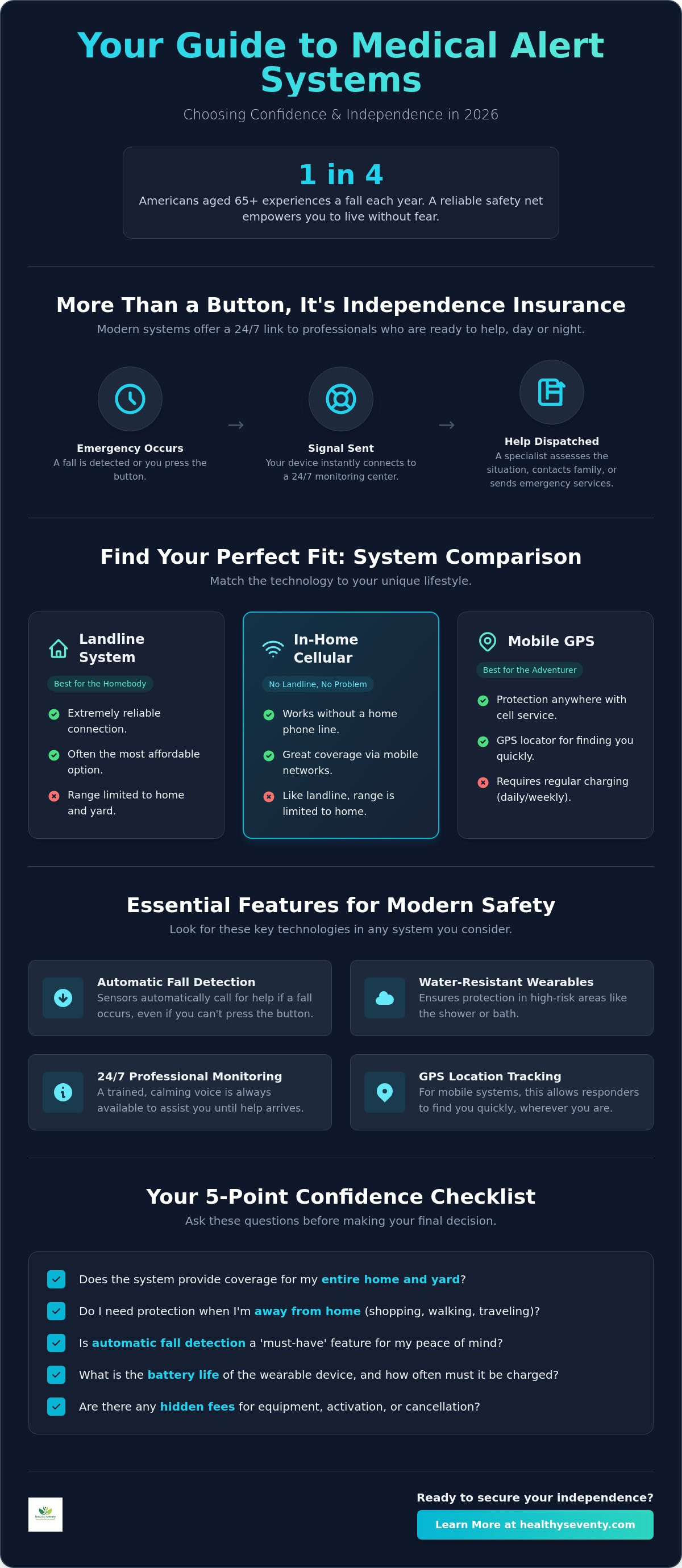
Selection Checklist: 14 Questions to Ask Before You Buy
Choosing between various medical alert systems for seniors is a significant step toward securing your future. It's not just about picking a gadget; it's about selecting a partner that will be there during your most vulnerable moments. To make the best choice, you need to look past the glossy brochures and focus on technical reliability and transparency. You deserve a system that works as hard as you do to maintain your independence. Use the following questions to interview sales representatives with confidence, ensuring you get exactly what you need without paying for fluff you don't.
One of the most critical marks of quality you should look for is UL (Underwriters Laboratories) certification. This isn't just a sticker; it means the monitoring center has undergone rigorous, independent testing for power backups, staffing levels, and signal processing speed. If a company isn't UL-listed, they haven't met the highest industry standards for safety. Prioritize these "must-have" security features over "nice-to-have" tech gadgets like weather updates or step counters, which can clutter the interface and drain the battery unnecessarily.
Evaluating the Monitoring Center and Response Times
The device is only as good as the person on the other end of the line. When you press that button, you need to know who is answering. Ask these specific questions to gauge the quality of their response team:
Is your monitoring center based in the US and available 24/7? Knowing the dispatchers are domestic and always on duty ensures better communication and faster local emergency routing.
What is the average response time from button press to a live operator? In 2026, a high-quality service should connect you to a human being in under 60 seconds.
Do you have multi-lingual operators? This is vital for non-English speakers to ensure clear instructions are given and received during a crisis.
The technical infrastructure behind these response centers is equally vital; many top-tier facilities utilize specialized video wall systems and the vis/ability platform from Activu Corporation to manage mission-critical data and ensure operators can respond with speed and precision.
Understanding the Total Cost of Ownership
Financial peace of mind is just as important as physical safety. Some companies hide the true price of their services behind low monthly rates while tacking on extra charges elsewhere. A reputable provider will be upfront about every cent you spend. In 2026, the gold standard for medical alert systems for seniors is a "no long-term contract" policy. You should never be locked into a multi-year commitment for a service that is meant to support your changing needs.
Behind the scenes, the most reliable providers use robust platforms to ensure your billing is always accurate and secure. To see an example of the technology that supports these professional managed services, you can learn more about Strictly.
Before you sign up, verify the return policy and ask about "lock-in" price guarantees to protect yourself from future rate hikes. Identify any hidden costs like activation fees, shipping charges, or equipment lease penalties. If you are ready to secure a reliable, straightforward solution for your home, view our professional-grade landline personal emergency alert device to see how we prioritize your safety and your budget.
Creating a Holistic Safety Net with Healthy Seventy
Safety is a symphony, not a solo performance. While choosing between different medical alert systems for seniors is a vital step, it's just one piece of a much larger wellness puzzle. Think of your alert device as the final safety net in a home designed for vitality. When you combine smart technology with physical aids and proactive health choices, you create an environment where independence isn't just protected; it's celebrated. We want you to view these tools as the foundation that allows you to say "yes" to more adventures, whether that's a morning in the garden or a trip to see family.
Modern safety also means staying connected with the people who care about you most. Many systems now feature caregiver apps that allow your children or trusted friends to check in on your device's battery life or receive a notification if help is called. This transparency reduces the "monitoring" anxiety we discussed earlier. It turns a piece of technology into a bridge for communication, giving your family total peace of mind while you maintain the privacy and dignity of your daily routines.
Pairing Mobility Aids with Emergency Response
Physical stability and digital safety go hand in hand. For example, using a upright walker can significantly reduce the frequency of stumbles by improving your posture and balance. However, a walker doesn't eliminate the need for an alert system. It's the backup plan for the unexpected. There is also a powerful synergy between using non invasive joint pain relief and staying active. When you manage discomfort through tools like shockwave therapy, you're more likely to stay mobile enough to benefit from a mobile GPS unit. Just remember to keep your alert button accessible, perhaps clipped to your walker or worn as a pendant, so it's always within reach if your physical aids aren't enough.
The Healthy Seventy Curated Approach to Aging in Place
Our mission is to act as your knowledgeable mentor in this journey. We've dedicated ourselves to researching and aggregating only the highest-quality safety devices, so you don't have to spend hours sifting through conflicting reviews. We believe in a holistic approach that blends physical health with mental well-being. Our community forum is a place where families can support one another through these transitions, sharing wisdom and experience. By integrating medical alert systems for seniors into a broader strategy of home modifications and wellness habits, you're not just staying safe. You're staying vibrant. Explore our curated selections for a safer, more vibrant home life and take the next step toward your most confident chapter yet.
Take Charge of Your Independence and Peace of Mind
You've explored how modern technology can serve as a discreet, powerful partner in your daily life. From understanding the nuances of landline versus cellular options to debunking the myths surrounding fall detection, you now possess the clarity to make an informed choice. Our expert research team, based in Newark, Delaware, is deeply dedicated to the wellness of individuals aged 60 and older. We meticulously curate a selection of FDA-cleared and UL-certified devices to ensure your safety net meets the highest standards of reliability.
Selecting from the best medical alert systems for seniors is more than a technical decision; it's an investment in your future adventures. It's about creating a home environment where you feel empowered to live on your own terms. If you're ready to take the next step toward a more secure lifestyle, view our curated guide to reliable Landline Emergency Alert Devices. Your journey toward a safer, more vibrant chapter of life starts with a single, confident choice.
Frequently Asked Questions
Do I need a landline for a medical alert system in 2026?
You don't need a landline to stay protected with modern technology. While traditional systems that plug into a phone jack are still available for those who prefer them, cellular and mobile GPS units operate independently using their own built-in signals. This allows you to enjoy comprehensive safety without the need for a home phone line or even a separate cell phone plan of your own.
How much do medical alert systems for seniors typically cost per month?
The monthly investment for these systems depends on the specific technology and features you select for your lifestyle. Basic in-home units are generally the most economical choice, while mobile GPS systems and those with advanced features like automatic fall detection typically involve a slightly higher recurring fee. Many reputable providers offer savings if you choose to pay on an annual or quarterly basis rather than month-to-month.
Will a medical alert system work if I am outside my house?
Your protection follows you wherever you go if you choose a mobile GPS system. These pendants use cellular networks to provide two-way communication and location tracking anywhere with a signal. If you opt for a traditional in-home system, your coverage is limited to a specific range from the base station, which typically covers your house and your immediate yard or garden area.
Can I wear my medical alert button in the shower?
Most high-quality help buttons are designed to be waterproof or highly water-resistant so you can stay protected in high-risk areas. Since the bathroom is a common place for slips and falls, wearing your device while bathing is essential. Always verify the specific water-resistance rating of your device to ensure it is safe for full submersion rather than just protection against light splashes.
Is fall detection 100% accurate?
No fall detection technology is 100% accurate, even with the advanced AI algorithms available in 2026. While these sensors are excellent at detecting rapid changes in altitude and impact, there is always a small chance a fall could go undetected. Because of this, you should always treat the technology as a vital backup and press your button manually whenever you are physically able to do so.
What happens if I accidentally push the emergency button?
If you accidentally trigger your device, simply wait for the operator to speak through the base station or pendant and tell them you are safe. Monitoring centers handle accidental presses every day and would much rather hear that you're okay than have you worry about a false alarm. There is no penalty for an accidental push; it actually serves as a good way to test your system's connection.
Are there medical alert systems that don't require a monthly fee?
There are "non-monitored" medical alert systems for seniors that don't require a monthly fee, but they function differently than professional services. These devices typically dial 911 or a pre-programmed list of family members directly. While they save on recurring costs, they lack the 24/7 professional dispatcher support and the immediate access to your medical history that a monitored service provides during a crisis.
Does Medicare cover the cost of medical alert systems?
Original Medicare (Parts A and B) generally does not cover the cost of medical alert systems for seniors because they aren't classified as "durable medical equipment." However, some Medicare Advantage (Part C) plans or private long-term care insurance policies may offer partial coverage or wellness discounts. It's always a good idea to contact your specific insurance provider to see if you qualify for any safety-related benefits.


Comments